
Top 5 AWS Data Migration Challenges and How to Solve Them
A guide on common AWS data migration challenges to expect in the process and how to solve them.

Introduction
Data migration is the most sensitive part of any organization moving to AWS. Moving the applications is manageable, and rebuilding the infrastructure is also predictable. But moving data is a headache in itself. Data carries transaction history, customer records, compliance obligations, reporting logic, and operational dependencies. If something goes wrong here, the impact will be immediate and easily visible
Still, many organizations underestimate this phase. They assume AWS data migration is just a transfer activity. But, in reality, it is an architectural and operational exercise that demands clarity, sequencing, and strong ownership. The AWS platform does provide a number of tools and services to support data migration. The real challenge lies in how your teams plan, validate, and execute the migration.
Now, under my role as the head of the engineering department at my company, I oversee many such AWS migration projects that involve data migration. From my experience, I can say there are many such challenges common across projects of different sizes and industries. If handled correctly, AWS data migration can be completed smoothly, but if these challenges are overlooked and the process is rushed, it can introduce risks that disrupt your entire AWS setup.
So, let me share the most common AWS Data migration challenges we have observed, and how to manage them.
Top 5 AWS Data Migration Challenges
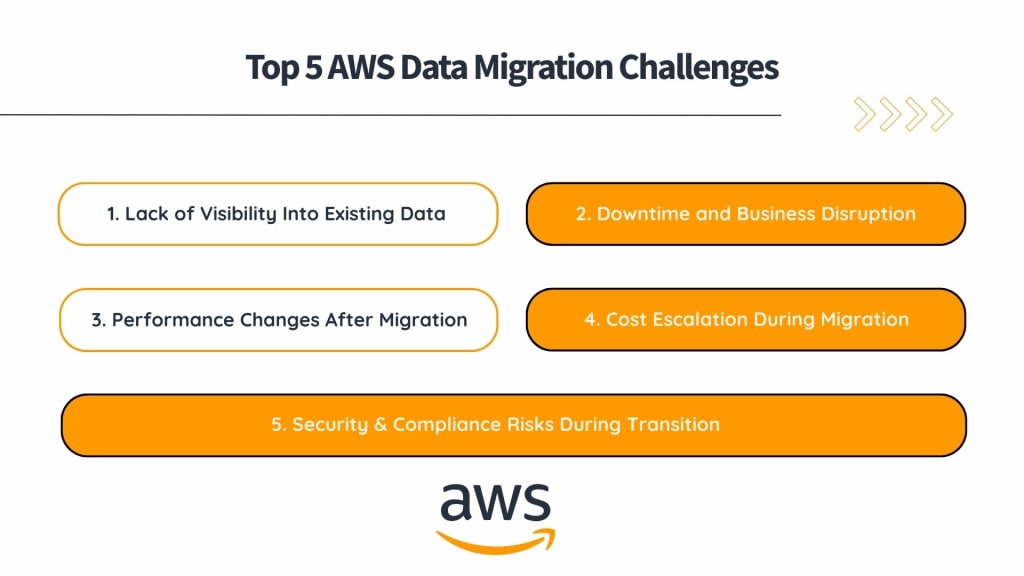
Here are the five major AWS data migration challenges that we commonly observe. We have also shared insights on how to solve them, based on our experience with in-house and client-facing AWS data migration projects.
1. Lack of Complete Visibility Into Existing Data
One of the first challenges we see in AWS data migration projects is incomplete visibility. Many organizations believe they understand their data landscape until migration starts. That is when hidden databases, undocumented integrations, legacy scripts, and unused but still active tables begin to surface.
Over time, systems grow without strict governance. Reporting tools connect directly to production databases. Third-party tools extract data in ways that no one closely tracks. Backup copies exist in multiple locations. When this reality is not fully documented before migration, the risk increases significantly.
If even one dependency is missed, issues appear after cutover. Scheduled jobs fail. APIs return inconsistent responses. Business reports produce inaccurate numbers. These problems do not occur because AWS is unreliable. They occur because the migration began without full structural clarity.
How to Manage It:
Before moving even a single dataset, perform a structured discovery exercise. Create a detailed inventory of all data sources, including relational databases, file systems, analytics layers, and archived data. Map how each system consumes and produces data. Identify business-critical datasets and clearly classify sensitive information.
Clear up what does not need to move. Archive redundant data. Fix inconsistencies before replication.
When migrating relational databases, use tools such as AWS Database Migration Service to achieve controlled replication and validation. If the target storage is Amazon S3, define the storage hierarchy and lifecycle policies in advance.
2. Downtime and Business Disruption
Another major AWS data migration challenge is downtime. Most production systems cannot afford extended outages. E-commerce platforms, healthcare applications, fintech systems, and SaaS products are very dependent on constant data availability.
Still, many teams attempt migration within a narrow maintenance window using a single export and import strategy. That approach introduces operational risk, especially when dealing with large datasets or high-transaction systems.
If the migration exceeds the planned window, pressure increases. If unexpected validation errors appear, rollback becomes stressful and rushed.
How to Manage It:
Adopt a phased cloud migration strategy instead of a big-bang approach.
Move historical data first. Keep the source and target systems synchronized using continuous replication. Validate data consistency between environments while both systems are active. Switch traffic only after verification confirms stability.
AWS Database Migration Service supports change data capture, which helps minimize downtime significantly. However, replication alone is not enough. Conduct load testing on the target system before final cutover to ensure it can handle production traffic.
Also, plan rollback procedures clearly. A migration plan without a rollback option is incomplete.
3. Performance Changes After Migration
Many AWS data migrations technically succeed, but performance issues show up later. Applications connect successfully. Data appears intact. But query latency increases. Batch processing slows down. Resource utilization behaves differently.
Cloud managed services such as Amazon RDS and Amazon Aurora do not behave exactly like on-premise systems. Default configurations are rarely optimized for specific workloads. Storage performance tiers, memory allocation, and connection handling may require adjustment.
Assuming direct parity between environments creates unrealistic expectations.
How to Manage It:
Establish performance baselines before migration. Measure latency, throughput, peak concurrency, and resource consumption in the existing environment. Define clear service-level expectations for the AWS environment.
After migration, compare real metrics against those baselines. Adjust instance types, tune indexing strategies, and review query execution plans where necessary. Enable detailed monitoring through AWS monitoring tools like CloudWatch from the beginning.
Migration is not complete until performance stability is verified.
4. Cost Escalation During Migration
AWS Data migration often results in temporary duplication of infrastructure. Source systems continue running. Target systems run simultaneously. Replication services operate continuously. Storage requirements expand during transition.
If this phase is not governed properly, AWS costs increase quickly.
In many AWS migration projects, overprovisioned resources remain active longer than necessary because cleanup was not clearly planned.
How to Manage It:
Define a migration cost plan early. You can also take the help of AWS consultants for expert guidance with the planning. Estimate how long dual environments will operate. Monitor resource usage weekly during migration. Tag temporary instances and storage clearly.
For data stored in Amazon S3, apply lifecycle rules to prevent unnecessary retention of staging datasets. Decommission legacy infrastructure promptly after successful cutover.
5. Security and Compliance Risks During Transition
Data migration may lead to temporary exposure because data may exist across multiple environments simultaneously. Sensitive information such as customer records, payment data, or regulated industry information requires strict cloud governance.
When AWS teams focus only on technical steps in migration, security controls may be configured later than required. Encryption may not be enforced consistently. Access rights may remain too broad. Logging may not capture all activity.
These gaps can easily create audit and compliance risks.
How to Manage It:
Before any data transfer starts, define who will have access in the target environment and why. Do not copy legacy permissions blindly. Re-evaluate them. Many old environments carry excessive access that was never cleaned up.
All data transfers should run over encrypted connections. Storage in the target environment should have encryption enabled from day one, not as a follow-up task. Access policies should be tightly controlled through AWS Identity and Access Management, with clear separation between operational roles and administrative roles. Encryption keys should be managed deliberately using AWS Key Management Service, with defined ownership and rotation policies.
Logging also needs to be active before the migration traffic begins. You should be able to answer basic questions at any time: who accessed what, when, and from where. If an auditor reviews the migration six months later, the records must already exist.
Conclusion
From what I have seen across projects, AWS data migration becomes difficult only when it is treated casually or pushed to the last stage of planning.
Data supports reporting, compliance, integrations, and day-to-day business operations. When migration is rushed or not mapped properly, issues show up quickly. Jobs fail. Reports break. Performance drops. Access control gaps appear. Costs rise unexpectedly.
The five AWS data migration challenges discussed in this article are not unusual situations. They appear in most migration programs in some form. The real difference lies in how early they are identified and how seriously they are handled.
Clear visibility into existing systems, phased execution instead of a one-time switch, performance validation, security defined upfront, and active cost control make the process steady and predictable.
And if you need expert guidance at any stage, opt for AWS migration services. An experienced team can help you assess your current data landscape, design a phased migration roadmap, secure the environment from day one, and control performance and cost throughout the transition.
About the Creator
Harman Diaz
I'm a seasoned technology consultant with six years of hands-on experience collaborating with major industry players. Let's explore the future of technology together!
Keep reading
More stories from Harman Diaz and writers in 01 and other communities.
Top DevOps Consulting Service Providers You Need to Know in 2025
DevOps was always there, just not in the spotlight. Lately, it has become essential for organizations that want faster releases, stable production environments, and seamless collaboration between development and operations teams. Choosing the right DevOps consulting service provider can help set up automation, secure pipelines, and optimize cloud infrastructure in ways that align with both technical needs and business goals.
By Harman Diaz6 months ago in 01
How a Startup Built a Crypto Exchange in Just 30 Days (A Detailed Breakdown)
Launching a crypto exchange is often perceived as a long and technically demanding process. From regulatory considerations to liquidity integration and platform security, the journey appears complex and time-intensive. However, with the right strategy, structured planning, and access to ready-made technological infrastructure, a startup can significantly reduce development time. This detailed breakdown explains how a startup successfully built and launched a crypto exchange in just 30 days.
By smithtaylora day ago in 01



Comments
There are no comments for this story
Be the first to respond and start the conversation.