
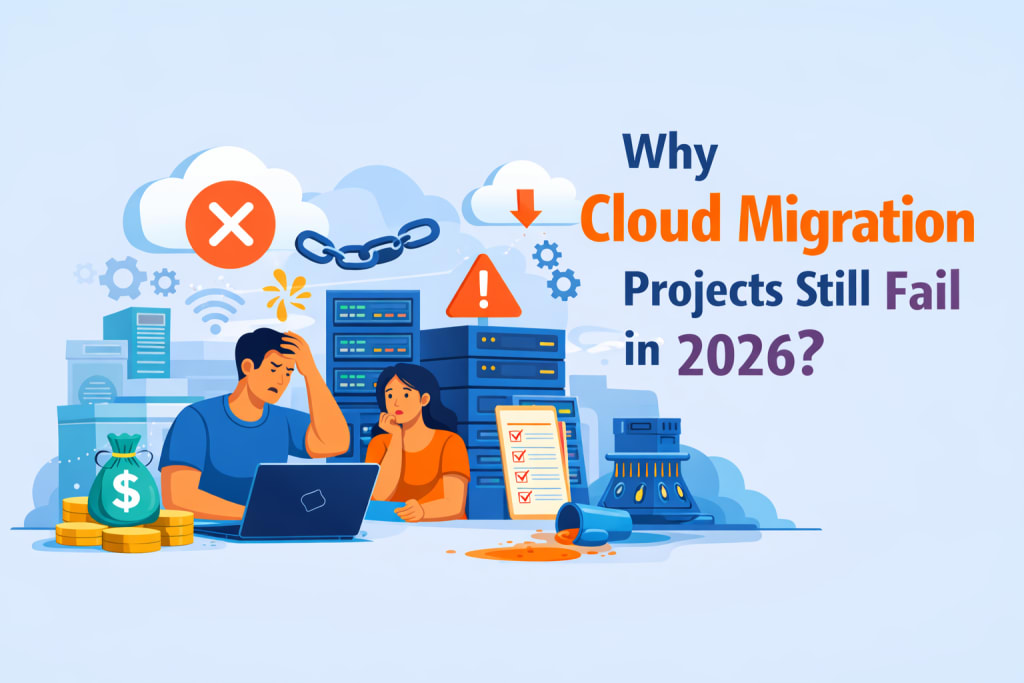
Why Cloud Migration Projects Still Fail in 2026?
Despite more than a decade of cloud adoption, billions in consulting spend, and mature tooling ecosystems, organizations continue to struggle with migration initiatives — revealing that the greatest barriers are no longer technical limitations but misaligned incentives, underestimated cultural shifts, architectural shortcuts, and financial blind spots embedded deep within modern enterprise strategy.

In boardrooms across industries, the phrase “move to the cloud” once carried a tone of inevitability.
It signaled modernization. Agility. Future-readiness.
Yet in 2026, cloud migration remains one of the most frequently delayed, over-budget, or partially reversed initiatives in enterprise technology.
The irony is striking. Cloud infrastructure is no longer experimental. Major providers operate globally distributed networks with uptime metrics exceeding 99.99%. Tooling for containerization, orchestration, and observability has matured. Documentation is extensive.
And still, projects stall.
The reason is not immaturity of technology. It is a misunderstanding of what migration actually demands.
The Illusion of Lift-and-Shift Simplicity
Many organizations approach migration as a relocation exercise.
Applications are “lifted” from on-premise environments and “shifted” into cloud infrastructure without significant architectural redesign. The expectation is continuity with reduced maintenance overhead.
Reality often diverges.
According to Flexera’s 2025 State of the Cloud Report, 27% of enterprises describe their cloud migrations as slower than planned, while 22% report exceeding budget projections by more than 20%.
Lift-and-shift frequently transfers inefficiencies into a consumption-based billing model. Monolithic applications designed for fixed infrastructure may generate unpredictable costs in elastic environments.
Without refactoring for cloud-native architectures, cost volatility increases.
Migration becomes relocation without transformation.
Financial Misalignment and Cost Surprises
Cloud pricing models differ fundamentally from traditional infrastructure investment.
On-premise systems require upfront capital expenditure but offer predictable operational costs. Cloud environments convert infrastructure into metered consumption.
A 2026 survey by the FinOps Foundation found that 64% of enterprises identified cloud cost forecasting as their primary operational challenge. Meanwhile, 31% admitted they lacked real-time visibility into usage patterns across departments.
Unexpected data egress charges, idle compute instances, and underutilized storage tiers accumulate quietly.
Gartner estimates that by 2027, organizations that lack disciplined cloud financial governance may overspend by as much as 25% annually.
Migration often begins as a technical initiative but ends as a financial reckoning.
Cultural Resistance and Skill Gaps
Technology shifts faster than organizational behavior.
Cloud environments demand new operational practices — DevOps workflows, infrastructure-as-code, continuous deployment pipelines, and cross-functional collaboration between engineering and finance teams.
The 2025 Global DevOps Report indicated that while 78% of organizations claim to have adopted DevOps practices, only 41% report consistent implementation across departments.
Partial adoption creates friction.
Legacy IT teams accustomed to hardware procurement cycles may struggle with rapid iteration. Security teams may resist new shared responsibility models. Leadership may underestimate training requirements.
Cloud migration fails not because tools are unavailable, but because habits persist.
Security Misconceptions
Cloud providers operate highly secure data centers, but responsibility is shared.
IBM’s 2025 X-Force Threat Intelligence Index reported that 45% of cloud-related security breaches resulted from misconfigured storage or identity access controls rather than provider-level vulnerabilities.
Migration introduces new attack surfaces — API endpoints, multi-cloud integrations, and identity federation systems.
Organizations sometimes assume that relocating infrastructure automatically improves security posture. In practice, improper configuration can create new exposure.
Security must evolve alongside architecture.
Overlooking Application Dependencies
Enterprise software ecosystems rarely consist of isolated applications.
Legacy systems often rely on tightly coupled databases, proprietary integrations, and hardware-dependent processes. Migrating one component without redesigning its dependencies can destabilize workflows.
The Uptime Institute’s 2025 enterprise infrastructure survey revealed that 38% of failed migration projects encountered unanticipated dependency conflicts during testing phases.
Without comprehensive mapping of application relationships, migration becomes reactive.
Complexity often emerges mid-project rather than during planning.
Vendor Lock-In Concerns
While cloud platforms offer scalability and advanced services, deep integration with proprietary tools can limit flexibility.
A HashiCorp 2026 cloud strategy survey found that 72% of enterprises express concern about long-term vendor lock-in. Yet 58% continue building workloads predominantly within a single provider ecosystem due to convenience.
When migration strategies emphasize speed over portability, future flexibility narrows.
Organizations may later discover that switching providers introduces operational disruption and retraining costs.
Migration decisions echo for years.
Performance Assumptions vs. Reality
Executives frequently expect performance improvements following migration.
In some cases, latency decreases and uptime improves. In others, performance issues surface due to network routing, region selection, or insufficient resource allocation.
According to a Cloudflare performance benchmarking study, application latency can increase by up to 18% when workloads are deployed in geographically distant regions without optimization.
Performance tuning in distributed environments requires deliberate planning.
Migration alone does not guarantee enhancement.
The Human Cost of Parallel Systems
Many enterprises operate hybrid environments during transition phases, maintaining both on-premise and cloud infrastructure simultaneously.
This dual-state operation increases operational overhead. Teams must manage separate monitoring systems, compliance processes, and security controls.
Deloitte’s 2026 Technology Adoption Index found that 47% of enterprises report strain on internal IT resources during prolonged hybrid periods.
Parallel systems extend migration timelines and amplify fatigue.
What was intended as a phased transition can become a prolonged state of ambiguity.
Misaligned Success Metrics
Cloud migration is often framed as a technical milestone rather than a business transformation.
Success is measured by percentage of workloads moved rather than operational outcomes such as cost efficiency, deployment speed, or customer impact.
Organizations may declare victory once systems operate in the cloud, even if performance gains or cost savings remain unrealized.
Without clearly defined objectives, migration becomes symbolic rather than strategic.
Lessons from Regional Development Ecosystems
Smaller firms navigating cloud transitions face distinct challenges.
Teams engaged in mobile app development Portland frequently balance agility with budget sensitivity. Cloud infrastructure offers scalability but requires disciplined usage patterns.
Startups often manage cloud costs more carefully because resource constraints demand visibility. Larger enterprises sometimes struggle precisely because scale obscures inefficiency.
Size does not guarantee migration success.
The AI Layer Complication
Artificial intelligence adds new pressure.
AI workloads require GPU-intensive infrastructure and dynamic scaling. Organizations layering AI services onto partially migrated systems may compound complexity.
A 2026 McKinsey enterprise AI adoption survey found that 36% of companies integrating AI into cloud environments experienced infrastructure bottlenecks during deployment phases.
Migration projects rarely anticipate AI expansion during initial planning.
Strategic foresight becomes essential.
Why Failure Persists
Cloud migration failures persist because migration is treated as a destination rather than an ongoing evolution.
The technical path is well documented. The organizational path is less so.
Success depends on:
Clear financial governance.
Full application dependency mapping.
Cultural alignment around DevOps practices.
Security configuration discipline.
Performance benchmarking before and after transition.
Without these components, projects drift.
A Reframing for 2026
Cloud infrastructure remains foundational to digital strategy. The question is no longer whether to migrate, but how to migrate responsibly.
The persistent failure rate reflects a deeper lesson: technological change does not resolve structural misalignment within organizations.
Migration exposes weaknesses in budgeting processes, communication channels, and operational culture.
In 2026, cloud failure is rarely about technology.
It is about preparation, discipline, and clarity of purpose.
Organizations that treat migration as strategic redesign rather than simple relocation are more likely to succeed.
The cloud has matured.
The organizations using it must mature as well.
About the Creator
Keep reading
More stories from Samantha Blake and writers in 01 and other communities.
Best Kotlin App Development Companies in USA (2026)
I reckon finding a solid dev team is harder than picking a winner at the races. You want speed, but you also want a build that does not fall apart when users flood in. That is why Kotlin app development companies are so busy lately.
By Samantha Blake4 days ago in 01
Low-Priced Tokens vs. Strong Fundamentals: Where Should Investors Focus?
In every crypto cycle, investors face the same dilemma: chase low-priced tokens with explosive upside potential or focus on established projects with strong fundamentals. The appeal of buying something “cheap” is powerful. A token priced under $1 feels more accessible and seems to offer greater room for growth.
By Muhammad Irfan Afzal7 days ago in 01
When the Shelter Closes
Across the street from my house, a man slept under a tree, his dog by his side. My first, naive thought: he must be traveling through. But he kept coming back, often sleeping there during the day. Then it hit me—that person might not have a home.
By Bride of Sound4 days ago in Humans




Comments
There are no comments for this story
Be the first to respond and start the conversation.