

1: The rise of the machines
A long time ago I wanted nothing more than to be a rock star. My late teens were spent devouring music like some kind of junkie crawling through records in shops for my next fix. I learned to play guitar, bass and a bit of keyboards and I tried to sing.
Unfortunately I am no singer and can barely hold a tune vocally which became somewhat of a challenge when it came to writing my own songs. Lyrically, I seem to have a knack for telling a good story whether it be based on my own vast amount of experiences or someone else, I tend to be able to put together a rhythmic verse and chorus with ease.
In my late 20's I studied music technology for a year at college. Here I gained some new skills in recording and composition, and showed a few I had already made but, my music was still missing something. I had dabbled with recording in my younger years using either my Dad's old reel to reel 4 or 8 track tape recorder, or two cassette recorders which enabled me to record one track onto one of the recorders, play it back and record a second track along with it onto the second.
This was far from ideal and the loss of sound quality was extremely noticeable. While studying music tech, I was introduced to the world of four track cassette recorders. The Tascam Porta studio II to be precise, I was so impressed with these portable little recording studios I went out and bought one.
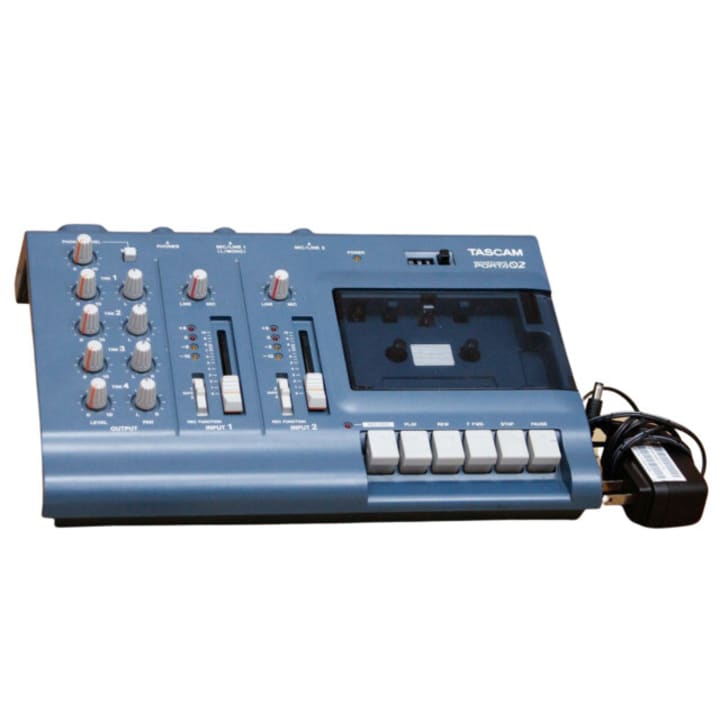
The sound quality again, wasn't what would be called “Studio” quality, there was the inevitable hiss that came with using cassette tapes but it served the purpose for demo's very well.
I am also a seasoned busker and spent many years travelling the UK to various towns, cities and resorts where I would spend a few hours playing my guitar on the streets. This isn't the only performing I have done but I must confess I am no performer and I prefer to work in the background.
This hasn't stopped me being in a few bands though, the last of these were only together for a couple of years and the only “gigs” we did was at the keyboard players daughters birthday one year, and at the bass players BBQ. If you can call them gigs.
I consider myself a writer first and foremost, and somewhat of an artist secondary. I also have many years experience within the field of music, such as working for the Performing Rights Society, roadie, artist management and even photographer and album/EP cover artist not to mention an extensive knowledge of music history.
Throughout the years I have witnessed many new and innovative technologies come along and redefine music as we knew it. Synthesizers in the late 70s/early 80s brought with them their fair share of nay sayers who thought they would bring about the end of music. Computers being used to record albums and singles instead of tape. DAW's (Digital Audio Workstations), Midi, Vst (Virtual Studio Technology) all made it possible for anyone to record music.
The question is, did any of those things destroy music? The obvious answer is NO! They did however open up a world that was at one time expensive and only available to a select few, to the public. They gave us the ability and freedom to record our music the way we wanted it.
More technological advances have come along since then. Autotune, as much as a lot of musicians dislike it and see it as cheating, its been used for many years to enhance vocal performances and the listeners bought the songs.
So, this brings us to the true reason for this article. A controversial one among many old school musicians. Al. Artificial Intelligence. In 2025 we saw a rise in AI generation tools appearing online. Udio, Suno, Google Gemini, Chat GTP, Copilot , Perchance and many more.
All of the above have one thing in common. Type a prompt and they will generate what you tell them to. Some of the above concentrate purely on certain areas of the arts. Perchance for example is an image generator and it does a very good job of creating an image from a text prompt.
Others such as Udio and Suno, focus on music generating. Now this is where it gets a little messy. Can music generated by a computer really be considered music?
To answer this lets travel back in time to the late 70s. A time when home computers were a thing of the future. If you wanted to play video games you had to go to an arcade or, if you were lucky enough your parents could afford a hand held space invaders or a console that plugged into your TV and allowed you to play Pong.
These basic video games had sound effects generated using code, not music as such, but this was the predecessor of modern gaming consoles. Lets fast forward to the 80s and systems like the Commodore 64, Atari, Sinclair Spectrum 48k etc. The games that you could buy for these came on cassette and took a lifetime to load. At least it felt like a lifetime, but once the horrible screeching of the loading screen had finished you were greeted with a unique soundtrack specifically tailored to that game.
How were these soundtracks made? With code of course which in turn generate raw synthesized waveforms in real-time, thus providing a computer generated tune. This is a far cry from the abilities of Suno but there is a dedicated following of fans of game music and it is considered music despite having no human input other than a few lines of code.
It was no threat to musicians though and this is where Suno and other music generating platforms are struggling. Many musicians who have spent years learning their instruments are now asking why did they bother?
What was the point in spending hour after hour with bleeding finger tips ripped to shreds on hard steel guitar strings? Why go to the trouble of that when a computer can do it just as well, or in many cases better?
I too thought this way at first when AI was introduced to the public, I refused to even entertain it and saw it as nothing more than a threat. However, my opinion on this changed dramatically when I decided to give Suno a chance.
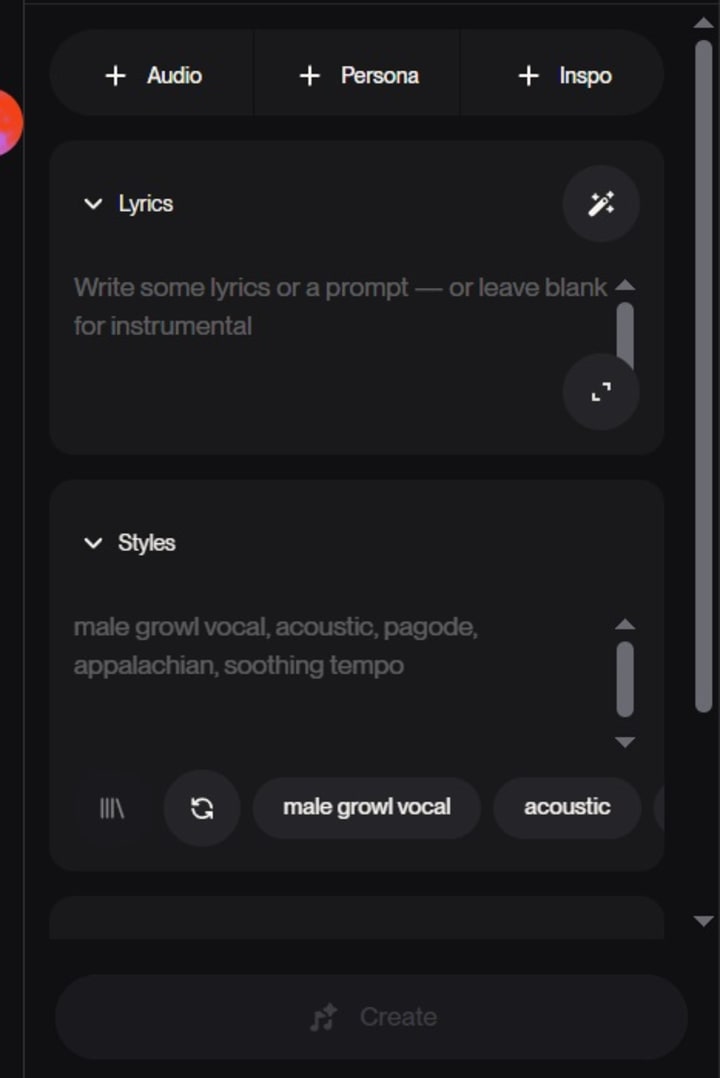
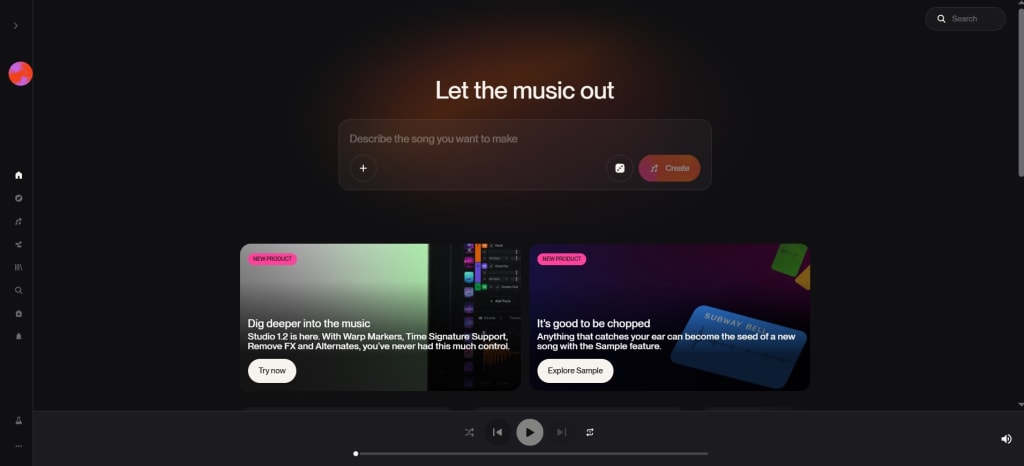
The first song I generated was using a poem I had written in my youth, I wrote a suitable prompt telling the AI the style and genre and how I wanted the song to sound. Then I hit GENERATE and waited.
A short while later (less than a minute) I was presented with two versions of the song. The first sounded very generic musically and the vocal was shall we say obviously not human. The second track however blew me away.
For years I had been searching for others to perform my songs the way I heard them in my head. Something I could never do and here it was the voice I had been searching for all these years presented to me within a website.
2:The problem with Artificial intelligence and musicians
Once I discovered that the AI could do what I had been attempting and failing at for 30 years or more, I was hooked. I read the terms and agreements and looked deeply into the copyright issues surrounding AI, and as confusing as it was at times I was able to grasp an understanding that as long as I provided the lyrics and used my own chords, riffs or melodies. In the UK I own the rights to these parts of the song. However I would not own the performance rights.
The ins and outs of the copyright are much more complicated and differ between the UK and USA for example so please check with your countries copyright laws where you stand if you wish to use Suno or any other music generating platform.
Putting the copyright labyrinth to one side, this isn't the main issue among human musicians. Some of the comments I have seen personally posted on AI music Social Media groups have been downright insulting to those who use the AI The following are just a few that I can recall.
“All Ai music is all slop”
“You're not a musician if you use AI”
“ its cheating”
“it doesn't have emotion or passion”
“only talentless people use AI”
Some people won't even entertain AI generated music, citing it all as being terrible without giving it a chance. While some of the above may seem like valid points to some people they couldn't be further from the truth. Yes, there is a multitude of talentless hacks out there using AI to generate a song with just a prompt and then claiming “I wrote/created this”. There are also those who feel its okay to create a fake artist/band and try and pass it off as human or in a few cases are open about it being AI generated.
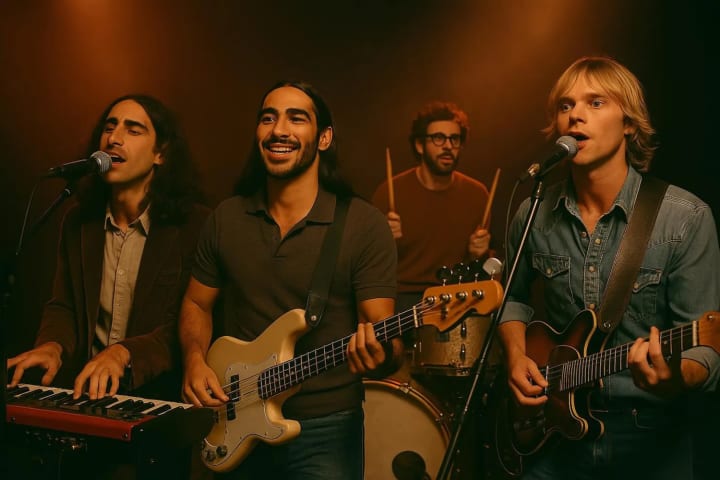
Those people are the real issue with AI music. If you did nothing more than type a prompt you are not a musician you're a prompter, and that is fine but be transparent about it and admit that you had zero musical input in the song.
If you have created a fake band or artist, shame on you. This is fraudulent practice in my opinion and the saturation of these types of “AI artists” on platforms like Spotify have become a real problem, some have thousands of listeners generating a high percentage of royalties for a band they used AI to generate using purely prompts.
Its wrong, morally and I do understand the outrage among those who have spent years honing their musical talents. However as we know, there are two sides to every coin and AI music is no exception.
We are also seeing or rather hearing (if you bother to listen) an influx of poets using the technology to generate songs from their words. As well as a host of musicians who have accepted the AI as a tool to enhance their work and not as something that will destroy it.
I am one of the latter, and as you read at the beginning of this article I am no stranger to the world of music. The AI has given me a voice when I couldn't speak, people listen to my words and they are often moved by them, my melodies, riffs and chord structures now have life when before my songs sounded dull and amateur they now sound polished and professionally arranged. There is very little difference between session musicians and vocalists recording a demo for a songwriter or having the AI do it for you. The only difference is the cost, where it costs me just $8 a month to use Suno and have the ability to generate 50 or more songs per month the equivalent with session musicians would bankrupt me and the results may not be much different, if at all.
What I will say though is there will always be a need for human musicians, music is an integral part of human life. People will always want to see live performances, something the AI cannot provide, at least not yet and even then I can't see it affecting human performances. Only a minority are going to want to pay to see a bunch of robots pretending to play instead of living, breathing people.
Yes, Suno can do what they do in a recording studio, despite what others may think it can also deliver an emotional and passionate performance on said recording. However, it cannot connect to a live audience like a human can. So, to answer one or two of the questions I mentioned earlier that I have seen from other musicians.
Why did you bother learning your instrument? Simple. It was because it was your journey, your path to do so. Whether it took you to the dizzy heights of stardom or just doing gigs at the local pub, or even if you only play to yourself or family at home its part of who you are.
The AI isn't stopping you from expressing yourself through your music, like you always have. It isn't taking your gigs away and it certainly isn't taking away your chance at fame and fortune. As we all know only a select few are privileged to tread that path, and to be honest with what I have learned about many who did become famous, it isn't worth the pain, sleepless nights and constant travelling.
If, after reading this you still believe that AI is a threat to you as a musician perhaps its time to reevaluate why you became a musician. Was it for the money? If so, you will be sorely disappointed as even the pro's seem to struggle these days. Perhaps you see it as an attack on your ego, your own failure to “make it” in music? A vast amount of those I see with negative comments about AI are people who are either playing in cover bands or they only have a small following.
I never became a rock star, I've never had a hit song and I have had my lyrics rejected over and over again. Yet, this hasn't stopped me. I only have a small number of followers, around 500 on Reverbnation where I post music I have played and sung myself, and around 415 subscribers on YouTube where I post the AI performed songs.
The number of subscribers and amount of listeners dropped on YouTube in the last four months (at the time of writing) not due to the songs I was posting, but thanks to Google changing the way their site operates especially with anything related to AI
This hasn't deterred me either, and I embrace AI with open arms and look forward to seeing where, if anywhere, it may take me. After all we are still in control of it.......for now.
About the Creator
Phill Ross
I have been writing for 39 years starting out with poetry then moved on to song lyrics and music/band reviews,I now write mostly historical related books and I have written and self published 15 books to date.
Keep reading
More stories from Phill Ross and writers in Beat and other communities.
It's 2026. Songs Turning 10 This Year
In 2016, we saw the rise of short form videos and what would lead to the birth of TikTok. We cannot forget the Snapchat filters no matter how cringe worthy some of them might have been. It was also the year in which the hit series Stranger Things debuted.
By Jasmine Aguilar7 days ago in Beat
"Palomino" - A Grace Filled Memory Ride Toward Todd Mosby's Upcoming Album "American Heartland"
With the release of “Palomino,”, acclaimed composer and guitarist Todd Mosby offers listeners a vivid and deeply personal entry point into the emotional world of his forthcoming album American Heartland.
By Whitney Miller6 days ago in Beat
Belle of the Bayou
Bad move, cher. Not just the slip of her kitten heel on the rainy February cobblestones in the Fourth Ward. She got caught snooping. Detective Deleon clucked and strutted like a rooster in his rush to clear her from the scene, waving cigar smoke to and fro as he gesticulated amid the thick air of the speak easy. An experienced crime reporter, Marie knew better than to let the coppers catch her on the wrong side of the line, but curiosity had gotten the better of her.
By Maia Gadwall the metAlchemist7 days ago in Fiction


Comments
There are no comments for this story
Be the first to respond and start the conversation.