
Lonnie Johnson
The Inventor Who Turned Pressure Into Possibility

A long-form narrative of curiosity, perseverance, and the imagination that reshaped both science and play.
When people talk about the origins of genius, they often imagine vast laboratories, towering machines, and million‑dollar facilities. But sometimes genius is born in a kitchen—between pots, pans, and the lingering smell of last night’s dinner. For Lonnie Johnson, it began with curiosity that refused to sit still. Before he ever walked the halls of NASA or filed patents that would alter industries, he was a boy in Mobile, Alabama, tinkering with anything he could get his hands on.
His childhood was not filled with expensive tools or specialized mentoring. Instead, it was driven by a restless desire to see how things worked. If a radio stopped playing, he took it apart. If something hummed, glowed, or clicked, he wanted to understand what made it do so. His experiments were often messy—mixtures that boiled over, sparks that jumped farther than expected, and an infamous homemade batch of rocket fuel that earned a permanent family story. Yet behind every so‑called “accident” was talent, and behind the talent was a determination that would carry him across decades of innovation.

As Johnson grew, so did his ambitions. He didn’t want to just understand the world; he wanted to build in it. Create in it. Improve it. His mind was already shaping inventions long before he had the means to bring them to life. Robots became possible companions. Turbines became puzzles waiting to be solved. Pressure, force, flight, and motion—all of them called to him the way music calls to a musician.
It was only natural that he would find his way into engineering. But the path was not smooth. Many doors were closed to him; many institutions were slow to recognize his brilliance. Yet he did what great inventors do: he kept building. And eventually, the world began to notice.

By the time he stepped into NASA’s Jet Propulsion Laboratory, Lonnie Johnson was no longer just a curious boy with tools in a kitchen—he was an engineer with the ability to shape the future. His early years at NASA weren’t spent on trivial tasks or quiet testing. He was placed at the heart of high‑stakes missions. One of his projects involved developing a nuclear power source for the Galileo spacecraft—a mission designed to travel farther than any manned mission had ever gone, toward the swirling storms of Jupiter. The work demanded precision, courage, and brilliance. Johnson had all three.
Later, he contributed to classified research, including technology for the stealth bomber, a piece of aviation engineering that lived halfway between science and science fiction. At NASA, he proved that he could handle the most advanced challenges of his time. But in his heart, innovation was not a job—it was a pulse. It followed him home at night. It kept him awake with ideas. And because of that, another invention was waiting to be born—one that would eventually put smiles on millions of children’s faces.
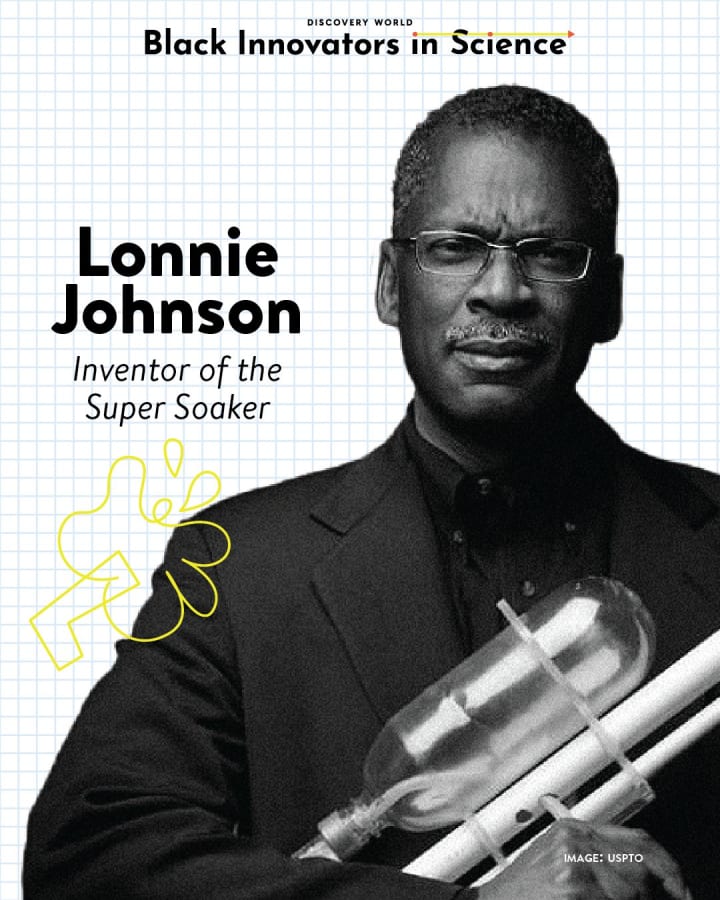
It didn’t begin in a lab. It began in a bathroom.
While experimenting with a heat pump and a nozzle system, Johnson noticed something interesting: pressurized water shot farther, faster, and with more force than he expected. That spark—one moment, one observation—became the seed of a revolution. Most people would have laughed. A water gun? Something so simple, so playful, so far removed from nuclear power systems and spacecraft?
But Johnson had always seen the extraordinary inside the ordinary.
He began sketching, adjusting, prototyping. The early versions were crude but promising. He refined the chambers, the seals, the valves, the pressure systems. Eventually he created something the world had never seen: a water gun that didn’t rely on small, weak bursts—but on air pressure, physics, and power. When he first tested it, water arced through the air like a liquid rocket, and Lonnie Johnson saw what he had created: the future of play.

The Super Soaker was born.
Bringing it to market was another challenge. He faced skepticism from toymakers who didn’t understand the technology, or who couldn’t imagine that children wanted a high‑performance water blaster. But Johnson was used to skepticism. He was used to being underestimated. So he kept pushing. He kept refining. And when the right partner finally saw the brilliance of his invention, they helped bring it to the world.
The impact was explosive—quite literally.
The Super Soaker didn’t just sell; it transformed summer itself. It turned backyards into battlefields of laughter, driveways into arenas of fun, and hot afternoons into memories that would last decades. It became one of the most successful toys ever created, generating hundreds of millions in sales and inspiring countless spinoffs. More importantly, it brought joy—pure, unfiltered joy—into the hands of children everywhere.

But Johnson didn’t stop there.
While the world associated him with the Super Soaker, he kept innovating far beyond the toy aisle. He developed digital distance‑measuring tools, air‑powered mechanisms, advanced turbine systems, green‑energy concepts, and even a device designed to detect moisture in diapers—proof that he could solve everyday problems as gracefully as he solved complex scientific ones. His company, Johnson Research and Development Co., grew into a hub of creativity in Atlanta. Over the years he founded additional development companies, pushing new boundaries in engineering, energy storage, and materials science.
With over 80 patents—each representing a spark of genius captured on paper—Lonnie Johnson stands not just as an inventor of things, but as an inventor of possibilities. His path is a reminder that curiosity is the first tool, failure is the first teacher, and perseverance is the fuel that turns ideas into impact.

Imagine him now, in a quiet workshop late at night. The tools are organized, the lights hum gently, and a prototype sits on the table—half assembled, wires exposed, potential gleaming under the lamp. This is where futures are made. Not with fanfare. Not with applause. But with focus. With a mind that does not quit.
And that is the true story of Lonnie Johnson—not the simplified version where a toy becomes famous, but the deeper truth of a man who never stopped imagining, never stopped experimenting, never stopped believing that problems were just puzzles waiting for the right hands to solve them.

Through him, children learned physics without realizing it. Engineers were inspired. Innovators found courage. And the world gained not only a legendary inventor—but a mentor whose story whispers to every young mind:
Build. Explore. Question. Create.
Because you never know which idea—born in a kitchen, a garage, or a quiet room—might someday change everything.
CHECK OUT MY EBOOK COLLECTIONS
Dive into premium, extended stories and original works in my growing library of curated ebooks.
Let me know if you want another inventor, another image, or an entire series!

About the Creator
TREYTON SCOTT
Top 101 Black Inventors & African American’s Best Invention Ideas that Changed The World. This post lists the top 101 black inventors and African Americans’ best invention ideas that changed the world. Despite racial prejudice.
Keep reading
More stories from TREYTON SCOTT and writers in BookClub and other communities.
Rachel Reviews: Lunch Tales: Teagan by Lucille Guarino
Well, I did enjoy this! Sometimes, all you need is just great storytelling and this is what Lucille Guarino delivers here. There's no big message to this book; it's just about folks and families, living their lives and coping with everything that's being thrown at them and finding their way. But when it's done well, like it is here, then you have characters to whom you can relate, tension which leaves you rooting for a better outcome, attraction which has your heart racing and an urge, as a reader, to see the characters happy with the people with whom they belong.
By Rachel Deeming21 days ago in BookClub


Comments
There are no comments for this story
Be the first to respond and start the conversation.