
Has World War III Started?
Rising Global Conflicts, Power Rivalries, and the Dangerous Path Toward a New World War

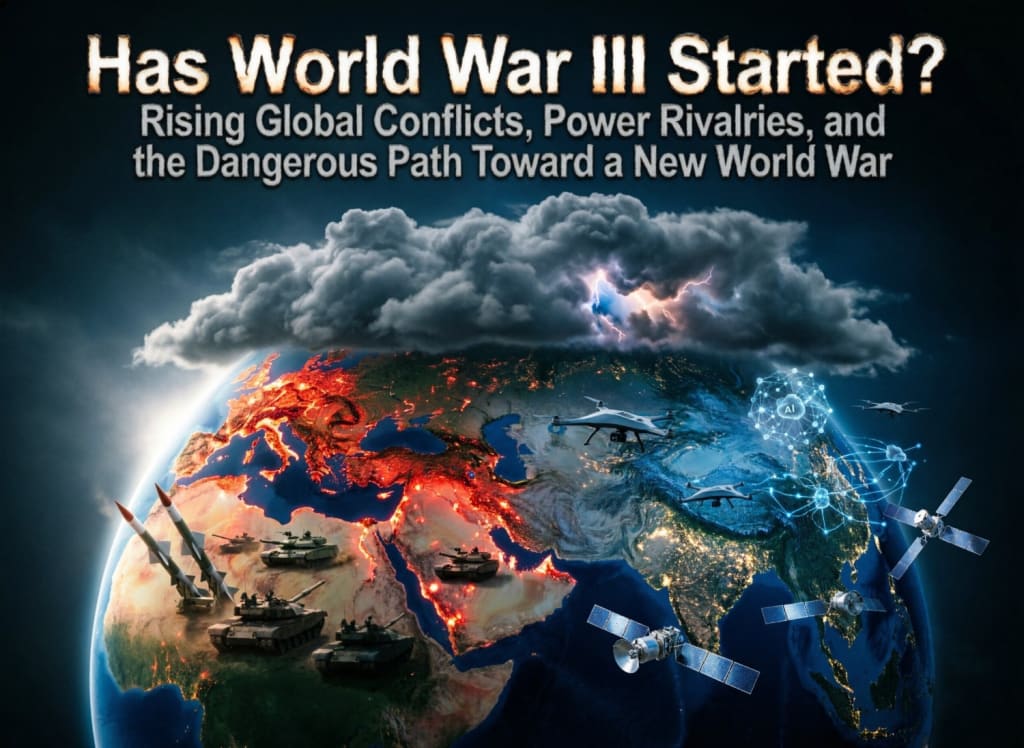
Has World War III Started?
The question “Has World War III started?” is no longer limited to academic debate or fictional movies. It is now openly discussed in newsrooms, policy circles, and online platforms around the world. While the simple answer remains no, the conditions shaping today’s global environment are deeply alarming. The world is experiencing an unprecedented convergence of regional wars, technological disruption, and power competition that closely resembles the early stages of past global conflicts.
World War III, if it begins, will not look like World War I or World War II. There will likely be no single declaration of war or one dramatic event that marks its start. Instead, it would unfold gradually—through proxy wars, cyberattacks, economic warfare, and information manipulation—before the world even realizes the threshold has been crossed.
At present, several regional conflicts are drawing in major global powers. In Eastern Europe, the Russia–Ukraine war has evolved into a prolonged confrontation between Russia and Western-backed Ukraine. While Russia and NATO countries are not officially at war, military aid, intelligence sharing, and strategic coordination have made the conflict global in nature. This indirect confrontation has already reshaped Europe’s security landscape and revived Cold War-era tensions.
In the Middle East, ongoing conflicts involving Israel, Gaza, Iran-linked groups, and regional powers have raised fears of a wider regional explosion. The presence of U.S. naval forces, Iranian-backed militias, and constant air and missile exchanges has created a highly volatile environment. One miscalculation—an attack that kills foreign troops or targets critical infrastructure—could rapidly expand the conflict beyond regional boundaries.
Meanwhile, tensions in East Asia continue to rise. The Taiwan Strait remains one of the most dangerous flashpoints on Earth. China considers Taiwan a core national issue, while the United States views its defense as essential to regional stability. Military drills, airspace violations, and naval patrols have become routine, increasing the risk of an accidental clash between nuclear-armed powers.
Despite these dangers, global war has not yet begun because major powers are still exercising restraint. Institutions like the United Nations continue to serve as diplomatic forums, even if their influence is weakening. Military alliances such as NATO emphasize deterrence rather than direct confrontation. These mechanisms act as buffers, slowing escalation even in moments of crisis.
However, the nature of modern warfare makes the situation more dangerous than in the past. Artificial intelligence, cyber weapons, drones, and hypersonic missiles drastically reduce decision-making time. Leaders may have minutes—or seconds—to respond to perceived threats. False alarms, hacked warning systems, or AI-driven misinterpretations could trigger irreversible actions before human judgment intervenes.
Another major difference is the role of economic warfare. Sanctions, trade restrictions, energy manipulation, and control of supply chains are now used as weapons. While these measures stop short of open combat, they create long-term instability and resentment. Over time, economic pressure can harden political positions and make compromise more difficult, pushing nations closer to military solutions.
Public perception also plays a role. Constant exposure to crisis-driven news creates a sense that war is inevitable. This mindset can become self-fulfilling, as governments prepare for conflict rather than prioritize de-escalation. History shows that world wars often begin not because leaders want them, but because systems fail under pressure.
So, has World War III started? Not yet. But the world is standing in a dangerous transition zone—one where regional conflicts are interconnected, alliances are tightening, and technology amplifies risk. The line between peace and global war has become thin and fragile.
The future depends on diplomacy, crisis management, and restraint. If major powers continue to avoid direct confrontation, strengthen communication channels, and control emerging technologies, a global war may still be prevented. But if miscalculation replaces caution, history warns that escalation can happen faster than anyone expects.
About the Creator
Wings of Time
I'm Wings of Time—a storyteller from Swat, Pakistan. I write immersive, researched tales of war, aviation, and history that bring the past roaring back to life
Keep reading
More stories from Wings of Time and writers in Chapters and other communities.
After Khamenei: How the Middle East Crisis Could Redraw Global Politics
After Khamenei: How the Middle East Crisis Could Redraw Global Politics The confirmed death of Ayatollah Ali Khamenei after joint strikes by the United States and Israel has sharply intensified the ongoing conflict in the Middle East—turning what was a dangerous regional crisis into a moment with global implications. Khamenei, who led Iran for nearly four decades and wielded extraordinary political and military influence, was killed when missiles and airstrikes hit Tehran in the opening phase of a major military operation targeting Iranian leadership and strategic infrastructure. The impact of his death is already reverberating across the region and the world in ways that may last for years.
By Wings of Time a day ago in Chapters
Brass Ring Chapter 14: When Bad Things Happen to Good People
Captain Sandoval walked into the room. In this room were ten of the best of his precinct, men who had proven themselves again and again. They had access to the best training, the best equipment, and the best weapons. Each had been assigned a suit of armor capable of handling an anti-tank weapon, a rifle that could switch between a sonic blaster, a grenade launcher, and a slug-thrower capable of eliminating a marble statue. They were ready to deal with most super-powered crime.
By Jamais Jochim7 days ago in Chapters
Pearl
1980 something. we all hung out at Pearl and you and i were nothing special, or so i thought. i mean we all danced, drenched in our own sweat, our own saline solution of fear, too many beers, shots, laughter, tears, fucks in the bathroom and i don't know when we began to be afraid. do you?
By ROCK aka Andrea Polla (Simmons)5 days ago in Fiction


Comments
There are no comments for this story
Be the first to respond and start the conversation.