
Is This War Turning Into World War III?
Rising Middle East Tensions, Global Power Involvement, and the Thin Line Between Regional Conflict and a Global War

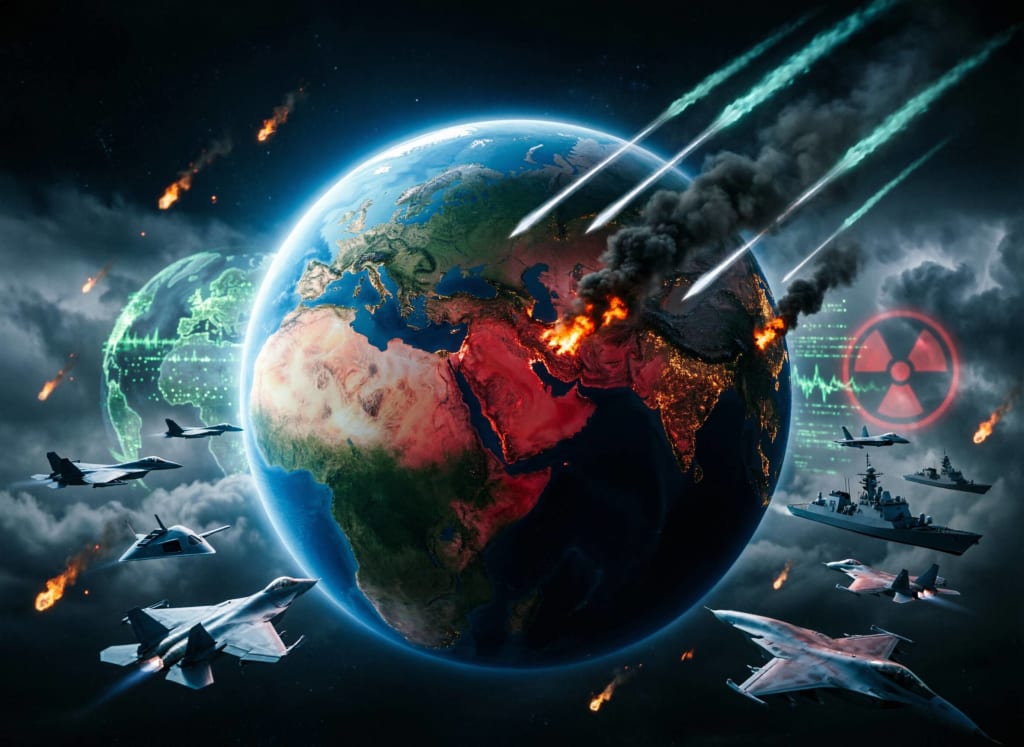
Is This War Turning Into World War III?
The question many people around the world are quietly asking today is unsettling but unavoidable: Is the current war climate pushing humanity toward World War III? What once appeared to be localized conflicts in the Middle East are now entangled with global rivalries, advanced technologies, and fragile alliances. History shows that world wars rarely begin with a single dramatic declaration. Instead, they grow out of overlapping crises, miscalculations, and escalating power struggles—many of which are visible today.
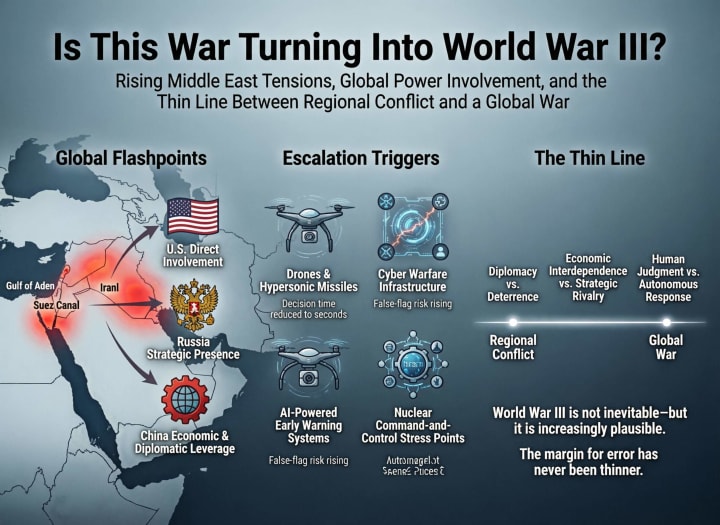
At the center of global anxiety lies the Middle East, a region that has long been a geopolitical fault line. Conflicts involving Israel, Iran, and various non-state actors have expanded beyond borders through proxy warfare. What makes the current moment more dangerous than past crises is the level of direct and indirect involvement by major powers such as United States, Russia, and China. Each brings its own strategic interests, red lines, and military capabilities into an already volatile environment.
Unlike earlier regional wars, today’s conflicts are deeply connected to global systems—energy markets, trade routes, digital infrastructure, and financial stability. Any major escalation in the Middle East has immediate ripple effects across the world. Oil prices spike, shipping lanes face disruption, and global markets react with panic. This economic interdependence means that regional instability is no longer regionally contained; it becomes a shared global risk.
Another critical factor pushing the world closer to a wider war is modern military technology. Drones, hypersonic missiles, cyber weapons, and AI-assisted surveillance systems have compressed decision-making time. Leaders now have minutes—or even seconds—to interpret threats and respond. In such an environment, the margin for error is dangerously thin. A radar misreading, a cyber intrusion, or an autonomous system malfunction could be mistaken for an intentional attack, triggering rapid escalation before diplomacy has a chance to intervene.
Nuclear weapons remain the most frightening backdrop to this situation. While no state openly desires nuclear war, deterrence systems rely heavily on command-and-control stability. When tensions are high, internal political pressure, misinformation, or technological interference can weaken these systems. The fear is not just deliberate use, but accidental or misinterpreted use—an outcome that would instantly turn a regional conflict into a global catastrophe.
Great power competition adds another layer of risk. The United States seeks to maintain its global influence and protect allies. Russia views Western expansion and sanctions as existential threats. China, while often more cautious, is increasingly assertive in shaping a multipolar world order. These competing visions collide in places like the Middle East, where strategic positioning matters as much as ideology. What begins as support for partners can quickly resemble a confrontation between nuclear-armed states.
Public perception and media also play a powerful role. Constant exposure to war imagery, strong political rhetoric, and social media-driven narratives harden public opinion. Leaders under domestic pressure may feel compelled to act aggressively to avoid appearing weak. This dynamic reduces the space for compromise and increases the likelihood of confrontation driven by perception rather than necessity.
However, it is important to recognize that World War III is not inevitable. History also shows that periods of extreme tension can end without global war—through diplomacy, back-channel communication, and strategic restraint. International institutions, despite their flaws, still provide platforms for dialogue. Economic interdependence, while a vulnerability, also acts as a deterrent by raising the cost of total war to unbearable levels.
The true danger lies in complacency. Assuming that “it won’t happen” is how miscalculations thrive. The world today stands at a crossroads where regional wars, global rivalries, and advanced technologies intersect. Whether this moment becomes another chapter of contained conflict or the opening act of a global war depends on leadership decisions, communication clarity, and the ability of societies to resist fear-driven escalation.
In the end, the question is not only whether this war could become World War III, but whether humanity can learn to manage power responsibly in an age where mistakes travel faster than reason. The line between regional conflict and global war has never been thinner—and the world is watching to see which side we fall on.
About the Creator
Wings of Time
I'm Wings of Time—a storyteller from Swat, Pakistan. I write immersive, researched tales of war, aviation, and history that bring the past roaring back to life
Keep reading
More stories from Wings of Time and writers in Chapters and other communities.
Speed, Lasers, and the Risk of the First Mistake
New World Affairs Today: Speed, Lasers, and the Risk of the First Mistake Today’s world affairs are no longer shaped only by armies, borders, or even nuclear weapons. They are increasingly shaped by speed. In modern conflict, the side that reacts first often gains the advantage—and this reality is quietly transforming global security in dangerous ways.
By Wings of Time 13 days ago in Chapters
Donald Trump — Power, Politics, and a Divided Nation
Donald John Trump is one of the most recognizable and polarizing figures in modern American history. Known first as a businessman and television personality, he later became the 45th and 47th President of the United States. His life story is filled with ambition, success, controversy, and constant public attention. Whether admired or criticized, Trump’s influence on politics and media is undeniable.
By Haroon Pasha6 days ago in Chapters
Pearl
1980 something. we all hung out at Pearl and you and i were nothing special, or so i thought. i mean we all danced, drenched in our own sweat, our own saline solution of fear, too many beers, shots, laughter, tears, fucks in the bathroom and i don't know when we began to be afraid. do you?
By ROCK aka Andrea Polla (Simmons)4 days ago in Fiction



Comments
There are no comments for this story
Be the first to respond and start the conversation.