
US CENTCOM Deploys LUCAS Drone Against Iran, Raising Questions Over Starlink Integration
Low-Cost Combat Drone Resembling Iran’s Shahed-136 May Use Satellite Communication for Real-Time Targeting

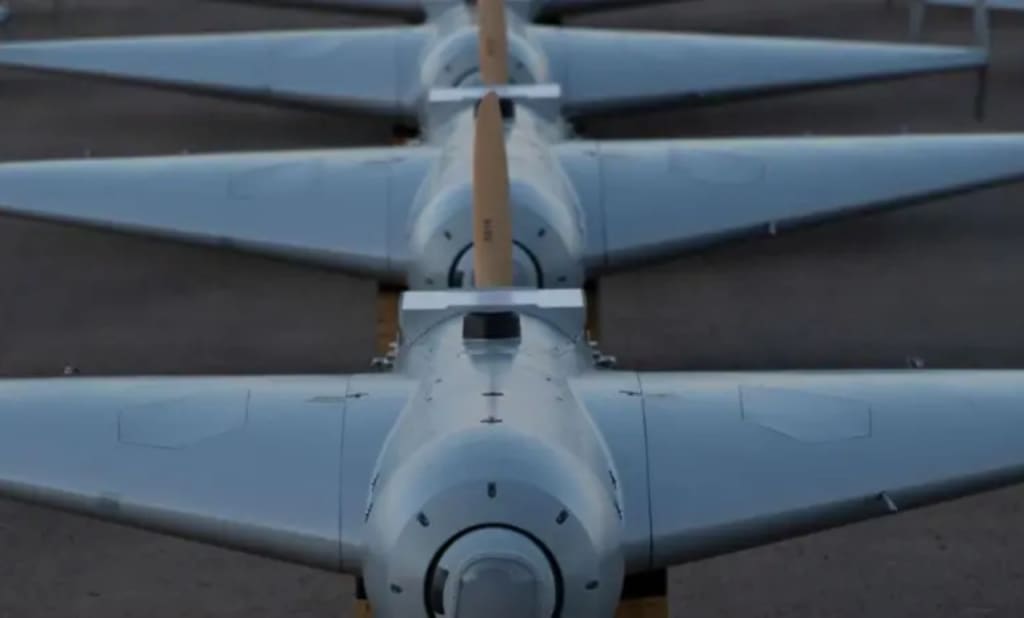
The United States Central Command (CENTCOM) has announced that the US has used new long-range drones against Iran. Structurally, these drones resemble the Iranian “Shahed” drones.
Based on published images, it is being suggested that these drones are equipped with satellite communication terminals.
Many analysts refer to the “low-cost unmanned combat attack system” as a drone known as “LUCAS,” calling it an “unlicensed version of the Shahed-136,” and believe the drone was “reverse engineered,” meaning it was designed after examining a crashed drone.
At least structurally, there are similarities between them: a similar aerodynamic design, an internal combustion engine, and a pusher propeller.
In images released in December by US Central Command, light-colored rectangles can be seen on the upper body of the drones, resembling Starlink satellite internet terminals.
The United States has officially confirmed the first use of these drones in Iran but has not mentioned the use of satellite terminals in their structure.
It is also unclear what type of terminal was used in the LUCAS drone. In addition to the commercial Starlink network, the manufacturer has developed a military system with different capabilities.
The use of drones equipped with satellite communication terminals allows them to be controlled throughout the entire flight. If the drone is equipped with a camera, guidance can be visual and conducted in real time.
Disrupting satellite signals is not easy. An operator can fly the drone at low altitude to avoid radar detection or bypass known air defense zones. This makes such drones very difficult to intercept.
This capability can further enhance the drone’s performance and increase its operational precision and autonomy.
Russian Experience
In December, Russian forces also began using drones equipped with Starlink terminals in the war in Ukraine. The equipment was purchased abroad and then imported into Russia while bypassing sanctions.
At the end of January, Ukrainian Defense Minister’s adviser Serhii Beskrestnov announced that hundreds of confirmed cases of drone attacks equipped with Starlink had been recorded.
“What is the threat? Imagine a large first-person view drone being directed in real time by an operator from Russian territory. We all know that Starlink works well and provides a relatively clear channel for image transmission and guidance. So this is one of the challenges we are currently facing and must address,” he said.
In early February, Ukraine’s Ministry of Defense reached an agreement with the manufacturer to disable satellite communication terminals that were not registered on Ukraine’s “whitelist.”
As a result, the Russian military not only lost the ability to use drones equipped with those terminals, but also lost internet access in many frontline areas, as Starlink had provided reliable communications to many Russian units.
Russia is unable to replace Starlink satellite communications because it does not have a comparable space-based system.
A private Russian company called Bureau 1440 is developing a constellation of low-orbit communication satellites similar to those deployed by Starlink. The company had planned to launch its first group of satellites in 2025, but the plan failed.
Cheap and Abundant
There is no information in public sources about who first came up with the idea of installing a Starlink terminal on a drone.
On December 15, 2025, a leading Ukrainian expert in military radio technologies, Serhii Beskrestnov (known by the nickname “Flash”), announced for the first time the discovery of a Russian drone equipped with Starlink.
Two weeks earlier, on December 3, US Central Command had released images of completed LUCAS drones that appeared to be equipped with Starlink-like terminals.
However, the idea of widespread use of inexpensive attack drones originally came from Iran and Russia.
Russia began its attacks on Ukraine in 2022 using Iranian “Shahed” drones, which it renamed “Geranium-2,” and has steadily increased production of these systems.
In addition to directly damaging targets, these attack drones also force air defense systems to expend resources. In some cases, the cost of interception exceeds the value of the target.
The low-cost concept is also reflected in the name of the American system: “Low-Cost Unmanned Combat Attack System,” emphasizing affordability. Each drone may cost approximately $35,000.
To deploy these drones, a special unit was created in the United States and deployed to the Middle East, called the “Operation Scorpion Strike Group.
About the Creator
Keep reading
More stories from Real content and writers in Chapters and other communities.
Bagram Air Base Targeted? Pakistan–Afghanistan Border War Intensifies
Clashes between Pakistan and the Taliban in Afghanistan have entered their sixth day, during which Pakistan has claimed to have carried out airstrikes on 56 locations inside the neighboring country. Meanwhile, the Afghan Taliban claim they have foiled an operation targeting Bagram Air Base.
By Real contenta day ago in Chapters
Story of Earl Shaw
Earl Shaw and his groundbreaking contributions to laser science. Earl Shaw was born in 1937, during a time when the world was teetering on the edge of tremendous technological transformation. From a young age, Shaw displayed an unusual fascination with the unseen forces of nature—light, magnetism, and the mysterious waves that seemed to govern the behavior of the physical world. He did not see science as a cold, rigid discipline. Instead, he viewed it as a living tapestry woven with curiosity, imagination, and endless possibility. This mindset would one day position him at the forefront of laser technology, leading to the invention of the spin-flip Raman tunable laser, a breakthrough that would quietly shape modern photonics.
By TREYTON SCOTTabout 13 hours ago in Chapters


Comments
There are no comments for this story
Be the first to respond and start the conversation.