
Icons: Between Belief and Doubt
A conversation on icon theology between belief and hesitation;

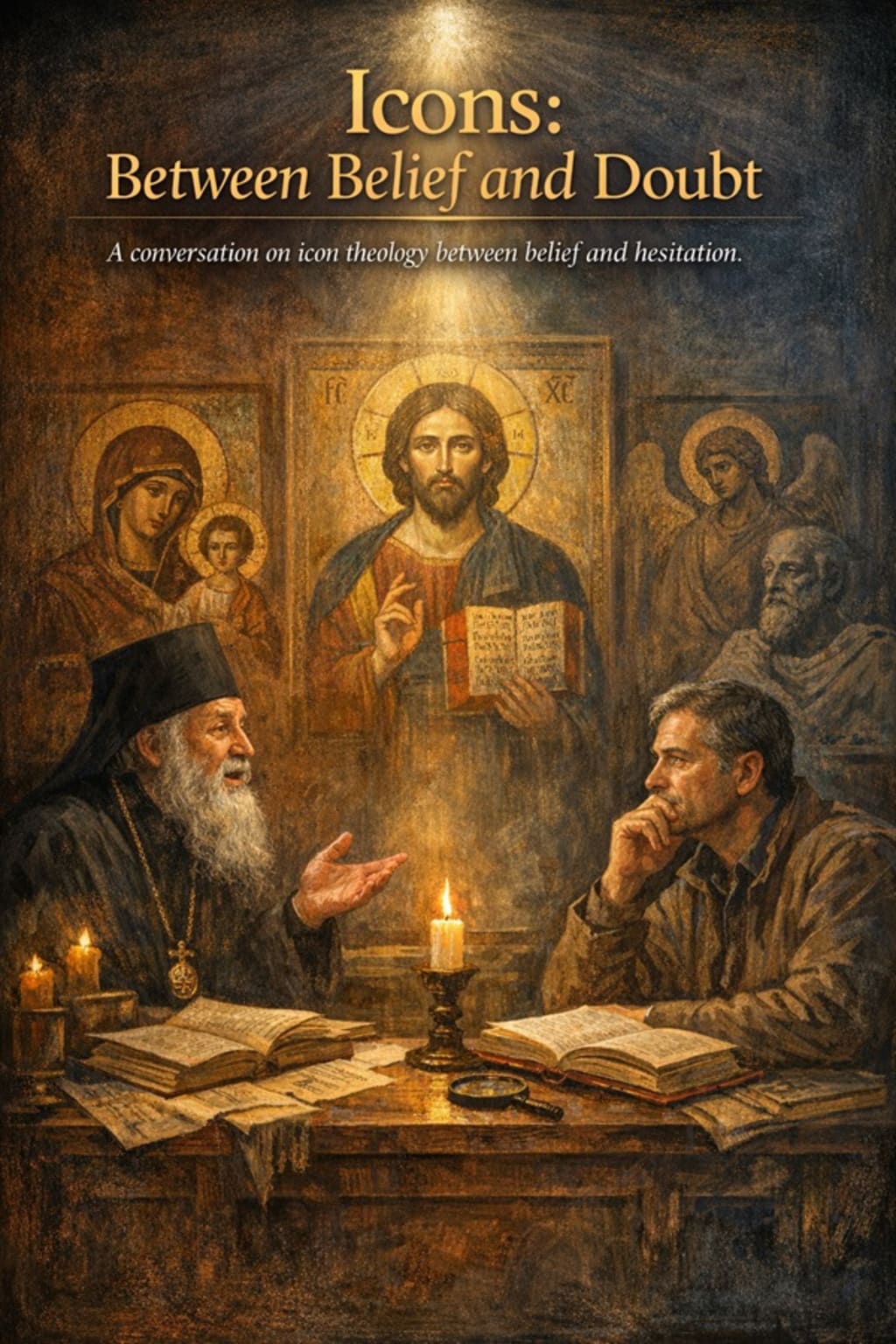
Icons are considered windows toward heaven, not simple images, but means of communion with the divine.
But doesn’t Christ say that we can communicate with God only through Him?
This is a deep and very well‑posed question. Christ clearly says in the Gospel of John 14:6: “I am the way, the truth, and the life. No one comes to the Father except through Me.” This verse is the theological foundation of Christianity and affirms that Jesus Christ is the only direct way to God.
How does this fit with the use of icons?
Icons are not a separate or alternative path to God. They are a visual aid that helps us focus our prayer and meditation on Christ. They do not replace a personal relationship with Him; they make it more tangible and more intimate. In the Orthodox tradition, an icon is considered a “window to heaven,” but Christ remains the centre.
His icon helps us connect with Him, not avoid Him. Saint John of Damascus, the defender of icons, said that “the honor given to the icon passes to its prototype,” meaning that we do not venerate the wood or the paint, but the divine Person represented.
Soare icons carved images?
This is one of the most common questions when discussing icons and the second commandment: “You shall not make for yourself a carved image.” But the Orthodox answer is clear and well‑argued. In the Old Testament, “carved image” refers to idols, meaning material representations of false gods that were worshipped as deities. The commandment forbids idolatry, not religious art itself. The purpose was to prevent confusion between the Creator and created things. An icon is not a carved idol in the sense of idolatry. Saint John of Damascus explained that an icon is a representation, not a divinisation.
The respect shown to it is directed toward the person depicted, not toward the material object. An icon is like a photograph of a loved one; you are not kissing the paper, you are expressing love toward the person. After the Incarnation of Christ, God became visible and representable. Therefore, depicting Him is no longer forbidden but becomes a confession of faith. The Seventh Ecumenical Council in Nicea (787) established that icons may be honoured but not worshipped as God. It made a clear distinction between veneration and adoration: only God is adored, while icons are honoured.
In conclusion, an icon is not a carved idol in the sense of forbidden worship, but a window toward heaven, a means of communion with Christ and the saints. It does not compete with Christ as a way to reach God; it reflects Him, the One who is the Way, the Truth, and the Life.
The blessing of icons in Orthodoxy is a liturgical act that consecrates them as objects of worship rather than simple works of art. Even though, theologically, an icon is considered holy because it reflects the prototype it represents — Christ, the Mother of God, or the saints — the Church introduced a specific rite for their sanctification. The icon is placed in the middle of the church on a clean cloth. The priest, wearing the epitrachelion and the chasuble, begins the service with prayers such as “Heavenly King,” “Holy God,” and the “Our Father.”
Psalm 138 is read, along with a special prayer asking that the icon be blessed and become a channel of grace. The icon is sprinkled with holy water and sometimes anointed with blessed oil on its four corners. The troparion and kontakion of the saint depicted are sung, and the faithful may take the icon home immediately after the service.
In earlier centuries, icons were not blessed through a special service. They were considered holy simply because of the name and image painted on them. The formal liturgical practice of blessing icons appeared in the seventeenth century, influenced in part by Catholic tradition.
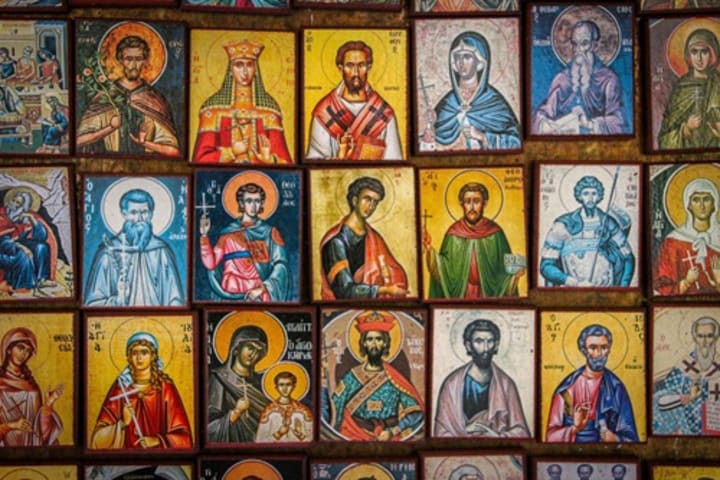
Although both Orthodox icons and Western religious paintings depict sacred figures, they differ greatly in purpose, style, and meaning. Icons serve worship, veneration, and communion with the divine, while Western paintings are often created for aesthetic, educational, or contemplative purposes. The artistic style of icons is symbolic and transfigured, while Western art tends to be realistic and emotional. The theology behind icons is rooted in the Incarnation of Christ, whereas Western religious art often emphasises allegory or moral themes.
The iconographer is traditionally anonymous and understood as a theologian in colour, while Western painters are celebrated artists expressing personal vision. Spiritually, as I said, an icon is a window toward heaven and a means of grace, whereas Western paintings inspire devotion but are not sacramental objects. Icons are made of wood, tempera, and gold leaf, while Western works use canvas, oil, fresco, or stained glass. The perspective of icons is frontal and flat, while Western art uses realistic depth and dramatic composition.
©Ca De Luce> MINDFUL MIND Blog 2025. All rights reserved.
©Ca De Luce> MINDFUL MIND Blog 2025. No part of this publication may be copied or reproduced without permission.
©Ca De Luce> MINDFUL MIND Blog 2025. Content protected — copying prohibited.
©Ca De Luce> MINDFUL MIND Blog 2025. Unauthorized use of text or media is not allowed. All images and photo are fulfilling the copyrights regulations. Much obliged to you all
About the Creator
CA'DE LUCE
I speak of spirit, soul, and flame,
Of humanity’s quest, our endless aim.
Religion, memory, stories untold,
Poetry woven with truths, oh! so bold.
Evolution’s path, the heart’s deep call,
Media’s noise, I’ll sift it all.
.
Keep reading
More stories from CA'DE LUCE and writers in Confessions and other communities.
Shabbat is the seal of the Creation! Six steps of becoming, one step of being! Part 1 A
I was reading :''Historian suggests Willian Shakespeare was actually a black women! Story on .............’. Can you believe that ? come on …Really ? What else are those so called ‘historians' able to say ?
By CA'DE LUCEa day ago in Confessions
How Emotional Intelligence Can Solve Communication Gaps In Open Relationships
Emotional intelligence (EI) is the skill to identify, recognize and control his or her emotions as well as with the emotions of others. Open relationships are prone to breaking down where a lack of communication tends to arise when there is a misunderstanding of boundaries, expectations, and emotions. Large EI enables partners to see through such complexities with clarity and compassion and lessen misunderstandings and conflict. People who have high emotional intelligence are in a position to detect their emotional needs as well as those of their partners which is vital in a relationship framework that has various dynamics.
By Willian James5 days ago in Confessions
Worth the Wait: Puerto Viejo, Costa Rica
Beach bumming in a small Caribbean beach town sounded like a perfect way to end our 6-month trip through Mexico and Central America. Or so we thought. The foul, fishy stench of rotten seaweed hit our nostrils as we stepped from the cramped bus and looked out at a rather depressing, empty, and underwhelming black sand beach. It was pouring with rain, and we had to quickly fish out our ponchos. We thought, this couldn’t be it, could it?
By Sh*t Happens - Lost Girl Travel3 days ago in Wander




Comments
There are no comments for this story
Be the first to respond and start the conversation.