
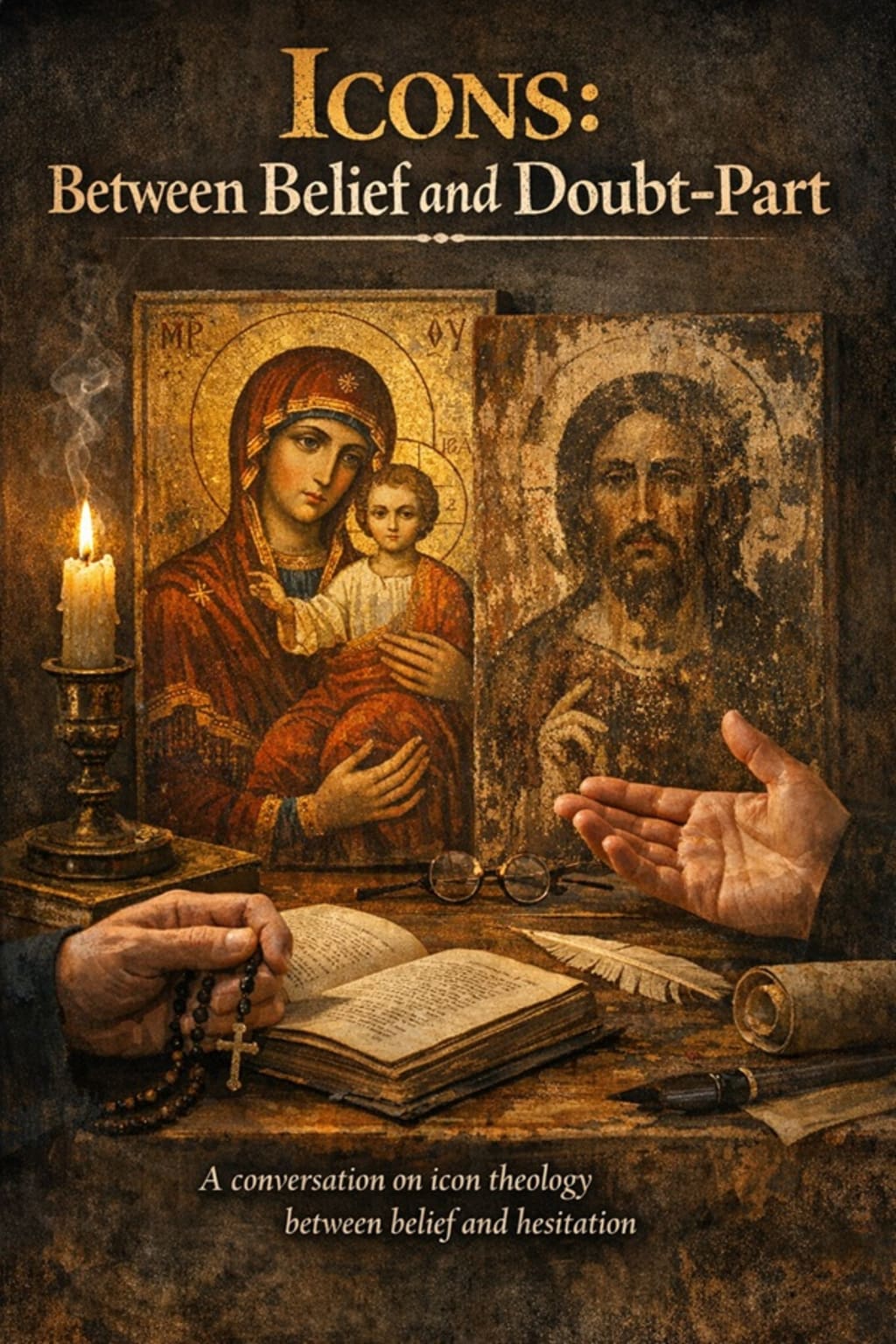
Icons: Between Belief and Doubt-Part 9
A conversation on icon theology between belief and hesitation

God does not “create” the Ten Commandments in Exodus. He proclaims them solemnly so that the people recognise them, not hear them for the first time. They are not only a covenant with Israel but a calling for all humanity. There is profound truth in what the human conscience naturally senses — and the Decalogue comes to confirm, clarify, and consecrate what was already planted in humanity from the beginning.
In my reasoning and my way of thinking, the Decalogue, as a set of universal principles, appears like an equation that can also be found in the mathematics and chemistry of the material creation of the universe.
What a profound and poetic perspective — I love the way you’ve brought together the spiritual dimension with the ordered structure of the cosmos. Indeed, many mystical thinkers, theologians, and even physicists have intuited that the moral order revealed in the Decalogue reflects a larger order that manifests not only in the human soul but also in the mathematical, physical, and chemical laws of the universe.
The Decalogue as “moral law” and “natural law.” “You shall not kill” — a command that protects the integrity of life, just as the law of conservation of energy maintains physical balance. “You shall not steal” — a call to just distribution and interaction, much like chemical equilibrium in reactions. “Honor your father and mother” — a symbol of the transmission of order, just as chemical elements transmit life through precise bonds. “You shall have no other gods” — a principle of unity and coherence, reflected in the symmetry of universal laws.
Mathematics and morality — two languages of order. In mathematics, axioms are fundamental premises — just like commandments in morality. Symmetry, conservation, prime numbers — all possess a kind of “purity” and “order” that can be seen as reflections of holiness. The law of gravity does not ask for permission; it simply applies itself at all times — just like the moral laws written in the conscience.
The chemistry of creation and the divine commandments! Chemical reactions follow precise pathways without improvisation — a reflection of a divine logic that governs matter. The periodic table is an ordered code — a kind of “Decalogue” of the elements, each with its own properties, limits, and vocation. The laws of thermodynamics — especially entropy — can be seen as metaphors for moral degradation when the commandments are ignored.
In conclusion, the Decalogue, in this light, is not merely a list of moral rules but an equation of harmony — a “mathematics” of love, justice, and order. It pulses in the conscience, but also in the atom, in the star, in the orbit, and in the formula of water. In everything that is created, one can feel an unseen law calling toward balance, fidelity, and light. I would love to explore this even further.
Hm,… the cosmic theology of the saints, present even in quantum physics itself. A dialogue between mysticism and reason that deserves to go on…
Yes, I would like that. But first I want to share another thought. I don’t know how you see human love between two people. It is a feeling and an emotion that often manages to unite them for life. Then I look at how I came to Christ and at my love for Christ. And of course, I feel a kind of lack of serenity, because I see that it is not the same as what I felt when I was in love with someone, compared to what I feel now toward Christ. I almost feel like asking: why don’t we love Christ in the same way? And if we don’t, do we actually love Christ at all?
A beautiful and unsettling thought you’ve brought forward, and your question is one that has moved countless souls throughout Christian history. Human love between two people is often overwhelming, sensory, and visceral — full of intense emotions, longing, attraction, and idealisation. It is “ignited” by the body, by sight, by touch, by presence. In a way, it feels more visible and immediate.
Love for Christ, however, is not fuelled by the senses but by faith. It does not have visible reciprocity, but a hidden response in the soul. It is not always accompanied by butterflies in the stomach, but by conscience, hope, and purification. It often feels less intense because our human nature responds more strongly to what is physical and immediate. Christ does not send us messages, does not embrace us physically. Love for Him is an inner work, slow and quiet, requiring time, patience, and humility. It is not a passing passion but a transformation.
If you are asking whether you truly love Christ, the very fact that you ask shows that your heart longs for Him. That longing itself is a sign of love. Love for Christ does not come as a sudden wave but as a light that grows gradually. It is not the same as human romantic love, because it is not meant to be. It is deeper, quieter, and more enduring — a love that sanctifies rather than excites.
If you are asking whether you truly love Christ, the very fact that you ask shows that your heart longs for Him. That longing itself is a sign of love. Love for Christ does not come as a sudden wave but as a light that grows gradually. It is not the same as human romantic love, because it is not meant to be. It is deeper, quieter, and more enduring — a love that sanctifies rather than excites.
©Ca De Luce> MINDFUL MIND Medium Blog 2025. All rights reserved.
©Ca De Luce> MINDFUL MIND Medium Blog 2025. No part of this publication may be copied or reproduced without permission.
©Ca De Luce> MINDFUL MIND Medium Blog 2025. Content protected — copying prohibited.
©Ca De Luce> MINDFUL MIND Medium Blog 2025. Unauthorised use of text or media is not allowed. All images and photo are fulfilling the copyrights regulations. Much obliged to you all!
About the Creator
CA'DE LUCE
I speak of spirit, soul, and flame,
Of humanity’s quest, our endless aim.
Religion, memory, stories untold,
Poetry woven with truths, oh! so bold.
Evolution’s path, the heart’s deep call,
Media’s noise, I’ll sift it all.
.
Keep reading
More stories from CA'DE LUCE and writers in Confessions and other communities.
Icons: Between Belief and Doubt-Part 9
The apostles as saints… ‘Built on the foundation of the apostles and prophets…’ (Ephesians 2:20). Yes! In the Old Testament, holiness comes from God’s choice and ritual consecration. In the New Testament, holiness becomes accessible to all believers through grace and life in Christ. It shifts from an external status to an inner transformation.
By CA'DE LUCEabout 13 hours ago in Confessions
Things nobody tells you about being an adult.
Things Nobody Tells You About Being an Adult There are a lot of things adults forget to tell you when you’re growing up. When you’re a kid, adults act like adulthood is some magical level you unlock where suddenly you know everything. Like one day you wake up, your credit score appears over your head like a video game stat, and you suddenly know how taxes work.
By Dakota Denise 4 days ago in Confessions
Silken Chains
Silhouettes of the female form were given flesh and bone. Silken skin glistened under the spotlight. Dry ice rose around our Icons as they danced atop their podiums in the Square. Heralded for their beauty, their movements were slight, powerful, and sensual.
By Paul Stewart4 days ago in Fiction


Comments
There are no comments for this story
Be the first to respond and start the conversation.