Nonfiction
Why Saying Less Makes Words Feel More Valuable
There is a widely held belief that words gain value through scarcity. When someone speaks rarely, their statements are treated as weightier, more deliberate, and more worth attending to. When someone speaks often, their words are assumed to be interchangeable, disposable, or less carefully considered. This intuition is not entirely wrong, but it is frequently misapplied. Scarcity does affect perception, but perception is not the same as truth, and rarity is not the same as meaning.
By Peter Thwing - Host of the FST Podcastabout 10 hours ago in Critique
Stassi Schroeder: The Gender Gap in Accountability
Stassi Schroeder. The #OOTD creator, the queen bee of SUR, the blueprint of the strong-willed woman. Many believe that Lisa Vanderpump's hit reality television show Vanderpump Rules would not have been nearly as successful without Nastassia Schroeder's strong opinions and intense personality.
By Autumn Henderson3 days ago in Critique
Protect the Children
At the time of writing this article, there is a lot of talk going on about Jeffrey Epstein, a new batch of files was released relating both to his victims and potential clients who abused said victims. I'm going to assume that if you're reading this, you are already at least somewhat familiar with the controversy surrounding Jeffrey Epstein and his private island, as well as the nature of those who were implicated in the released files. What I want to focus on for this article is how the conversation about Epstein started, how it shifted from Hilary to both Trump and right-wing politicians, why that shift happened, and what it means for people who actually care about protecting children.
By ChampionElCid9 days ago in Critique
On a Publisher’s Refusal
There was a day in my life, a kind of point of no return, when I lost everything: an apartment, a boyfriend, all my belongings, any clear vision of my future, and, icing on the cake, my bank account was in the red. By pure chance, a man I barely knew picked me up, and we set off on a road trip. We didn’t become a romantic couple by the end of the journey, as happens in movies: we just spent a month together, and then I was on my own again. That was when I decided to write about everything that had happened to me. Since I was no longer attached to anything in this world, my ability to write was the only thing still holding me up…
By Anastasia Tsarkova14 days ago in Critique
Speaking to Time Instead of the Room
Much of modern communication is oriented toward immediacy. Writing is framed as something meant to be consumed quickly, reacted to instantly, and replaced just as fast by whatever comes next. Under this model, the value of a piece is measured almost entirely by its initial reception. If it does not land immediately, it is treated as a failure. This assumption narrows the purpose of writing and misunderstands how meaning actually travels through time.
By Peter Thwing - Host of the FST Podcast15 days ago in Critique
Practice vs Performance
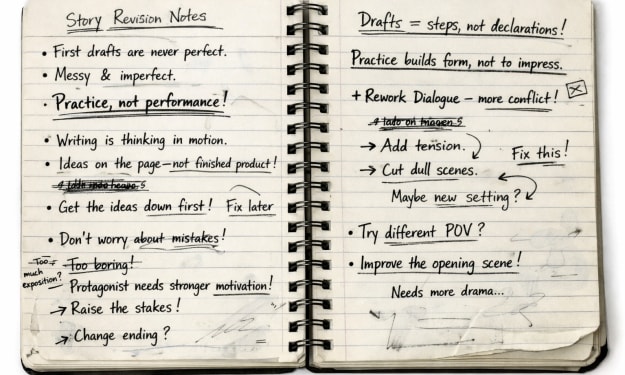
One of the quiet pressures shaping modern communication is the assumption that anything written should be immediately shareable. Drafts blur into declarations, and exploration is mistaken for conclusion. Under this pressure, writing becomes performative by default. The moment words are placed on a page, they are treated as finished statements rather than steps in a process. This expectation distorts both how writing is produced and how it is received, collapsing practice into performance and leaving little room for genuine development.
By Peter Thwing - Host of the FST Podcast16 days ago in Critique
The power of branding, and the creation of an illusion of higher level authority! Part 2 A
I wrote this article 2 weeks ago. Is about the word metacognition. Is a combination between a Greek preposition and an substantive. The association of the preposition, it is miss-used. I was wondering about it, and spoke with my friend. Of course saying meta means something superior, as ist is commonly used today, it's preposterous. And still, there are a lot of words, from philosophical world and psychological world, using regularly the preposition meta. IN a very wrong context!
By CA'DE LUCE23 days ago in Critique
AI as a Reflective Surface
Much of the confusion surrounding artificial intelligence comes from treating it as an agent rather than a surface. When people speak about AI “doing the thinking,” “creating the ideas,” or “speaking for someone,” they are often projecting agency onto a system that does not possess intention, belief, or understanding. This projection obscures what is actually happening in many real-world uses. In those cases, AI is not acting as a source of meaning, but as a surface that reflects, redirects, and reshapes what is already present.
By Peter Thwing - Host of the FST Podcast24 days ago in Critique
Mental Health Tips for Digital Creators (From Someone Who Knows the Burnout)
Mental Health Tips for Digital Creators (From Someone Who Knows the Burnout) It sounds like the ideal job to be a digital creator. You get to work from anywhere, be your own boss, and turn your ideas into content people actually care about.
By Farida Kabirabout a month ago in Critique
Marty Supreme: Movie Review
Marty Supreme presents itself as a sports film, but it isn’t really about victory, legacy, or even competition. It’s a hyper focused character study of an athlete whose entire sense of self is tied to proving his superiority even when the proof is unnecessary, humiliating, or already lost.
By Louise Noel about a month ago in Critique
When Is a Move Final?
The Commitment Problem in Modern Chess Modern chess operates under a fractured commitment model that no longer aligns with how players think, how turns function in most games, or how chess itself is actually played across physical and digital formats. At the heart of the problem is that chess treats physical contact with a piece as binding commitment while simultaneously relying on a separate explicit action to end a player’s turn. This creates a logical contradiction: a move becomes final before the turn is over. In most turn-based games, interaction with game components is provisional until the player explicitly signals the end of their turn. Chess is an anomaly in this respect, and the inconsistency becomes increasingly visible in modern play.
By Peter Thwing - Host of the FST Podcastabout a month ago in Critique