
The Shaped Self: Images Without History
Article

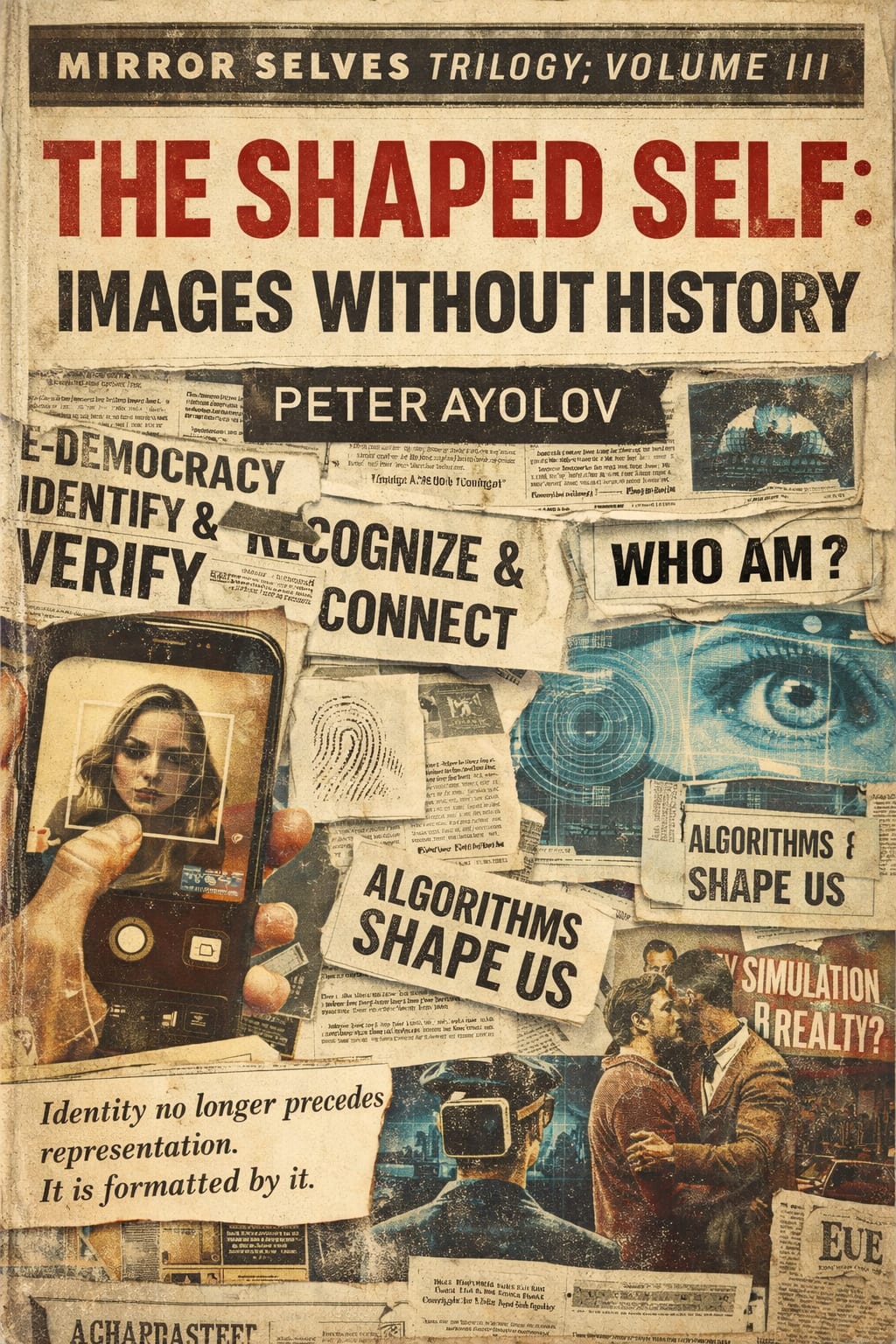
The Shaped Self: Images Without History
Peter Ayolov, Sofia University “St. Kliment Ohridski”, 2026
Abstract
E-democracy is not a technical upgrade of representative government. It is a transformation of citizenship inside a regime of visual formatting. Drawing on Žarko Paić’s analysis of video-centrism and the world-picture, this article argues that contemporary political life unfolds in an environment where images no longer reflect history but organise reality in advance. In this condition, the citizen does not merely participate; the citizen appears through an interface. Political agency becomes inseparable from visibility, recognisability, and circulation. By placing Paić in dialogue with Marcel Duchamp, Jean Baudrillard, Tom Wolfe, and Jean-Luc Nancy, the article develops the concept of the shaped self as the central figure of e-democracy: an interface-formed subject structured by edges, templates, and repeatable visual patterns that enable identification but risk reducing agency to performance. The struggle for democracy becomes a struggle over representation itself: over ownership of likeness, transparency of distribution systems, and the capacity to distinguish voice from simulation in an environment saturated with images, metrics, and deepfakes. As the concluding work of the Mirror Selves Trilogy, this article presents the book The Shapes of the Self: Identity and Recognition in Visual Space (2026) that investigates how the self emerges not as an inner essence but as a shaped and formatted presence within contemporary visual space.
Keywords
e-democracy; shaped self; world-picture; video-centrism; visual space; interface citizenship; recognition; representation; Duchamp; Jean Baudrillard; Tom Wolfe; Žarko Paić; simulacra; deliberation; algorithmic visibility; identity as property; deepfakes
Introduction: Images Without History
“Not that the image represents the self, but that the self comes into being only where it is shaped, formatted, framed, and admitted into the world-picture.”
The contemporary political subject emerges from a screen. To grasp what is changing, we should begin less with constitutions than with the smartphone image. The device in the palm of the hand has become a laboratory in which identity is selected, framed, circulated, and authenticated. What once belonged to galleries and institutional art worlds now unfolds within feeds and timelines. The image is no longer an aesthetic supplement to life; it is a condensed declaration of who one is. The screen does not merely display the self. It shapes it. This is why the language of citizenship increasingly resembles the language of visibility: profile, verification, authenticity, reach, engagement, reputation. The public sphere has not simply become more visual; it has become structurally dependent on formatting. The citizen appears as an interface object before appearing as a voter. Recognition comes before argument. The capacity to circulate comes before the capacity to persuade. If older political modernity asked citizens to reason, this new regime asks them to render themselves legible.
Tom Wolfe’s diagnosis in The Painted Word offers an unexpectedly sharp key. Wolfe argued that modern art became dominated by explanatory systems: the theory became the mountain and the artwork the flag on its summit. What matters is not whether one likes Wolfe’s tone but whether the mechanism persists. In digital political life, the frame becomes more powerful than the content it carries. The platform’s grammar, the interface’s defaults, and the distribution system’s incentives structure what counts as presence. The result is not that politics becomes “fake,” but that it becomes pre-framed. In the era of feeds, the caption often precedes perception. A photograph of a protest, a ballot, a badge, a patriotic symbol, a “receipt” of moral action rarely exists for contemplation. It exists as evidence inside a script. The image does not report reality; it certifies alignment.
Marcel Duchamp radicalized the logic of modern art by showing that selection and context generate meaning. A Readymade became art not through craft but through nomination: the declaration that this object counts. The smartphone universalizes this gesture. Each user performs micro-Readymade acts: the world offers infinite scenes; the user selects, crops, filters, uploads, and signs with a username. Craft dissolves into choice. Presence becomes validated through circulation. The event is confirmed by being posted. The everyday becomes a sequence of nominated fragments inserted into the gallery of the feed. Politics follows the same logic: one’s civic self becomes a curated series of gestures designed for recognisability.
Baudrillard pushes this logic toward its most unsettling conclusion. In hyperreality, representation precedes substance; the map does not reflect the territory but replaces it. Digital politics intensifies this inversion because the sign of participation can eclipse participation itself. A clip can substitute for deliberation. A viral image can substitute for argument. A metric can become a referendum. This does not mean citizens become irrational as individuals. It means the environment rewards forms that travel faster than judgement. Visibility becomes a mode of power. Influence becomes a function of circulation. The public sphere becomes a competition of signs. Under such conditions, the question of e-democracy changes: it is no longer simply whether citizens can speak, but under what formats they can appear as citizens at all.
Images Without Words: Paić and the World-Picture
Žarko Paić’s concept of video-centrism without history names the structural core of this transformation. The issue is not merely that we live among images; it is that the image becomes the condition under which anything can appear. Paić revisits Heidegger’s world-picture: modernity does not produce many pictures of the world; it grasps the world as something that can be set before us, arranged, calculated, and made present through representation. In the digital constellation, this becomes operational. The world is not merely represented; it is configured as an information-communication assemblage. Images do not reflect reality; they organise it.
This is why “scene” is not a metaphor but an ontological description. To exist socially and politically is to appear within interfaces that predefine what can count as presence. Profiles, biometric identifiers, data traces, algorithmic portraits are not secondary representations of a prior self. They are primary modes of existence. The self must be legible to be counted, visible to be acknowledged, searchable to be managed, circulable to be influential. The subject is no longer merely the operator of visibility but its product. The world-picture turns back upon the human.
This shift reorganizes democratic concepts at their roots. Classical democratic imagination presupposed a citizen capable of deliberation over time: narrative continuity, memory, and accountability. Video-centrism privileges immediacy and simultaneity. Logos does not disappear; it is absorbed into visual grammars. Speech becomes caption, argument becomes clip, narrative becomes feed. The present becomes continuous presentness. History becomes an aesthetic residue: a filter, a theme, a style of staging rather than a binding temporal order of responsibility. In such a regime, the question is no longer whether a citizen has rights in principle, but whether the citizen can be formatted as present in practice. The interface becomes a silent constitution of appearance.
Images Without Worlds: Nancy and the Dangerous Image
If Paić describes the regime in which images become environment, Jean-Luc Nancy helps clarify what is lost when images become mere operational surfaces. Nancy refuses to treat the image as a disembodied sign. The image is bound to the body, to distance and touch, to presence and withdrawal. It is not “innocent” visibility. It is intensity. The classical doctrine of mimesis tried to secure the bond between image and world: the image imitates the world and thereby gains meaning. Nancy complicates this by suggesting that the image is not simply a copy of a hidden essence. It is an event that seizes the spectator, that participates (methexis) rather than merely depicts. The image does not just show; it gathers.
This matters politically because interface life tends to flatten images into pure legibility: icons without intensity, visibility without weight. Yet a democratic public sphere depends on more than legibility. It depends on the capacity for shared exposure to what cannot be fully appropriated: the otherness of other people, the irreducibility of lived experience, the remainder that resists being reduced to a profile. When that remainder disappears, images become simulations that circulate perfectly while meaning collapses. The danger is not that images lie. The danger is that they become too clean, too operational, too compatible with governance. A world of perfectly formatted images can become a world in which nothing truly happens, because happening requires friction, memory, and consequence.
Images Without Reason: Art as Symptom of a World That Cannot Justify Itself
Paić asks a question that sounds naïve and therefore corrosive: what else should art be? When a world loses the capacity to justify its institutions, the demand that art justify itself becomes a symptom of a deeper collapse of grounds. Contemporary conceptual art is not simply an aesthetic development; it is an intervention into institutional power. The work is action against the museum, the market, and hierarchy. Yet this victory can become a trap. When art is absorbed into “life” as permanent cultural production, it risks losing the distance that once allowed it to open a world. Resistance becomes style. Subversion becomes market identity. The world-system can absorb critique as content.
In the digital public sphere this same logic appears as a politics of permanent novelty: endless circulation that produces repetition. The “new” becomes a posture. The endless demand for innovation empties meaning, because nothing can begin when everything must continuously refresh. This is why e-democracy can intensify democratic deficits rather than resolve them. It does not automatically make citizens more equal; it makes appearance more decisive. The question becomes: who can connect, who can be seen, who can control the formats that determine what counts as a citizen?
Images Without Humans: From Dehumanization to Transhumanization
When Paić asks how much contemporary art still needs humans, he is not merely provoking. He is naming the logical endpoint of a world where images become habitats. If philosophical anthropology defines the human by eccentric positionality, then technique is not an external invasion but the human’s structural second nature. The inhuman is internal. From this follows a grim clarity: the human becomes an operable component of technical systems, a programmable node within networks of representation.
The cyborg, in this context, is not science fiction. It names the dead nature of the body: a body that lives as technical composite, organic matter braided with informational code. Virtuality is not “there.” It is “here,” as real-time environment. Art, technology, and life converge in experimentation. Under biopolitics, the management of life becomes the central logic: genetic technology, global capital, and bioethical ideology converge on the body as resource. Identity politics becomes less “political” than anthropological-cultural: a way of marking belonging in a global system. Documentation becomes crucial because art and political gestures increasingly exist as events; what remains is the image archive that allows them to appear at all.
This is the point at which democracy, identity, and aesthetics merge. The citizen becomes shaped not only by ideology but by infrastructure. The political subject becomes a formatted subject. The question of simulation becomes ontological: once identity is primarily a visual and circulatory object, simulation does not merely deceive; it competes for existence. Deepfakes are not only a threat to truth; they are a threat to the conditions of recognition. The question “who spoke?” risks being displaced by “which image won?”
Images Without Art: Painting as Flashback in the Spectacle
The return of figurative painting is often explained as fatigue or nostalgia. But the deeper point is that painting returns inside a world where the conditions of worldhood have already been replaced by mediation. Danto’s notion of transfiguration helps here: the boundary between artwork, object, and event collapses. Pop Art revealed that everydayness is already medially produced. Warhol’s reality was never raw; it was already a picture of reality. In the same way, contemporary figuration cannot restore a stable human subject. The figure returns when the figure has ceased to anchor meaning. The body becomes a token in a system that already assumes technical redesign: genetic, cosmetic, cybernetic, algorithmic.
Within the society of the spectacle, painting cannot escape mediation. It becomes one more commodity-sign among others, a strategic costume that mimics authenticity. The “artist” returns as brand-like node because the spectacle requires personalized points of attention. This is why “new abstraction” and “new figuration” often function as retro-avant-garde effects: flashbacks rather than beginnings. Duchamp’s gesture already operationalized the boundary between art and life. Once that boundary becomes operational, the return to painting can no longer reveal what lies behind the gesture. It reveals only the machinery of circulation that makes the gesture visible at all.
Conclusion: Images Without Shape
What this web argument has tried to show is simple and severe: e-democracy should be understood as a transformation of citizenship under a regime of visual formatting. The political subject is increasingly defined not by interior conviction but by exterior legibility; not by narrative continuity but by interface presence; not by deliberative depth but by circulatory power. The shaped self is the citizen produced inside this regime: a subject made of edges, templates, and repeatable patterns that allow recognition while threatening to reduce agency to performance. If older democratic imagination relied on history as continuity, accountability, and memory, video-centrism dissolves time into stream. The stream does not abolish events; it dilutes their weight. It turns judgement into reaction and responsibility into engagement. The citizen becomes present everywhere and answerable nowhere.
The phrase images without shape names the final danger. Shape is not only a visual contour; it is the condition by which meaning can hold. Shape anchors an image to consequence, to a body, to an event, to a place, to a memory that can be tested over time. When images lose shape, they become pure circulation: endlessly transmissible, perfectly exchangeable, and therefore empty of obligation. Democracy cannot survive as a pure politics of appearance, because appearance without shape produces a public sphere without accountable time. If politics becomes only the management of images, then citizenship becomes only the ability to be formatted. Equality becomes a technical distribution of visibility.
The struggle for democracy therefore becomes a struggle over formats: who owns likeness, how distribution systems rank voices, what counts as authenticity, and whether citizens have the right to remain more than the images that represent them. The solution is not to abolish images, and it is not to romanticize an older public sphere that never fully existed. The task is to restore a remainder: a civic capacity for interruption, delay, memory, and judgement that cannot be optimized into a feed. Otherwise the future will belong to images that circulate flawlessly while the human disappears into perfect legibility.
“The picture is not in the world; it is what makes a world appear, and when it no longer holds, the world falls into mere visibility.”
References
Paić, Ž. (2021). Aesthetics and the Iconoclasm of Contemporary Art: Pictures Without a World. Springer.
Wolfe, T. (1976). The Painted Word. Bantam.
Baudrillard, J. (1994). Simulacra and Simulation. University of Michigan Press.
Heidegger, M. (1977). The Question Concerning Technology and Other Essays. Harper.
Nancy, J.-L. (2005). The Ground of the Image. Fordham University Press.
Debord, G. (1995). The Society of the Spectacle. Zone Books.
Ayolov, P. (2026) The Shapes of the Self: Identity and Recognition in Visual Space. Sofia: SAMIZDAT.
About the Creator
Peter Ayolov
Peter Ayolov’s key contribution to media theory is the development of the "Propaganda 2.0" or the "manufacture of dissent" model, which he details in his 2024 book, The Economic Policy of Online Media: Manufacture of Dissent.
Keep reading
More stories from Peter Ayolov and writers in Critique and other communities.
2012, Shale Gas and... Bright Future
Shale Gas and a Bright Future: Looking back at the birth of post-truth In 2012 Bulgaria experienced what looked like a classic modern conflict: a global corporation wanted to extract shale gas, students protested to protect land and water, media polarised the public, politicians divided into camps, and the government imposed a moratorium. At the time the story appeared simple — nature versus profit, citizens versus corporations, science versus fear.
By Peter Ayolov6 days ago in Critique




Comments
There are no comments for this story
Be the first to respond and start the conversation.