
The Yin–Yang Structure of a Home
From Interior Orientation to the External Dragon–Tiger Environment

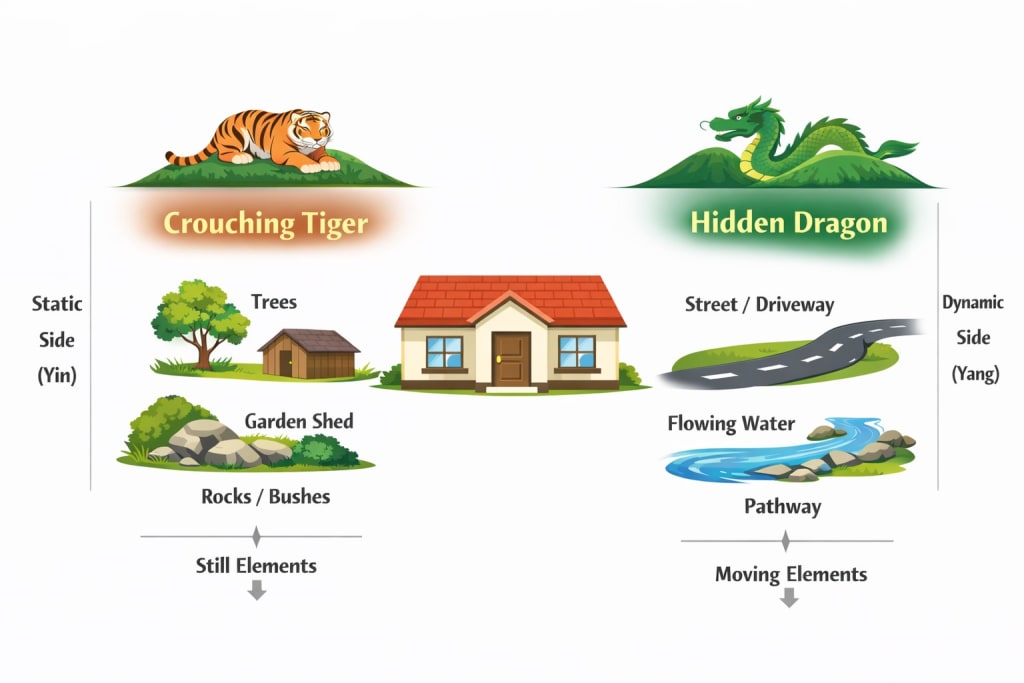
For ordinary people, the best approach to Feng Shui is not simply to rely on a practitioner. Instead, it is helpful to first understand some of its basic principles for oneself. With a little knowledge, anyone can begin to observe their living environment, recognize simple patterns of balance and imbalance, and make small but meaningful improvements to their surroundings.
This article introduces the Feng Shui principle of Yin–Yang and several very basic ways to examine the Yin–Yang conditions around a residence, helping readers better understand the spatial relationships that influence everyday life.
1. The Yin–Yang Orientation Within a Residence
The first step is to stand at the center of the home, which may be understood as the Taiji point of one’s living environment.
In the Book of Changes (Zhou Yi) it is said:
“Taiji gives rise to the Two Forms.”
These “Two Forms” (Liang Yi) refer to Yin and Yang.
When we stand at this central point, the surrounding space naturally reveals distinctions of Yin and Yang. From the four cardinal directions to the more refined system of the twenty-four directions used in classical Feng Shui, this reflects the Yin–Yang structure of space itself.
As a starting point, we may first use the four directions to establish the basic Yin–Yang relationships within a space.
In this framework:
• East corresponds to Yang
• West corresponds to Yin
• South corresponds to Yang
• North corresponds to Yin
This directional Yin–Yang framework has long influenced the spatial organization of traditional Chinese architecture. For this reason, mainstream traditional buildings are typically constructed facing south with their backs to the north.
This orientation corresponds to Laozi’s statement in the Daodejing:
“Bearing Yin and embracing Yang” (负阴而抱阳).
According to this principle, if a house has two entrances opening in different directions, the entrance facing Yang—namely East or South—should normally serve as the primary daily entrance.
Within the interior arrangement of the house, spaces associated with Yang directions, such as those facing East or South, are often designated for active family use, including the living room or study.
Bedrooms, by contrast, are more appropriately located in Yin-oriented directions, such as the West or North, which tend to provide a calmer and more restful environment.
Of course, not every residence follows the ideal orientation of sitting to the north and facing south. When the orientation differs, the direction receiving stronger sunlight or opening toward a broader, unobstructed space may function as Yang within that particular context.
For example, if a house faces west and receives strong afternoon sunlight, the western direction may function as Yang within that specific spatial environment.
Such situations correspond to another classical Yin–Yang spatial model known as the Four Symbols (Si Xiang).
This model is defined from the standpoint of the Taiji point, the central position from which one observes the space.
Standing at this center and facing the front of the house:
• the left side corresponds to the Green Dragon (Qinglong) — Yang
• the right side corresponds to the White Tiger (Baihu) — Yin
• the front corresponds to the Red Bird (Zhuque) — Yang
• the back corresponds to Xuanwu, traditionally depicted as a tortoise entwined with a snake — Yin
These symbolic directional relationships play an important role in classical Feng Shui environmental analysis.
2. The Yin–Yang Structure of the External Environment
While interior space matters, classical Feng Shui places even greater emphasis on the external environment.
If the outside environment is unfavorable, adjustments made inside the house will have only limited effect.
In traditional Feng Shui, one of the most important theoretical frameworks for analyzing the external environment is known as the Five Geographical Principles, which include:
• Dragon
• Site (Xue)
• Sand
• Water
• Orientation
Although the full theory behind these principles is complex, ordinary residents can still understand them by relating them to everyday living environments.
For example:
• The city in which we live can be viewed as the Dragon, representing the broader environmental energy field that surrounds our living space.
• The Site (Xue) refers to the specific location where the residence is situated.
• Water often corresponds to nearby roads, streets, rivers, or other flowing pathways in the environment.
• Orientation refers to the directional energy field of the house. In classical Feng Shui, this involves not only the four cardinal directions but also the more refined system of twenty-four directions, which belongs to the more advanced field known as Li Qi (energy calculation).
Sand: A Critical Point of Observation
For ordinary residents, however, the most visible and practical aspect to observe is Sand.
In Feng Shui, “Sand” refers to the immediate surroundings of a residence, including nearby streets, buildings, slopes, ponds, rivers, and other physical structures.
The shape of streets, traffic flow, building height, the distance between houses, land elevation, and water movement all fall within this category.
These surrounding features create different environmental energy fields, influencing us both directly through visible conditions and indirectly through more subtle environmental effects.
People can often sense these differences intuitively. Some places feel comfortable and uplifting, while others feel tense, stressful, or oppressive.
Dragon and Tiger: The Energy of the Two Sides
One well-known Feng Shui expression describing these environmental relationships is the phrase:
“Crouching Tiger, Hidden Dragon.”
In Feng Shui, this phrase refers to the environmental energy on the two sides of a site, such as the two sides of a residence. The phrase was later adopted as the title of a well-known novel.
As shown in the figure, in Feng Shui theory:
• The left side of a house corresponds to Dragon energy
• The right side corresponds to Tiger energy
The Dragon side represents energy that is gathering strength and preparing to move—hence the image of a “Hidden Dragon.”
Elements such as streets, driveways, pathways, or flowing water on this side can represent dynamic environmental features associated with Dragon energy.
The Tiger side, by contrast, represents a more stable and quiet presence—like a tiger resting on the ground—thus the image of a “Crouching Tiger.”
More stationary features, such as walls, trees, storage structures, or solid buildings, often correspond to the calm and protective character of the Tiger side.
As shown in the figure, from the perspective of Yin and Yang:
• Dragon corresponds to Yang
• Tiger corresponds to Yin
When the environments on both sides of a house are balanced and harmonious, they help stabilize the energy field of the residence. Such balance can, in turn, create a more supportive and harmonious living environment for the people who live there.
In this way, Feng Shui does not need to remain mysterious or complicated. By understanding a few basic principles—especially the balance of Yin and Yang—anyone can begin to observe their living environment with greater awareness. Small adjustments in orientation, spatial use, and surrounding conditions can gradually create a more balanced and comfortable living space. In this sense, Feng Shui becomes not only a traditional theory of space, but also a practical method for improving everyday life.
About the Creator
Lidong Yu
I am a Chinese Feng Shui consultant and educator, raised and trained in China. My work draws on classical Feng Shui traditions to help people better understand the relationship between themselves, their environments, and time through Qi.
NCLEX Study Plan: A Step-by-Step Guide for Nursing Students
Preparing for the NCLEX-RN is one of the most important milestones in the nursing students’ career. This is because the NCLEX is the final step before nursing students can become licensed nurses. However, it is not as easy as simply reading nursing textbooks and taking notes from class lectures. This is because the NCLEX is designed to test the nursing students’ clinical judgment and decision-making skills.
By Sulcus Learningabout 14 hours ago in Education
The Value of Hard Work
Hard work is one of the most important qualities for success in life. It means putting effort, time, and dedication into our tasks and responsibilities. Many people dream of becoming successful, but success does not come easily. It requires patience, determination, and continuous effort. Hard work helps people achieve their goals and build a better future. It also teaches discipline and responsibility, which are necessary for personal and professional growth.
By aadam khan5 days ago in Education
Guard Your Battery
Why are some people so attractive just by standing there? It’s not because they are "likable," but because they don’t need everyone to like them. I realized later that truly charismatic people allow themselves to be criticized, but they never criticize themselves. They never try to please the world; instead, the world stops to watch them.
By Emily Chan - Life and love sharing7 days ago in Poets



Comments
There are no comments for this story
Be the first to respond and start the conversation.