
“Your Visa Is Approved”
A Real-World Guide to the New USA Student Visa Rules for 2026

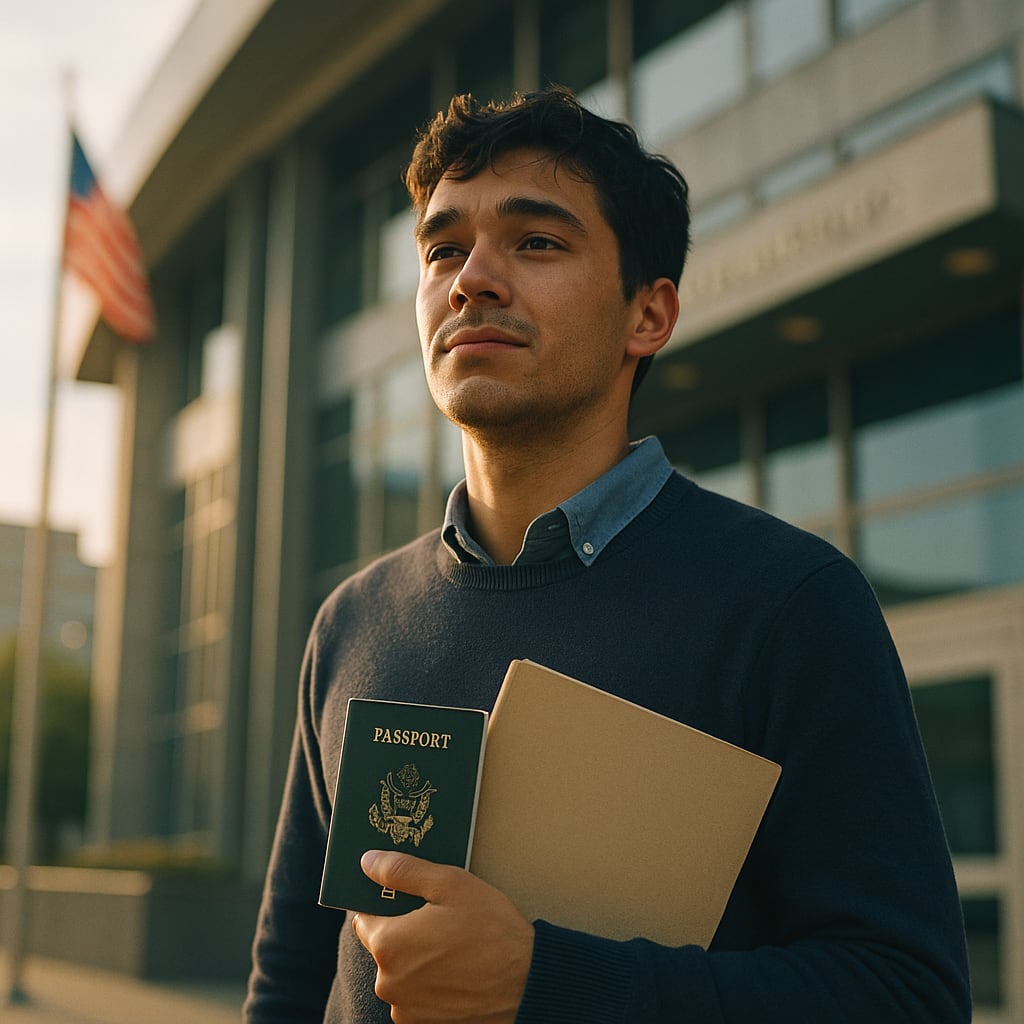
The rules changed. The dreams didn’t. What nobody tells you about the new F‑1 visa reality.
The email hit my inbox at 3:17 a.m.
Subject line: “Your visa interview has been scheduled.”
I should’ve been thrilled. I’d spent years planning for this moment—TOEFL scores, bank statements, late-night calls with admissions offices running on different time zones.
Instead, I sat there in the dark, phone screen burning my eyes, scrolling through yet another thread about “new U.S. student visa rules for 2026” and feeling that familiar knot in my stomach.
What if I say one wrong thing?
What if my parents’ bank statement format isn’t “acceptable”?
What if the rules changed again while I was sleeping?
If you’re planning to study in the U.S. for Fall 2026 or later, you’ve probably felt this too: the dream is still shiny, but the visa feels like a trap door.
This is the guide I wish someone had handed me before I ever opened that DS‑160 form. Not the sanitized bullet points from government websites—the real-world version of what’s changing, what actually matters in your interview, and how people like us are getting through it without losing our minds.
The moment everything becomes real: “Why do you want to study in the U.S.?”
If you’ve never sat across from a visa officer, you don’t fully understand how one question can rearrange your heart rate.
The glass window. The fingerprints. The tiny speaker that makes every word sound more aggressive than it is.
Then they look up and ask something that sounds simple:
“Why do you want to study in the United States?”
The wrong idea about that question is everywhere online.
People rehearse speeches, memorize generic answers, try to sound like a brochure.
“I want to experience world-class education and cultural diversity…”
Visa officers hear that 200 times a day.
With the new 2026 rules tightening how they evaluate intent, finances, and post-graduation plans, that kind of robotic answer won’t just be useless. It might actually hurt you.
Because here’s the uncomfortable truth behind all the rule changes:
the U.S. government is less interested in your dreams and more interested in your story making sense.
Not perfect. Not dramatic. Just… believable.
The way you connect your past, your present, and your future is now your strongest visa document.
What actually changed for 2026 (without the legal jargon)
Let’s clear the fog first.
A lot of people throw around “new F‑1 rules” like it’s one single law. It’s not. It’s a bunch of policy shifts, internal instructions, and consulate-level practices that, together, change how your case is judged.
Here’s what’s really different if you’re applying for a U.S. student visa for 2026 and beyond:
Tighter scrutiny of “non-immigrant intent”
The core rule hasn’t changed: F‑1 is still a non-immigrant visa.
But officers are under more pressure to ask, “Are you actually going to come back?”
More detailed questions about funding stability
It’s not enough to show money exists. Officers increasingly want to see where it comes from, how consistent it is, and how realistic your plan is for the whole program, not just year one.
Closer look at “paper admissions”
Schools that admit anyone with a pulse are under more scrutiny. If your university is barely known and your grades are average, you’ll have to work harder to show this isn’t just a backdoor immigration attempt.
Greater focus on return path
No, you don’t have to swear you’ll never work in the U.S. ever.
But you do need to show that your life doesn’t end in the U.S.
Your degree should lead somewhere—back home or elsewhere—with a story that doesn’t sound like a flimsy excuse.
More data, less randomness
Consulates now lean heavily on data: country trends, school reputations, refusal histories, even your prior visa attempts.
That “30 seconds and your life is decided” feeling is still real, but it’s less random than it seems.
So no, 2026 isn’t the year the U.S. shuts its doors on students.
It’s the year the system quietly started asking:
“Are you serious, or are you just trying your luck?”
Your job is to show you’re serious.
Your three invisible “cases”: Story, Money, and Future
The mistake most people make is thinking they’re presenting one case:
“I got admitted, here’s my I‑20, please approve me.”
In reality, you’re silently presenting three different cases at once:
Your Story Case – Who you are and why this program fits.
Your Money Case – How you’ll pay for this without collapsing.
Your Future Case – What your life looks like after the degree.
If even one of these feels weak or fake, the officer can say “no” in under a minute and move on.
Let’s walk through each the way it actually plays out at the window.
The Story Case: When your past and your program don’t match (and what to do about it)
Picture this:
You studied mechanical engineering.
You’re now going for a master’s in digital marketing in Florida.
Your work experience? One internship in a local factory.
On paper, that looks random.
Random is dangerous.
With the new rules, officers are more likely to deny cases that feel like you just picked any program that would admit you.
But randomness can be fixed through connection.
You don’t need a perfect linear path, you need a believable thread. Something like:
“I studied mechanical engineering, but during my final year project, I had to market our prototype within campus. I realized I was more drawn to the communication and strategy side than the technical side. That’s why I spent the last year helping small businesses in my city with social media marketing. This program in digital marketing is a way to formalize what I’ve already started doing.”
Truth test:
Does that sound human?
Does it explain the shift without making you sound confused?
Does it show a pattern instead of a sudden whim?
That’s what your Story Case needs to do.
What 2026 officers quietly look for in your story:
Some kind of logical progression from where you’ve been to where you’re going.
Proof you didn’t pick this program just because it’s in the U.S.
Signs you’ve actually thought about your field beyond the admission letter.
And no, you don’t need fancy vocabulary.
You need clarity and consistency between your documents, your DS‑160, and your spoken answers.
The Money Case: Bank statements are not the whole story anymore
Show money. Get visa.
That’s how it used to feel.
Now? Not so much.
The cost of U.S. education has climbed, and consulates know it.
They also know how easy it is to print a bank statement for one month that looks rich and then goes back to zero.
So with the 2026 visa environment, officers are silently asking:
Is this funding real?
Is it sustainable for multiple years?
Is the source believable?
If your uncle “suddenly” appeared as a sponsor with $80,000 in his account but no clear income history, that raises eyebrows.
What works better now:
Clear, traceable sponsors.
Parents with steady jobs. Employers sponsoring degrees. Recognizable scholarships. Even if the amount is modest, if it looks stable and logical, it’s stronger.
Spread-out proof, not just one big number.
Salary slips, tax returns, business registration, property documents. Officers don’t always ask to see these, but the confidence of knowing you can show them changes how you speak.
A realistic plan, not a miracle story.
“My parents will sell land” with no proof is risky.
“My parents have been saving for five years; this is their main savings account, and they will support my first year while I use my CPT/OPT options later” is more grounded—if the numbers support it.
You’re not just proving you can pay.
You’re proving you won’t crash halfway through and turn into a desperate overstay story.
The Future Case: Saying you’ll “definitely come back” isn’t enough
Here’s where a lot of applicants panic.
You’ve read everywhere that F‑1 is a non-immigrant visa. That means you’re supposed to “intend to return home” after graduation.
At the same time, F‑1 literally builds in Optional Practical Training (OPT) and pathways that could, one day, lead to longer stays.
So what do you say when they ask:
“What are your plans after graduation?”
The old, lazy answer:
“I will finish my degree and come back to my home country.”
It sounds safe.
It also sounds rehearsed and empty.
With the 2026 tightening, officers are looking for something else: credibility.
You don’t have to promise to never step foot in the U.S. again.
You do have to show your life isn’t a black hole after graduation.
Better answers sound like this:
“My plan is to complete my master’s, then use up to one year of OPT to get hands-on experience in my field, ideally in a mid-sized tech company. After that, I want to return to India and join a growing SaaS startup or continue in my family business, but with a stronger technical and global background.”
or
“I want to specialize in early childhood special education. My country is just starting to build serious infrastructure for children with learning disabilities. After graduation, I plan to come back and work with NGOs or schools that need those skills. The U.S. gives me a level of training that doesn’t yet exist here.”
Notice what’s happening here:
The U.S. is framed as a chapter, not the entire story.
There’s a home-country pull: job market, family, existing commitments.
There’s structure—not “I don’t know,” but also not “green card or die.”
That’s how you fit your future into the non-immigrant rule in a way that feels honest and aligned with the new expectations.
What the 2026 interview really feels like (and how to not freeze)
No one warns you about the sound of the visa officer’s stamp.
You can hear it from three windows away.
Thump.
Thump.
Thump.
Some people walk away dazed and smiling. Others walk away in slow motion, holding a blue paper that feels heavier than it looks.
With the 2026 rules tightening, interviews can feel even shorter and more intense. But the pattern is still the same:
Most interviews are decided in the first 30–60 seconds.
Not because the officer is cruel or bored, but because:
They’ve already seen your DS‑160.
They already know your school, your country, your basic profile.
They’re comparing every single thing you say to a mental model built from thousands of similar cases.
So what matters most in that tiny window?
1. The way you carry your story.
If you sound like you’re reading from inside your skull, they feel it.
If you sound like someone who knows why they’re going, even if you’re nervous, they feel that too.
2. Your first couple of answers.
If your program, funding, and post-study plans sound mismatched or unclear, they don’t need to hear more.
3. Your eyes and your breathing.
It sounds cheesy, but your body gives away whether you believe your own story.
You can be scared and still be grounded. That combination is powerful.
A few practical ideas that helped me and others:
Practice out loud, but not to memorize.
Talk through your story to a friend who doesn’t care about visas.
If they don’t understand why you’re going, an officer won’t either.
Know your numbers without staring at paper.
Tuition, estimated living expenses, how much your sponsor earns, roughly how much savings there are. You don’t need exact cents, just ballpark accuracy.
Accept that fear will be there.
Courage isn’t no fear; it’s walking up to the window while your heart does somersaults and still answering like you mean it.
You can’t control who sits on the other side of the glass.
You can control how coherent, grounded, and human you feel on your side.
The myths that quietly sabotage 2026 applicants
If you hang around Telegram groups and Reddit threads long enough, you start seeing the same myths repeated in different fonts.
With the new visa landscape, some of them are more dangerous than ever.
Myth 1: “If you say you want to stay in the U.S. forever, they’ll appreciate your honesty.”
They won’t.
There are other visa categories for that. F‑1 isn’t one of them.
You can be honest without announcing your green card fantasies at the window.
Myth 2: “Just show a big bank balance and you’re fine.”
For 2026, consistency beats drama.
A modest, believable funding story is stronger than a flashy, suspicious one.
Myth 3: “Everyone from my country is getting rejected, so it’s hopeless.”
Countries do go through phases of higher scrutiny, but that doesn’t mean no visas are issued.
It means the margin for sloppy stories and weak finances shrinks.
People are still getting approved—you just hear from the rejected ones more.
Myth 4: “Agents know the magic answer.”
Some are helpful. Some are guessing. Some are straight-up inventing things.
If an agent tells you to lie, polish your story into something unrecognizable, or “just say this exact sentence,” walk away.
The 2026 game isn’t about being perfect. It’s about being coherent enough that the officer has no easy reason to say no.
The approval moment: why those three words hit so hard
When the officer finally looked up at me and said,
“Your visa is approved,”
I didn’t say anything clever.
I just nodded too fast, whispered thank you, and tried not to cry until I was at least past the security gate.
There’s something quietly brutal about this whole process that doesn’t show on paper.
You spend years building your profile, saving money, researching programs.
You fly or bus to the consulate.
You stand in line with strangers who are just as scared.
And then someone who has known you for less than three minutes decides whether your next few years will happen in the way you’ve imagined them or not.
The 2026 rules don’t change that emotional weight.
But here’s what they do make clear:
The officer isn’t judging whether you deserve a dream.
They’re judging whether your dream fits inside a system that was never built to understand everything about you.
That’s unfair in a way.
And yet, knowing that also gives you a strange kind of power:
You stop trying to be a perfect applicant.
You start trying to be a believable human with a real plan.
That shift changes how you fill forms.
It changes how you answer.
It changes how you walk out of the consulate—even if the answer, this time, is “no.”
What you carry with you, whether you’re approved or not
If you’re applying for a U.S. student visa in 2026, here’s what I hope you keep in mind:
Your visa result is not a verdict on your worth, your intelligence, or the validity of your dreams.
It’s a yes or no inside a system that:
cares more about risk than about potential,
cares more about consistency than about passion,
cares more about rules than about story—unless you learn to speak in both languages.
So learn the rules.
Know that they’re stricter with intent, with money, with future plans.
Know how to build your Story Case, your Money Case, and your Future Case in a way that feels like you when you say it out loud.
But also remember this:
A rejection doesn’t erase who you were before the appointment.
An approval doesn’t magically fix everything that comes after.
Both are just doors.
And if you’re sitting there right now, reading this on a cracked phone screen in a noisy house, wondering if you should even bother applying under these new rules—
that wondering is already a sign you’re taking this seriously enough to have a chance.
The consulate will never see the full version of you.
That doesn’t mean you shouldn’t try to bring as much of your real self as you can to that small square of glass.
Somewhere in that gap—between bureaucracy and human life—those three words might still land in your ears one morning:
“Your visa is approved.”
And whether they come this year, next year, or not at all, the person you became while fighting for them?
You get to keep that.
About the Creator
abualyaanart
I write thoughtful, experience-driven stories about technology, digital life, and how modern tools quietly shape the way we think, work, and live.
I believe good technology should support life
Abualyaanart
Keep reading
More stories from abualyaanart and writers in Education and other communities.
Leading with Integrity: How Authentic Executive Communication Strengthens Organizational Trust
Leadership no longer thrives on hierarchy alone. While authority once defined executive presence, today’s environment demands openness, clarity, and genuine connection. Employees, investors, and customers expect leaders to communicate with purpose and honesty. As a result, executives must move beyond formal directives and cultivate trust through authentic communication.
By Yeasha Sobhan5 days ago in Education
Essential Drills for Travel Baseball Teams: Game-Ready Training Ideas for Success on the Go
Travel baseball teams spend many weekends away from home. Players ride buses, stay in hotels, and compete in new places. Practice time can feel short during busy tournaments. That is why essential travel baseball drills are so important. These drills help players stay sharp no matter where they are. Teams do not always have full fields or batting cages. They must adjust and stay focused. Smart coaches plan simple drills that fit small spaces. Players improve when they train with purpose. Even short sessions can build strong habits. Travel days can become training days with the right mindset.
By Joe Sottolano3 days ago in Education


Comments
There are no comments for this story
Be the first to respond and start the conversation.