
Chapter 1: Jasmine in the Spine
If They Ask, Tell Them the Sea Swallowed Me (Romantic Suspense Serial)

PROLOGUE — The Sea Swallowed Me
London Docklands — Years Ago
The water didn’t look like water at night.
It looked like a decision.
Black, thick, moving without hurry—like it had all the time in the world, and it knew the world would eventually belong to it anyway. The rain came down in a thin, relentless hiss, turning the dock into a pane of glass that reflected nothing honestly. Every light was doubled, smeared, made uncertain.
Kamran stood at the edge of the river with his hands in his pockets, as if he were waiting for someone who had promised to be late. His coat was too light for the weather. His hair was damp, clinging to his forehead in narrow strands. He did not shiver. His body had learned that shivering was a luxury.
Behind him, the city held its breath.
Somewhere a siren rose and fell, bored of itself. Somewhere a train ran like a thought trying to outrun regret. The Docklands, usually loud with commerce and men who spoke in numbers, were quieter now—emptier, as if the river had asked for privacy.
A man moved in the darkness behind him.
Not close enough to be seen clearly, but close enough to be felt.
“You shouldn’t have come here,” the man’s voice said.
It was calm. That calm was a kind of violence.
Kamran smiled faintly. “I came because you asked.”
Silence stretched. Rain stitched it tighter.
“You misunderstand,” the man said. “I didn’t ask. I allowed.”
Kamran’s smile faded. “I allowed myself.”
He felt the man shift, annoyed. Men like this hated when you claimed ownership over your own fate. Ownership was the one currency they could not counterfeit.
“You have something,” the man said.
Kamran’s gaze stayed on the river. “Everyone has something.”
A soft laugh behind him—clinical.
“You write beautifully,” the man said. “You should have written less.”
Kamran turned his head just enough to see the shape in the gloom. Dark coat. Clean shoes. Face forgettable on purpose. But the eyes—deep-water eyes—patient, certain.
“You’re not here for my poems,” Kamran said.
“No,” the man replied. “I’m here for your pages.”
Kamran’s fingers tightened around the waxed cloth bundle hidden under his coat. Light enough to be dismissed. Heavy enough to end a life.
“You’re going to kill me,” Kamran said, not a question.
The man’s calm didn’t shift. “Not if you cooperate.”
Kamran laughed once, ugly. “So… yes.”
The man reached into his pocket and produced a folded slip of paper, offered like a business card.
Kamran didn’t take it.
“When they ask,” the man said softly, “you will tell them—”
Kamran cut in, low and bitter. “—that the sea swallowed me.”
The man smiled faintly, pleased. “Good.”
Kamran stared at the sentence, clean and portable, a lie designed to travel easily. A lie that sounded poetic enough to be believed.
He thought of jasmine—of how something delicate could insist on surviving, stubbornly fragrant even when crushed. His mother used to say scents were languages. He wondered what language fear spoke. He wondered who would translate it.
“If I give it to you,” Kamran said, “you’ll still bury me.”
“Probably,” the man said.
Kamran inhaled. The air tasted like metal and rain.
“Then I won’t give it to you,” he said softly.
For the first time, the man’s calm cracked—just a fraction. Irritation surfaced.
Kamran did something almost tender then. He took the folded lie from the man’s hand, folded it carefully, slipped it into his pocket.
The man watched, satisfied.
Kamran looked at the river and smiled—not at the man, but at the future.
“Thank you,” Kamran said.
The man’s eyes narrowed. “For what?”
“For giving me the line,” Kamran whispered.
And then Kamran moved—toward the edge.
His hand flashed under his coat. The waxed cloth bundle was in his fist.
He threw it into the river with all the force of someone hurling his own heart into darkness.
It vanished into black water without a splash loud enough to matter.
The man lunged too late.
Kamran stepped back from the edge, rain running down his face like tears he refused to shed.
“You can drown me,” Kamran said. “But you’ll be chasing water.”
The man’s eyes burned with quiet fury.
“You have no idea what you’ve done.”
“Oh,” Kamran murmured. “I do.”
He turned his head slightly, listening—not to the man, but to the story that hadn’t been written yet.
Somewhere, years ahead, a woman would touch a book like it was alive.
And the sea would regret that it had ever learned his name.
The darkness moved.
Hands. A shove. A strike that stole air.
Kamran hit the ground hard enough to see white. Rain filled his mouth. Blood tasted like iron and salt.
Above him, the man’s calm returned, reclaimed.
“You were brilliant,” the man said softly. “You should have been obedient.”
Kamran coughed, laughed weakly through pain. “You’ll still be chasing water.”
The man leaned closer.
“When they ask,” he whispered, “you will tell them the sea swallowed you.”
Kamran’s vision blurred.
He thought of jasmine.
He thought of paper remembering.
And then the world narrowed into a single sentence, the last thing he carried forward like a sealed letter:
Let the sea take me—
but don’t let it take the story.
CHAPTER ONE — Jasmine in the Spine
British Library — Present Day
The British Library had its own kind of weather.
Outside, London performed its familiar theatre—grey sky, hesitant rain, wind that bullied umbrellas as if the city were bored and needed to feel powerful. Inside, the air was regulated to protect what the world kept trying to destroy. Temperature measured. Humidity controlled. Light softened into mercy.
Lina Hart lived in this mercy.
She worked in the conservation studio where time came to be repaired.
On her table, under a magnifying lamp, a book lay open like a patient who had survived too much. Its spine was cracked; its hinge loosened; its pages smelled faintly of smoke, as if it had once been held too close to a fire and learned to fear warmth.
Lina’s hands moved with the care of someone who had learned that some things did not forgive haste.
Microspatula. Brush. Tweezers.
Attention.
That was her religion: the quiet discipline of not breaking what was already fragile.
Behind her, Marta Kowalski rolled a cart past with the hard, practical grace of someone who believed sarcasm was an essential tool.
“If this vellum curls again,” Marta muttered, “I’m quitting and opening a bakery.”
Lina didn’t look up. “You say that every week.”
Marta snorted. “Every week is a new disappointment.”
The clock ticked with quiet arrogance.
That morning, acquisitions had called Lina directly—rare.
“Lina,” the voice had said, “we’ve got an estate trunk donation from Hampstead. The paperwork is… odd.”
Odd meant danger in a building full of paper.
When the trunk arrived, it waited like a mouth that hadn’t decided whether to confess or bite.
Heavier than it should have been. Old wood, iron fittings, leather straps worn smooth by hands that had held on too tight. The air around it smelled of cedar and damp and—strangely—something floral that didn’t belong to rot.
Jasmine.
Lina froze at the scent.
Scents were memories that didn’t ask permission.
Her mother’s voice rose uninvited: Some scents are languages.
She swallowed, filed the thought away, wheeled the trunk into the studio, and opened it under warm light.
Books stacked in uneven towers. Ribbon-tied journals. Envelopes swollen with age. Poetry drafts with torn edges. A life compressed into objects.
On the intake sheet, a name sat in neat, quiet handwriting:
E. Marlowe.
Lina didn’t recognise it.
Names didn’t need recognition to be dangerous.
She reached in and pulled out a small dark green clothbound book—no title, no author, no gold stamping. A blank face. Corners rubbed pale. A spine that sat slightly crooked, as if it had been opened too many times and now refused to pretend otherwise.
She placed it under her lamp.
The cloth caught the light like wet moss.
Lina tested the hinge with a fingertip.
Something shifted inside.
A tiny papery thk—like a breath caught in a closed throat.
Her focus sharpened.
Hidden compartments weren’t unheard of. People had smuggled messages in books for centuries. But this sound wasn’t metal. It wasn’t wood.
It was soft. Organic.
Paper. Petal. Something fragile insisting it still existed.
She adjusted the magnifier and began to lift the spine lining—millimetre by millimetre, coaxing it away like a secret that didn’t want to be told.
The lining peeled back.
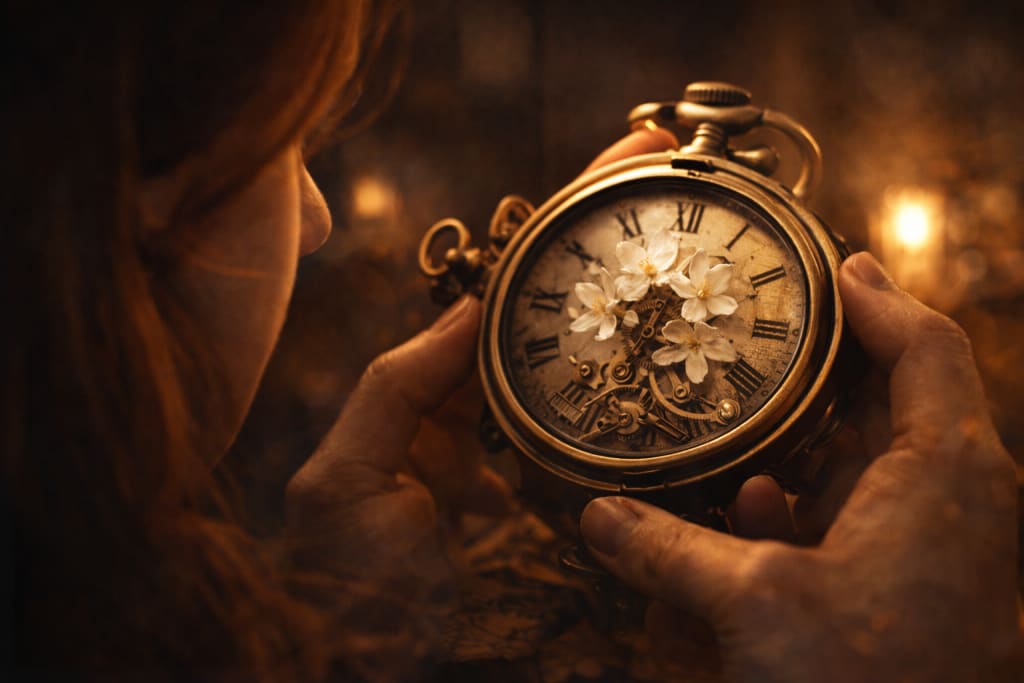
And there—tucked into the hollow like a private tongue—was a flower.
Not pressed flat. Not crushed to dust.
Dried, yes, but intact. Stubborn.
Jasmine.
Lina stared.
For a moment the studio’s controlled air seemed to change, as if it remembered a different climate—summer, street noise, warmth that didn’t ask permission. A memory she wasn’t sure belonged to her.
She lifted the jasmine with tweezers and set it on acid-free paper.
Beneath it lay a folded slip of thin, aged parchment.
Her pulse tightened.
She unfolded it carefully.
Ink flowed across the page in elegant Persian script—beautiful, confident, each letter leaning into the next as if the words couldn’t bear separation. It looked like handwriting that expected to be remembered.
Lina could read some Persian.
Enough to recognise poetry.
Enough to feel ashamed of what she’d forgotten.
Her eyes moved along the lines, catching fragments—night, promise, sea—and then stopped.
In the middle of the Persian text, one sentence stood in English, written in darker ink, like a hook thrown into the future:
If they ask, tell them the sea swallowed me.
Lina’s throat went tight.
She turned the paper.
No date. No signature.
Only two initials at the bottom—printed with deliberate restraint:
K. M.
The letters looked like a door.
Behind her, Marta’s cart squeaked faintly.
Lina breathed in.
Breathed out.
Then she did what she always did when she didn’t want to be alone with a thought that might change her life.
“Marta,” she said softly, “can you look at something?”
Marta leaned in, read the English line, raised an eyebrow. “That is… dramatic.”
“It doesn’t feel like poetry,” Lina whispered.
Marta’s gaze dropped to the initials. “K. M.”
A name surfaced in Lina’s mind—an architect from a meeting last month, a man who spoke like calm was a weapon:
Kasra Mehr.
Coincidence was a lazy explanation.
Lina didn’t trust lazy explanations.
She slipped the letter into a protective sleeve and wrote a neutral tag, hands steady through sheer discipline:
Concealed item found: letter + dried jasmine. Language consult required.
But inside her, something had already shifted.
Not fear.
Not yet.
More like recognition.
As if the paper had spoken her name in a language she used to know.
Lina removed her gloves and reached for her phone.
About the Creator
Keep reading
More stories from writers in Fiction and other communities.
Belle of the Bayou
Bad move, cher. Not just the slip of her kitten heel on the rainy February cobblestones in the Fourth Ward. She got caught snooping. Detective Deleon clucked and strutted like a rooster in his rush to clear her from the scene, waving cigar smoke to and fro as he gesticulated amid the thick air of the speak easy. An experienced crime reporter, Marie knew better than to let the coppers catch her on the wrong side of the line, but curiosity had gotten the better of her.
By Maia Gadwall the metAlchemist3 days ago in Fiction
It's 2026. Songs Turning 10 This Year
In 2016, we saw the rise of short form videos and what would lead to the birth of TikTok. We cannot forget the Snapchat filters no matter how cringe worthy some of them might have been. It was also the year in which the hit series Stranger Things debuted.
By Jasmine Aguilar3 days ago in Beat
Boundless
A geographical map could take you there. To the places I've been, to the sights I've seen, to the landscapes I've climbed. But no compass could point you in the direction of my memories. To the experiences I've lived, to the happiness I've felt, to the wonder I've held so close to my heart.
By Alyssa Musso3 days ago in Writers


Comments
There are no comments for this story
Be the first to respond and start the conversation.