
ELEVEN
some goodbyes are performed before they're decided

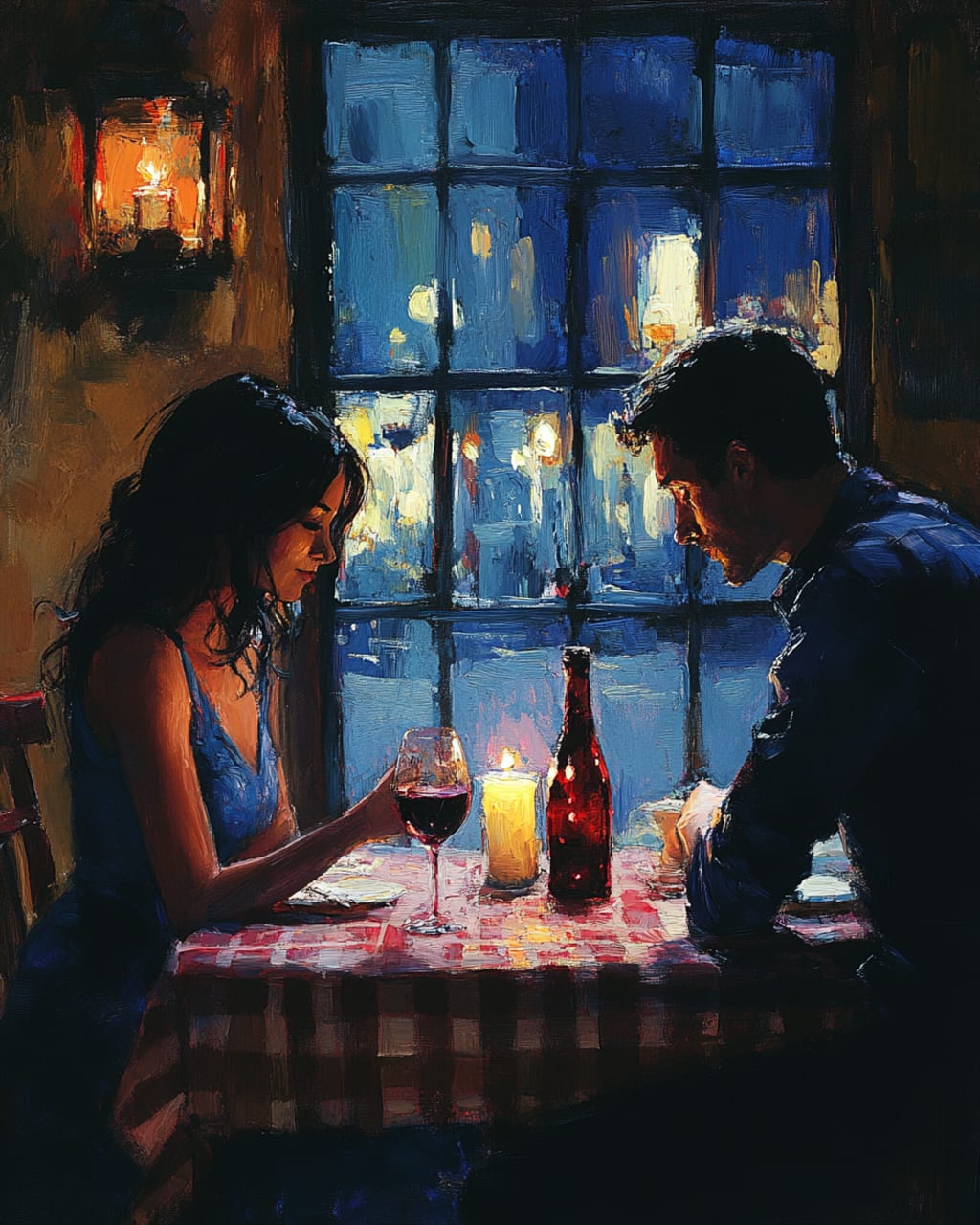
Marco made the reservation himself this year.
He'd done it two weeks out, which was not like him — Giulia usually called, usually remembered, usually tucked the confirmation into his coat pocket with a note in her handwriting that said Saturday, don't forget, dress nice. This year he'd opened the app in the parking lot of the hardware store and done it before he could think about whether he should. Same table. Eight o'clock. The one by the window where the candle in the wine bottle threw light across her face in a way he had photographed once, years ago, on a phone he no longer owned.
He'd told her about the reservation casually. She'd said oh, you remembered and smiled, and the smile was the right shape but something behind it moved too fast, the way an expression corrects itself.
He was learning to read her in a new way. The way you learn to read weather.
She wore the blue dress. He recognized it from the third anniversary, and the recognition was a small violence he absorbed without showing. He helped her with her coat at the door because he had always done that, and she thanked him the way she'd been thanking him for things lately — politely, like he was someone who'd held a door for her at a pharmacy.
They were seated. Marco ordered the wine without consulting the list.
Still the Barolo? the waiter asked.
Still the Barolo, Marco said, and across the table Giulia looked at her menu, and he watched her look at a menu she had memorized a decade ago, reading it the way a person reads when they need somewhere to put their eyes.
She was beautiful. That was the part that didn't fit anywhere, the part he couldn't architect into the story he'd been telling himself — that they had simply run out, that it was natural, that the distance between them had grown because distance was what happened over time. She was sitting across from him in candlelight in the blue dress and she was beautiful in a way that made the backs of his hands ache, and none of that changed anything, because he knew by now that you could love someone completely and still be invisible to them.
He had felt it first at the Brennan party in October. Giulia across the room, her head back laughing at something Danny Reyes had said, her hand on his arm, her whole body turned toward the conversation the way a plant turns toward light. He watched her be magnificent and thought: she saves that for other people now. He drove them home and she'd been quiet and pleasant and looked out the window the whole way, and later that night he'd lain awake and tried to remember the last time she'd reached for him. Not for something he could hand her. Just for him.
He couldn't.
She asked about the Caruso project. He told her. She listened with her chin in her hand, nodding, and he watched her do it and thought: she is good at this. She had always been good at looking present. He used to think it meant he had her full attention. Now he understood it was a kind of grace she performed, a way of being a good guest in a conversation she had already left.
The food came. They ate. He asked about her sister. She laughed at something he said — genuinely, he thought, or maybe he only thought it was genuine because he needed it to be — and for a few minutes the candle was warm between them and he forgot what the evening was for.
Then he remembered.
Near the end, without deciding to, he reached across the table and tucked a strand of hair behind her ear. The way he had done a thousand times. Her hair was the same as it had always been — dark, slightly escaped from wherever she'd pinned it — and his hand remembered the gesture before he'd given it permission, and he left his hand there a half-second too long, against the curve of her jaw, before he pulled it back.
He looked down at his wine.
Still, he thought. Even now. Still.
He paid the check. He helped her with her coat. They walked to the car in the cool air and he kept his hands in his pockets the whole way.
Giulia had almost not worn the blue dress.
She'd stood in front of the closet for a long time, the dress over her arm, and talked herself in and out of it twice before she put it on and stopped looking. It was the dress from the third anniversary, and wearing it was either brave or pathetic and she had decided not to decide which.
He'd made the reservation himself this year.
She was still thinking about that when he helped her with her coat at the door of Amici's — his hand at the back of her neck for just a moment, familiar as a key in a lock — and she thought: he made the reservation himself. Unprompted. Two weeks early. She'd found the confirmation on the counter and read it three times like it was evidence.
He made the reservation. He still made the reservation.
The waiter seated them at the window table without asking, and Marco ordered the Barolo without looking at the list, and Giulia looked at her menu even though she could have recited it in her sleep, because she needed a moment to put her face together.
He still knew. That was the thing she kept returning to. He still knew the table and the wine and the way she liked her coat taken at the door. You didn't keep knowing those things about someone you were finished with. You didn't maintain the details out of obligation. Details were love's fingerprints.
She'd been so sure, after the Brennan party. She'd watched him across the room — laughing with everyone, electric, the version of Marco that used to be her specific and private knowledge — and she'd understood it the way you understand things you've been refusing to — all at once, coldly, completely. She had become ordinary to him. Background. The person who was already home. He didn't perform for her anymore because he'd stopped thinking of her as someone worth performing for.
She'd gone quiet on the drive home and carried it the only way she knew. In the weeks after she'd been careful — pleasant, functional — because she would not let him see her grieve something while she was still inside it.
And then he'd said it. Sitting on the edge of the bed, his voice low and even. I don't think I feel the same as I used to. And she had said okay because the word was a small stone and she needed to put something between them before she fell.
She'd thought about that word every day since. The flatness of it. How he'd waited after, like he was expecting something from her. She hadn't known what he wanted her to say.
She asked about the Caruso project because she knew it was the thing on his mind. He talked and she watched him come alive a little — his hands moving, that small vertical line between his brows when he got to the complicated part — and she collected it like rain. Still. This. Still. He made her laugh and she let herself, and for a few minutes she forgot to be careful and just sat across from him in a restaurant they had eaten in for eleven years and thought: there you are.
Then his hand came across the table.
He tucked her hair back the way he always had — two fingers, the curve of her ear, unhurried — and she felt his hand rest a moment against her jaw, warm, and she looked down at her wine so he wouldn't see her face.
There you are, she thought again. I knew it. I knew it wasn't real.
She didn't know if she meant the goodbye or the distance.
He paid the check. They walked to the car. The night was cold and she thought about taking his arm and didn't, and the not-doing was the same as every other not-doing, and she was so tired of not-doing.
She sat in the passenger seat while he went around to the driver's side, and in those thirty seconds alone she looked at her hands in her lap and thought about the Brennan party. Marco across the room, lit up, laughing.
She had watched him and felt the distance like a physical thing.
But she hadn't watched where he looked, after.
She hadn't watched him cross the room and look for her.
The door opened. He got in. He started the car, and she looked at his profile in the dark — the jaw she knew, the hands on the wheel she knew — and the thought arrived quietly, the way the worst thoughts always did:
What if he was looking for me?
She opened her mouth.
She looked at the back of his hand on the gearshift. She knew that hand.
She looked out the window the whole way home.
About the Creator
Leslie L. Stevens Writer | Marfa, Texas
Her work blends personal essays, folklore-tinged storytelling, and emotional realism, often rooted in the West Texas landscape. She publishes fiction and nonfiction across Medium, Amazon KDP, and reader-driven platforms.
Keep reading
More stories from Leslie L. Stevens Writer | Marfa, Texas and writers in Fiction and other communities.
What the Dark Does First
The porch light had been out for three weeks. Delia had written it on the notepad by the coffeepot — bulb, porch — and then she'd written it again when the first note got buried under Ray's truck-payment reminder and the vet appointment for a dog they'd had to put down in October and a list of things she'd needed from town that she'd eventually just done without. The bulb stayed dark. She stopped writing it down.
By Leslie L. Stevens Writer | Marfa, Texasabout 20 hours ago in Fiction
Winterthorne
Winterthorne stood alone at the edge of the park. The beautiful snow that had surrounded him was all trampled now, from the feet of all of the children who had built him. He missed the sparkly clean snow blanket, but he was happy that so many children had come out to make him.
By Laura DePace5 days ago in Fiction
Stop Complaining
As a child, he was beaten and bullied. When he complained to his teachers and parents, he was told to stop moaning and grow up. The bullies were allowed to continue, so eventually he realised he would have to take things into his own hands, and a punch and a bully's broken nose was the action he took.
By Mike Singleton 💜 Mikeydred 3 days ago in Fiction


Comments
There are no comments for this story
Be the first to respond and start the conversation.