
Nothing in Stock
A surreal grocery-store story about hunger, politeness, and the rituals we mistake for reality

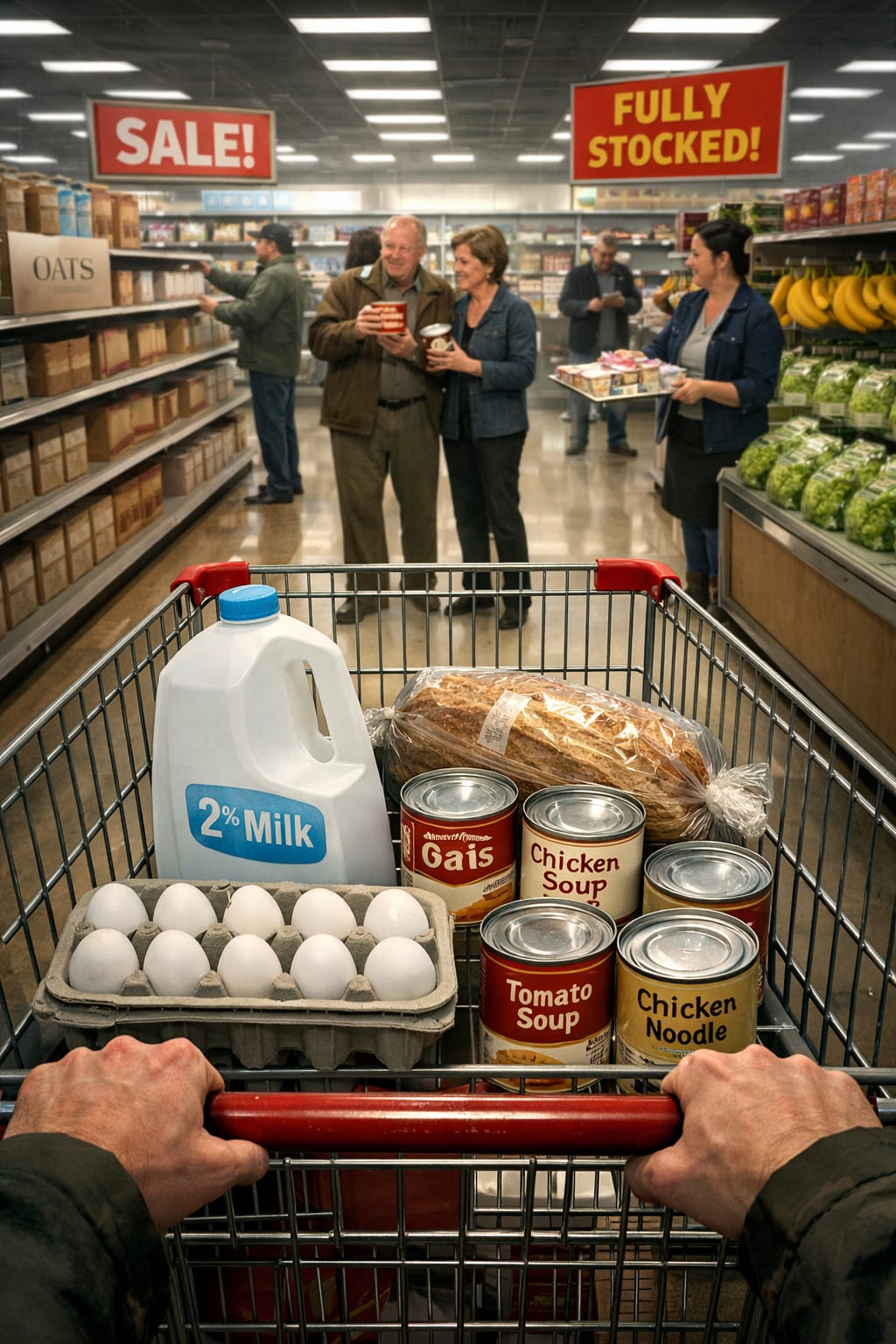
The automatic doors sighed open like they were tired of pretending.
A burst of refrigerated air hit my face—cold enough to promise milk, to swear on the gospel of dairy—but the first thing I saw was a tower of cartons labeled WHOLE, stacked in perfect family rows, each one feather-light. A woman in a beige coat lifted one, gave it a little shake, and smiled.
“They finally switched to the quiet kind,” she said to no one in particular.
A teenager in a green apron wheeled past with a dolly of oranges that were not oranges, just mesh bags cinched around nothing, each bag tagged 2.99 like a small insult.
I stood there with my list in my pocket and the familiar dull ache under my ribs, the one that had been there long enough to feel like part of my personality.
Bread. Eggs. Something warm. Anything that could become soup.
A greeter waved at me from behind a podium with a laminated smile.
“Welcome back!” she chirped, as if I’d left something here on purpose. “We’ve got fresh shipments today.”
Fresh shipments of what, I wondered, but the question stayed behind my teeth where it belonged. People moved around me with carts that rattled cheerfully, wheels squeaking like small laughter. Nobody hesitated at the towers of labeled nothing. Nobody looked confused at the emptiness wrapped in plastic.
Everyone behaved like the store was a store.
That was the first rule of Marketside: if you acted normal long enough, the world would reward you by continuing to make sense.
I took a cart because that’s what you do. You don’t walk into a grocery store empty-handed. Walking without a cart is an announcement. It tells everyone you’re either broke, lost, or thinking.
Thinking was considered rude.
The aisles were bright enough to make honesty difficult. Endcaps displayed seasonal promises: a pyramid of sparkling cider bottles that caught the light like celebrations, each bottle capped and labeled APPLE in a cursive font that tried very hard to be trustworthy. A man in gym shorts lifted one, inspected it, and nodded.
“They’re doing glass again,” he said to his partner. “So much better for the environment.”
She smiled in relief. “I was worried.”
They placed two bottles in their cart. The cart made no difference to the bottles. The bottles made no difference to the cart. Still, the transaction happened with the familiar gravity of something important.
I moved toward the produce section because I needed the lie to start with something green.
The mist machines hissed over piles of lettuce that looked almost real until you got close enough to notice the leaves weren’t leaves. They were layers of thin, glossy film shaped like romaine, each rib a manufactured suggestion. Someone had misted them anyway, water beading on plastic like tears that couldn’t sink in.
A woman in a yoga jacket picked up a head, peeled a corner like she was checking ripeness, and set it back.
“Nice crunch this week,” she said.
I touched one with my finger. Cold. Smooth. Wrong in the way a dream is wrong—too clean, too obedient. The label on the shelf read:
ROMAINE HEARTS — 3.49
There was no mention of “replica,” no asterisk, no apology.
I followed the aisle toward the bananas. The bananas were bright yellow sleeves, curved foam wrapped in a thin skin. A child tried to peel one. It did not peel. The child frowned. His father crouched beside him, patient, gentle, performing fatherhood the way everyone performed everything here.
“Remember what the sign says,” he whispered, pointing at a cheerful placard above the bananas.
PEELING IS OPTIONAL. ENJOY RESPONSIBLY.
The child nodded solemnly and placed the banana into the cart like a holy object.
My throat tightened, not from sadness exactly—more like my body couldn’t decide whether to laugh or cry, and chose nausea instead.
I pushed forward, trying to focus on the list. The list was normal. It was my handwriting. It was what a person writes when they intend to eat.
Bread. Eggs. Soup.
I turned into the bakery aisle, where the air should have been warm with yeast and sugar, but instead smelled like cardboard and cinnamon sprayed in the general direction of hope.
Loaves sat in clear plastic bags. Each loaf was perfectly shaped, each crust a painted gradient of golden-brown. I pressed one gently. It didn’t give.
A baker in a white hat—too tall, too crisp—stood behind a glass case arranging cupcakes topped with swirls of frosting that held their shape like architecture.
“Can I help you find something?” he asked.
He was smiling. He had flour on his forearms like a costume detail.
“I’m just looking,” I said.
“Everything’s baked fresh daily,” he said, as if reading from a script he’d been trained to love. “We’ve been getting great feedback on the sourdough.”
“That’s… great,” I managed.
He nodded, pleased to have provided information that kept the world intact.
I slid a loaf into my cart because my hands were doing what hands do when they’re trying not to betray you. When you’re hungry long enough, you start stocking up on symbols. You become superstitious with packaging.
Near the end of the aisle, a woman was asking an employee where the gluten-free section was.
“Right here,” the employee said brightly, gesturing to an entire shelf of empty bags labeled GLUTEN FREE in bold, proud letters.
“Oh perfect,” the woman said, deeply grateful. “I can really tell the difference.”
Her friend leaned in and whispered, “It’s so much lighter, right?”
They laughed like they were sharing a secret.
I turned away before my face could do something rude, like tell the truth.
The cereal aisle was louder. Families stood in front of boxes, debating brands. A teenage boy begged his mother for a neon-colored cereal whose mascot winked aggressively from the front.
“It’s got more marshmallows,” he insisted.
His mother sighed with the exhaustion of someone who’d been parenting against gravity.
“No,” she said, firm. “We’re trying to eat cleaner.”
She reached for a plain box that read OATS in minimalist font, the kind of design that signals virtue. She placed it into the cart, satisfied.
The boy rolled his eyes. “That’s basically cardboard.”
I wanted to tell him: Yes. That’s exactly what it is. But he already knew, didn’t he? His complaint wasn’t about reality. It was about the performance of preference. Even in famine, you have to pretend to have standards.
At the end of the cereal aisle, there was a promotional display:
TRY OUR NEW PROTEIN BARS!
Samples were arranged on a tray. A woman in a hairnet offered them with a smile that was almost desperate.
“Want to try?” she asked. “They’re amazing. Super filling.”
Super filling.
I looked at the tray. It was empty except for wrappers.
Still, people reached for the wrappers, thanked her, and pretended to chew.
“Mmm,” a man said, closing his eyes. “So good.”
The sample lady beamed as if she’d fed him with her own hands.
I gripped the cart handle harder. The plastic pressed into my palms like a warning.
Somewhere in the store, an announcement crackled overhead.
“Attention shoppers! We’re fully stocked in aisle twelve. Fully stocked in aisle twelve.”
Everyone behaved like that meant something.
A woman near me said, “Oh good,” and immediately started steering her cart toward aisle twelve, urgency in her posture like she’d just been given permission to survive.
I followed without deciding to. Hunger makes you obedient.
Aisle twelve was labeled PANTRY ESSENTIALS. The sign featured a smiling bowl of soup.
The shelves were lined with cans.
Each can was sealed, labeled, stacked with military precision. Chicken noodle. Tomato basil. Lentil. Split pea. The designs were beautiful—steam curls, herbs illustrated in delicate strokes, little wooden spoons that promised comfort.
My mouth watered so quickly it made me angry.
I reached for a can of tomato basil and lifted it.
It weighed nothing.
Nothing at all.
My fingers tightened around it anyway, because my brain had already begun its old bargaining ritual: Maybe this one. Maybe I’m wrong. Maybe it’s just… light.
The can made no sound when I shook it. Not even the whisper of liquid. Not even the rattle of solids. It was silence in metal.
A woman beside me selected three cans of chicken noodle and smiled at me like we were comrades.
“They finally fixed the sodium issue,” she said, approving. “Last week it was just too much.”
I stared at her. She stared back, calm, pleasant, waiting for me to do my part.
“Oh,” I said, because my body understood the stakes. “That’s… good.”
She nodded, content, and rolled away.
My throat burned with something that wasn’t tears yet.
An employee in a green apron was “fronting” the cans, pulling them to the edge of the shelf so the display looked abundant.
He noticed me holding my tomato basil like a question.
“Good choice,” he said. “That one’s popular.”
“Is it…,” I began, and then stopped because the sentence that wanted to come out was not allowed here.
Is it empty?
Is anything real?
Are we all going to die politely?
Instead I tried again. “Is it… new?”
He smiled with relief, grateful I’d chosen a question that could be answered without collapsing the building.
“Brand new shipment,” he said. “Came in this morning.”
“That’s great,” I said, because the script had room for that.
He continued arranging the cans, careful, reverent. He was building a display the way you build a shrine. His hands moved like he believed in something.
“People have been really stressed,” he added, still smiling. “So we’re focusing on keeping things… consistent.”
Consistent.
Yes. Consistent emptiness. Consistent lighting. Consistent denial.
The can in my hand suddenly felt heavy, not in weight, but in meaning. Like holding a prop in a play you never auditioned for.
I placed it in my cart anyway.
I moved on to the egg section—because maybe, somehow, eggs would be eggs.
The refrigerators hummed, glass doors gleaming. Rows of egg cartons sat inside, stacked like the promise of breakfast.
I opened a door.
Cold air spilled out. The smell was clean, almost sterile.
I pulled out a carton. It was light. Of course it was light.
Still, I opened it.
Inside were eggs.
Perfect, smooth, white eggs.
Relief hit me so hard my knees almost buckled.
My hands trembled as I reached to touch one. It felt… warm.
Warm eggs inside a refrigerated case.
I froze. My fingers hovered over the shell.
A woman nearby grabbed a carton without opening it and tossed it into her cart like she was late for something.
“You gotta get them while they’re fresh,” she called over her shoulder, smiling.
Fresh.
I touched the egg.
It wasn’t an egg.
It was plastic—no, worse than plastic. It was something that wanted to be an egg. A perfect imitation, engineered down to the faint chalky texture. The warmth came from somewhere else entirely, like it was being heated from within.
I closed the carton gently, like I didn’t want to startle it.
My stomach made a sound—small, animal, honest.
The sound was louder than I expected. A couple in front of the yogurt fridge paused, then continued talking about probiotics like nothing happened.
I looked down the aisle. I looked at the people. At the carts filled with packaging. At the polite conversations about flavor notes and sodium levels and “finally getting the good kind again.”
Nobody was panicking. Nobody was calling anyone. Nobody was yelling that there was nothing to eat.
They were shopping.
They were obeying the ritual of not naming it.
I pushed my cart forward with the slow care of someone carrying a bomb through a crowded room.
At the end of the aisle was the dairy section. Glass doors filled with milk jugs, cheese blocks, butter sticks.
I opened a door and took out a jug labeled 2%.
Feather-light.
The jug was empty, but a bead of condensation slid down its side like sweat.
A store employee appeared beside me like a thought I didn’t want.
“Need help?” she asked brightly. “We’re doing a promotion if you buy two.”
“Buy two empties,” I said before I could stop myself.
The words landed between us. Small. Sharp. A single pebble thrown into a lake of performance.
The employee blinked.
Just once.
Her smile didn’t falter, but something in her eyes tightened, like a camera lens focusing.
“Buy two items,” she corrected gently, as if I’d mispronounced something.
“Oh,” I said, throat dry. “Right. Sorry.”
She nodded, relieved. “No worries! It’s been a long week for everyone.”
For everyone.
She turned and walked away, her apron strings swinging like punctuation.
I stood there with my hand on the refrigerator door, the cold air spilling onto my face. For a moment, I considered screaming. Not words—just sound. A raw, animal sound that would force meaning into the room.
But screaming is also an announcement.
And announcements were rude.
I closed the door.
I moved my cart toward the checkout lanes because it was easier to continue than to decide what stopping would mean.
Checkout was a bright corridor of candy and tabloids. The candy bars were perfect. The gum packs were glossy. The magazines had headlines like 10 EASY DINNERS and BUDGET MEALS THAT FILL YOU UP, and I wanted to laugh so hard I might choke.
A cashier waved me forward. She looked young, tired, and expertly pleasant.
“Hi!” she said. “Did you find everything okay?”
It was the most absurd sentence I’d ever heard, and she delivered it like a prayer.
I looked at my cart: sourdough-shaped foam, cans of silent soup, plastic eggs warmed from within, two empty milk jugs because my hands had betrayed me while my mind was elsewhere.
“Yes,” I heard myself say. “Everything.”
“Perfect,” she replied, relieved.
She began scanning items, the beep-beep-beep of the register like a heartbeat pretending it meant life.
Beep. Bread.
Beep. Soup.
Beep. Eggs.
Beep. Milk.
Each beep said: This is real. This counts. This will feed you.
The screen lit up with totals. Numbers climbed like they were tracking substance.
Behind me, a man placed a case of bottled water onto the conveyor belt. The water bottles were clear, full—no, not full. They contained something that looked like water. A shimmer. A suggestion.
“You see they finally got the spring kind back?” he said cheerfully to no one.
“That’s great,” I said automatically, because I was part of the chorus now.
The cashier paused at my eggs.
“Oh,” she said, examining the carton with professional concern. “These are the warmed ones.”
I stared at her. “The… warmed ones?”
She smiled sympathetically. “Some people prefer them. It’s a comfort thing.”
A comfort thing.
She set them aside gently, like handling a live animal.
“I can swap them for chilled if you want,” she offered, still kind, still careful not to touch the truth.
I wanted to say, No. I want you to swap them for eggs. I wanted to say, I want you to tell me why everyone is acting like this is fine. I wanted to say, I’m hungry.
Instead, I shook my head.
“No, it’s fine,” I said. “Comfort is… good.”
Her smile brightened, grateful again that I’d chosen compliance.
She finished scanning. The total flashed on the screen.
I inserted my card because my body knew this part by heart. The machine asked if I wanted cash back. The question felt like a joke.
The receipt printed, long and detailed, listing every item like proof of abundance.
I took the bags—so light I could have carried them with one finger—and walked toward the exit.
The greeter smiled at me again. “Thank you!” she called. “Have a great meal!”
My mouth twitched, almost broke, but I held the expression in place.
“You too,” I said, because politeness is a trap you build for yourself one smile at a time.
Outside, the parking lot air was warmer, thick with exhaust and late afternoon sun. I loaded the bags into my trunk. They made no sound when they landed. Like putting pillows into a car. Like packing air for a trip.
I sat behind the steering wheel and stared at my hands.
My stomach growled again, louder this time. My body had run out of patience with the social contract.
Across the parking lot, a family was unloading groceries. The father lifted a case of “water.” The mother carried “produce.” Their kids skipped, swinging bags that contained nothing but the shape of belief.
Everyone moved like they’d done this a thousand times.
Maybe they had.
I turned the key in the ignition but didn’t drive.
I looked at the store doors—automatic, obedient, opening and closing like lungs.
For a moment I imagined walking back in, going to aisle twelve, and turning every can upside down. Opening cartons. Pulling off labels. Shouting the simplest sentence in the world.
There is nothing here.
But I could already hear the responses. Gentle, practiced, soothing.
It’s been a long week for everyone.
We’re focusing on keeping things consistent.
Peeling is optional. Enjoy responsibly.
Normal sentences. Perfectly packaged.
I rested my forehead against the steering wheel and let my breath come and go. In the quiet of my car, away from fluorescent lighting, the wrongness finally had room to speak.
And what it said was not dramatic.
It did not scream.
It simply insisted, with the calm certainty of hunger:
This is not food.
This is not a life.
This is a performance.
And I had been clapping along.
I lifted my head. The store glowed behind me like a staged sunrise. People kept entering. People kept exiting. Carts kept rolling. Receipts kept printing.
The world kept agreeing.
I drove home with a trunk full of emptiness and a receipt long enough to prove I’d done everything right.
About the Creator
Flower InBloom
I write from lived truth, where healing meets awareness and spirituality stays grounded in real life. These words are an offering, not instruction — a mirror for those returning to themselves.
— Flower InBloom
Keep reading
More stories from Flower InBloom and writers in Fiction and other communities.
Before the Sun Arrived
The first morning it happened, Mara thought it was a trick of the streetlamp. She woke before her alarm, before the garbage trucks, before the first commuter train dragged its metallic sigh across the edge of town. The sky outside her bedroom window was still a dark, uncommitted blue. The kind of blue that hasn’t decided whether to become morning.
By Flower InBloom9 days ago in Fiction
Veil of Subconscious Awakening
Images slide behind my eyelids like film cadres, bursting with meanings. In one moment, I’m speeding down the highway, making the speedometer swing wildly like a frantic pendulum. The next moment, I’m plunging from a falling plane, slowly crashing earthward. At home, I meet black cat’s green, googly eyes staring at me from the cavernous hollowness of the kitchen. When I turn for a moment, it disappears, and all I can see is a pair of blue suede shoes set up against the wall. I pick them up and put them on. When I glimpse at them again, they’ve become black as night, making me blink and flinch.
By Moon Desert7 days ago in Fiction




Comments (2)
Thank you💕💕💕 🤲🤲🤲🤲🤲🤲🤲🤲🥀🥀🥀🥀🥀🥀🥀🥀🥀🥀 BLESSINGS 🌹🌹🌹🌹🌹🌹🌹🌹🌹🌹🌹🌹🌹🌹🌹🌹🌹🌹🌹🌹🌹🌹🌹🌹
WOW Thank you Flower Of POWER HUGS ANGEL