
The City That Never Sleeps
In a city where night never comes, people carry on their lives as if nothing has changed. Fatigue, shadows, and exhausted bodies are now routine, yet no one dares to name the truth: the darkness has vanished forever.
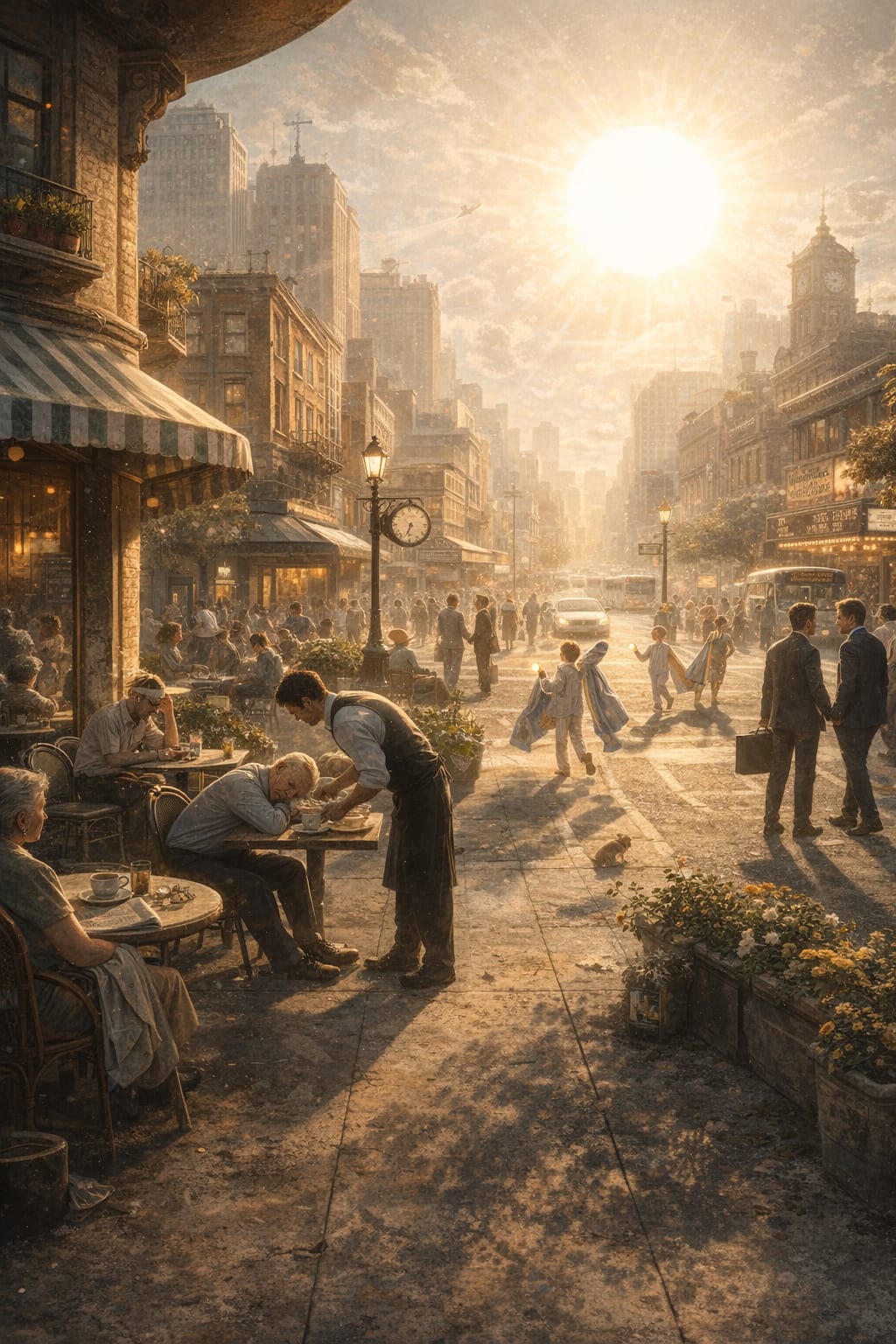
The sun hung high in the sky, bright and unyielding, its glare washing the streets in relentless light. People emerged from their homes squinting, rubbing their eyes, but no one complained. The world insisted on being normal, and so they followed. Children skipped down the sidewalks carrying blankets, pretending they were nightcaps, while their parents waved cheerfully and called out to neighbors who, like them, acted as though the sun’s permanence was nothing out of the ordinary.
In the corner café, Mrs. Lavelle stirred her coffee and watched her neighbor, Mr. Gruber, slump over his table, asleep mid-sip. She lifted her brow, then sipped quietly, neither startled nor concerned. The waiter approached, picked up Mr. Gruber’s cup, and set it aside, nodding politely as if he were merely moving a chair. No one spoke of his dozing; it was simply part of the day’s rhythm.
Outside, children played on a swing set, swinging back and forth with flashlights clutched tightly in their hands. The beams cut nothing but air; the playground was bathed in relentless sunlight. Parents stood at the edge, smiling as if they understood the game, exchanging nods as if to agree: yes, this is how the world should look, and yes, everything is fine.
In the office buildings, fluorescent lights hummed over rows of desks. Workers tapped at keyboards, shuffled papers, and made calls, their eyes heavy with fatigue, yet no one paused to question the absurdity of it all. A secretary yawned so widely that her jaw ached, yet she continued answering phones as if nothing had happened. A manager checked a clipboard with grim precision, noting deadlines that seemed pointless under a sky that would never darken. Routine was sacred; logic was irrelevant.
Even the city parks were strange with this perpetual day. People lounged under trees with books open, pretending the pages shaded them. A man stretched across a bench, sunglasses slipping down his nose, muttering softly to himself about the “evening breeze,” as if recalling a memory of a night that no longer existed. Others hid their faces under newspapers, trying to simulate a world where light ebbed away and shadows grew long.
At the market, a vendor arranged tomatoes with a meticulous hand. Customers haggled and smiled, gesturing at produce as though the sun’s endless glare were irrelevant. A woman picked up a peach, examined its warmth under the unbroken sunlight, and commented, “Lovely evening, isn’t it?” Her friend nodded, and they moved on, both aware yet silent about the absurd impossibility of evening.
Two colleagues met at a bus stop, the sun painting their long shadows across the pavement. “Another fine day,” one said.
“Absolutely normal,” the other replied. And yet, both felt the strange weight in the air, the tug of a world that had forgotten the night. They talked about meetings, about errands, about the trivialities of life, pretending that the light above them required no comment.
Evening activities carried on with an almost ritualized absurdity. Families gathered for dinner, candles untouched on the table, their flames unnecessary but ceremoniously placed. Television shows depicted twilight, while the audience, seated under the relentless sun, laughed at scenes that were supposed to be dark and secret. The contrast went unnoticed, acknowledged only in the corners of the mind where unease festered silently.
On the rooftops, a couple sipped tea, staring at the endless horizon. The sun was beginning to feel heavy, a constant gaze that pressed on their shoulders. “Do you ever miss… the dark?” one asked quietly.
“It’s night now,” the other answered, smiling, “in our hearts.” They drank, speaking only in metaphors, careful not to name what was undeniable.
The city’s street clocks had stopped moving hours ago. No one remarked on it. Shopkeepers continued opening and closing, commuters continued rushing, and street sweepers brushed the sidewalks with tireless diligence. It was as though time itself were performing a quiet conspiracy to keep everything orderly, everything sane.
At a small theater, a crowd gathered for a film billed as a nighttime thriller. The lights in the auditorium were dimmed, yet outside the sun shone with unwavering intensity through the cracks in the windows. The audience laughed at shadows, shivered at suspense, and whispered with fear, fully participating in the illusion. The characters on the screen crept through alleyways and moonlit gardens, while the viewers sat under the glare of perpetual day. The absurdity was collective, unquestioned, and complete.
In one apartment, a young man leaned against his window, watching the streets. Delivery trucks rolled by, people jogged, and someone’s radio blasted a late-night talk show. He rubbed his temples. Every instinct screamed that this was wrong, but he had learned the ways of the city: speak nothing, do nothing, and let the world pretend. He drew the blinds, letting the sunlight pour into the room anyway, as if by denying it he could alter nothing.
Some evenings, as they called them, the city’s fountains ran dry, or the flowers drooped under the relentless sun. Yet vendors sold fresh water and gardeners watered as if it were ordinary, everyday necessity. Conversations continued uninterrupted: “The hydrangeas look thirsty today,” one woman said.
“Yes, better give them a little extra,” replied her friend, neither acknowledging the absurdity of caring for plants under a sun that would never rest.
Children’s laughter echoed from rooftops where they held pretend sleepovers, dragging sleeping bags across terraces. Adults passed by, nodding politely, never questioning, never commenting, only maintaining the unspoken pact that the city would remain normal, and no one would name what had been lost.
One evening, or what they called evening, the streetlights blinked on automatically, as if obeying some obsolete programming. People walked under them, moving in their routines, never pausing. A cat wound between legs, meowed at nothing, and someone stooped to pet it, murmuring, “Another lovely night, isn’t it?” The cat purred. Everyone agreed.
In the hospital, a nurse walked the halls, checking monitors that showed normal readings despite patients’ complaints of exhaustion and disorientation. Doctors consulted charts, nodded gravely, and prescribed routines: sleep, hydration, meditation, all under the relentless light of day. Patients accepted these instructions unquestioningly, performing rituals that had become meaningless yet necessary.
At the train station, an old man read a newspaper from front to back, while his grandson sat beside him, flipping through the pages. They discussed politics and sports, as if the sun’s permanence had no relevance. A train arrived, its whistle shrill and unyielding in the unending daylight, and everyone boarded without comment. The routine made sense; the world’s absurdity was a background hum, ignored because acknowledging it would unravel everything.
A group of friends gathered for cards in the park. They played quietly, sipping lemonade that grew warm under the constant sun. One friend asked if it would ever get dark again. No one answered. Instead, another reshuffled the deck and said, “Let’s see who wins tonight.” And just like that, they fell into the agreed-upon normalcy, ignoring the truth that the night had vanished.
Across the city, a musician played a violin on a street corner, fingers moving with practiced ease. Passersby dropped coins, nodded, and smiled, though the melody seemed out of place under such unyielding light. It was a concert for a world that refused to admit it had lost something essential.
In quiet apartments, people lay in beds, pretending the room was dark. They drew curtains, covered eyes with pillows, whispered to themselves about sleep. Some counted sheep. Some stared at the ceiling, listening to imagined crickets. All acted as if night still existed, performing rituals that had become ceremony without meaning.
In cafés, parks, and offices, the unspoken understanding persisted: do not speak of the endless day. Do not question. Maintain routine. Smile, nod, pretend. And so the city continued, unbroken in its absurd perfection, a place where light reigned supreme, and the inhabitants lived, slept, and dreamed under a sun that never set, never gave rest, never allowed a shadow of doubt.
And somewhere, on the highest rooftop, a lone figure stood, looking over the city. The streets below bustled with ordinary lives, laughter, errands, and greetings. He exhaled slowly, feeling the heat on his face. Every instinct told him it was wrong. Every part of him longed for darkness. But the city, in its quiet consensus, refused to admit the truth. And he, too, joined the dance, adjusting his rhythm to the relentless sun, swallowing his questions, and stepping into the routines of a world that had forgotten how to sleep.
The city had become a ritual of light. And everyone agreed, silently, that nothing could be otherwise.
About the Creator
Keep reading
More stories from Lukáš Hrdlička and writers in Fiction and other communities.
Resident Evil Redefined Fear And Changed Survival Horror Forever
When discussing the origins of modern survival horror, one name inevitably rises above the rest: Resident Evil. Released during a time when action games dominated the market, it introduced a slower, more methodical experience that forced players to think, conserve, and most importantly, fear.
By Lukáš Hrdlička2 days ago in Gamers
Lightning Never Strikes Twice
The distant rumble, the sudden deluge, the crescendo of sound, the flash of light, the explosive energy — it never gets old. I became an amateur storm chaser about two years ago. My wife, Cindy suggested it. Sort of. She said, "Alex, you know this cancer is killing me. I've come to terms with that, but you're smothering me. Go join a band, write a book, or become a storm chaser, for all I care. I love you, but you need a hobby."
By Julie Lacksonen6 days ago in Fiction
The Nana Adventures: A Trip to the Dentist
Nana believed that even the smallest errands could become brave adventures. So when nine-year-old Eli learned he had a dentist appointment on Thursday afternoon, she clapped her hands softly and said, "Well then, Commander Eli, looks like it's time for Operation Sparkle Smile."
By Tabatha Nabors4 days ago in Fiction


Comments (1)
Zzzzzzzz 🚀 🚀💙💗🌹 LOVE🌹💛💗🚀 🚀