
Stephen Hawking’s Final Theory: The Universe May Not Be Alone
In his last scientific work, the legendary physicist suggested that our universe could be just one of countless universes in a vast cosmic multiverse.

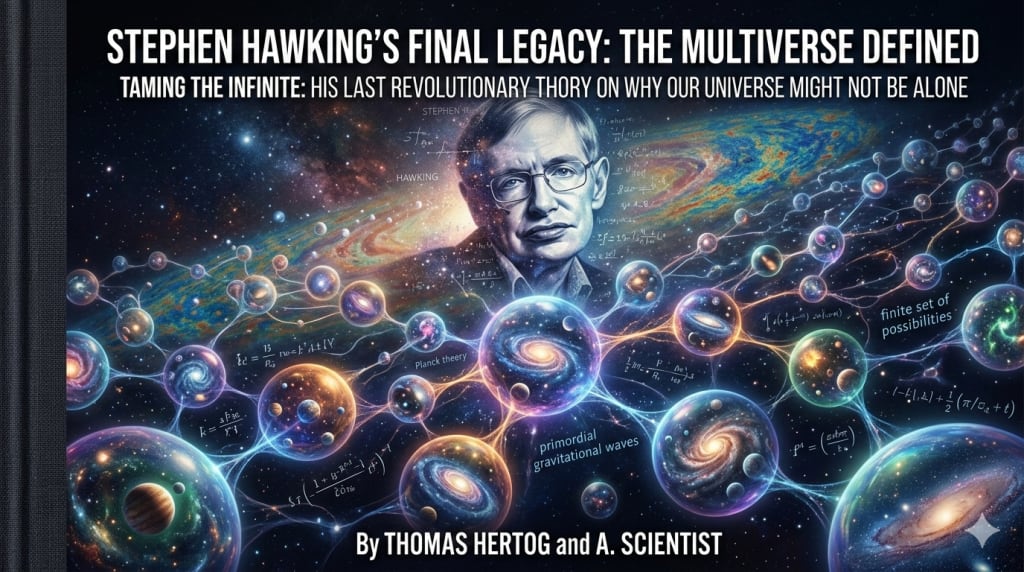
Few scientists in modern history have changed our understanding of the universe as profoundly as Stephen Hawking. Known for his groundbreaking research on black holes, cosmology, and the nature of space and time, Hawking spent decades exploring the deepest mysteries of the cosmos. Even near the end of his life, he continued to challenge humanity’s understanding of reality. One of his final scientific contributions suggested a breathtaking possibility: our universe may not be the only one.
Shortly before his death in 2018, Hawking worked with Belgian physicist Thomas Hertog on a paper that explored the concept of the multiverse. Their research was closely linked to the Big Bang, the event believed to have created our universe around 13.8 billion years ago. For decades, many cosmologists have proposed that the Big Bang might not have produced just one universe but possibly an infinite number of them.
This idea comes from a theory known as Cosmic Inflation, which describes a brief moment immediately after the Big Bang when the universe expanded at an extraordinary speed. According to many versions of this theory, inflation might not have happened only once. Instead, it could occur repeatedly in different regions of space, creating many separate universes—each with its own physical laws and properties.
These countless universes together form what scientists call the Multiverse.
However, earlier multiverse theories had a major problem. If inflation continued forever, it would produce an infinite number of universes with wildly different characteristics. In such a scenario, predicting anything about our own universe becomes extremely difficult. Hawking believed that science should aim for theories that can be tested and understood, not just ideas that produce endless possibilities.
To address this problem, Hawking and Hertog proposed a refined model of cosmic inflation. Their work suggested that while multiple universes may exist, the number of possible universes might actually be limited rather than infinite. In other words, the multiverse may be far more structured and orderly than previously thought.
Their theory uses principles from Quantum Mechanics, the branch of physics that describes the strange behavior of particles at the smallest scales. By applying quantum ideas to the early universe, Hawking and Hertog suggested that the process creating universes could be governed by predictable rules.
This means that the multiverse might not be a chaotic, endless collection of random universes. Instead, it could be a system where universes share similar properties and follow certain patterns. Our universe, therefore, might be just one member of a cosmic family.
One of the most exciting aspects of Hawking’s final theory is that it opens the door to possible observational tests. Traditionally, the multiverse has been criticized because it seemed impossible to prove. If other universes exist completely separate from ours, how could we ever detect them?
Hawking’s model suggests that traces of the early inflationary process might still be visible today in the Cosmic Microwave Background—the faint radiation left over from the Big Bang. By studying this ancient light in greater detail, scientists might find subtle patterns that reveal clues about the structure of the multiverse.
Future space missions and advanced telescopes could help search for these signatures. If such evidence were discovered, it would revolutionize our understanding of reality. Humanity would no longer see its universe as the entire cosmos but as just one bubble in a vast ocean of universes.
The implications of this idea are profound. Different universes could have different strengths of gravity, different types of particles, or even completely different physical laws. Some might be hostile to life, while others might contain galaxies, stars, and possibly even civilizations.
For Hawking, this possibility represented both scientific curiosity and philosophical wonder. Throughout his life, he asked questions about why the universe exists and why its laws appear finely tuned to allow stars, planets, and life to form. The multiverse offers one potential explanation: if countless universes exist, it is not surprising that at least one—ours—has the right conditions for life.
Although Hawking did not live to see his final theory fully explored, his work continues to inspire scientists around the world. His collaboration with Hertog remains an important step in bridging the gap between theoretical physics and observable cosmology.
In the end, Hawking’s last message to science may be one of humility and awe. The universe we see—the galaxies, stars, and planets stretching across billions of light-years—might be only a tiny piece of a much larger cosmic reality.
And if Hawking’s final idea proves correct, the greatest discovery of the future may be that our universe is not alone.
About the Creator
Irshad Abbasi
Ali ibn Abi Talib (RA) said 📚
“Knowledge is better than wealth, because knowledge protects you, while you have to protect wealth.
Keep reading
More stories from Irshad Abbasi and writers in Filthy and other communities.
The Sacred Canopy: How Bali Uses Umbrellas to Invite the Divine
In most parts of the world, an umbrella is a utilitarian object, tucked away in a bag or left by a door until the weather turns. But in the vibrant culture of Bali, Indonesia, the umbrella—locally known as the **Tedung**—is an essential spiritual tool. The word *Tedung* literally translates to "to guard" or "to shade," and its primary purpose is to provide a "shade of honor" for deities, ancestral spirits, and holy objects during religious processions.
By Irshad Abbasi 2 days ago in Filthy
Long Distance Relationships Work Best With Communication Patience And Emotional Effort
Long distance relationships (LDRs) are rare situations wherein dedication, trust, and deliberate effort have to be made. Although the physical distance may put a strain on intimacy and emotional connection, intimate relationships can be healthy and satisfying when the couples emphasize on communication, patience and emotional effort. Long distance relationships demand adjustments to new schedules, time-zone management and devising innovative methods of being emotionally attached. The three elements of concentration on understanding, empathy, and constant connection can give the couples a stronger relationship despite the distance between them. LDRs are not necessarily weaker, they just require more nurturing under your conscious.
By Robert Smitha day ago in Filthy
Early Breakups Help You Discover Self Worth And Emotional Strength
The first breakups are usually terrifying as they come at a time when feelings are still growing and relationships seem extremely significant. The first serious relationship of a person is often associated with a lot of hopes, expectations, and feelings. The abrupt loss can be confusing and painful when it comes to an end. Nevertheless, this experience turns out to be a great emotional awakening. It makes people fight against the sentiments that they might never have dealt with before, including rejection, disappointment, and vulnerability.
By Robert Smitha day ago in Filthy
📢 Raise Your Voice Thread: 03/05/2026
Our “Raise Your Voice Threads” are hosted most alternating Thursdays at 12PM ET to offer creators more avenues to uncover exceptional stories on Vocal. As we are continuously searching for fresh creators and inspiring stories, this thread provides an opportunity to exchange and discuss the stories that have moved and motivated us on Vocal.
By Raise Your Voice by Vocal3 days ago in Resources



Comments
There are no comments for this story
Be the first to respond and start the conversation.