

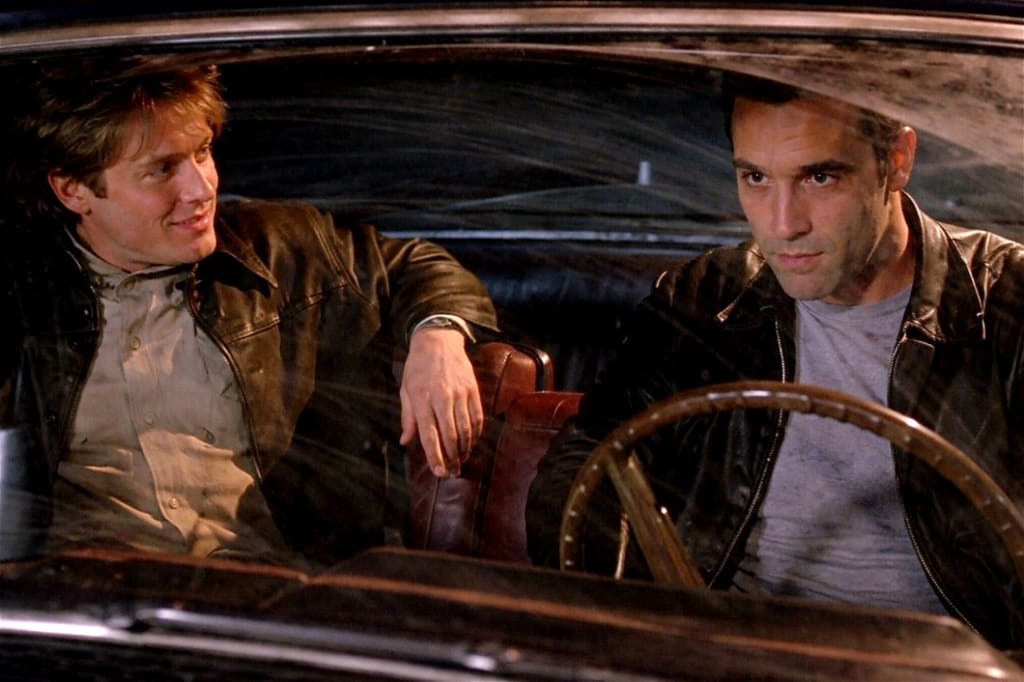
“Love in the dying moments of the Twentieth Century.” Tagline from Crash (1997)
Crash is a sleek, sexy, functional deep dive into the world of erotic obsession. It’s as sleek and streamlined as Rosanna Arquette’s delectable backside, wrapped lovingly in a leather mini above her fishnets, covered by cumbersome, torturous, old-fashioned leg braces. She’s a temptress and a cripple in one stroke—society will view this as polar opposites; fetishists of medical trauma will feel their anxiety rise in direct relation to a completely different form of stress.
James Spader plays James Ballard, a cinematic alter of author J.G. Ballard, the late, brilliant futurist whose avant-garde novel The Atrocity Exhibition—a surrealistic literary “neural landscape” of associative images—and Crash, both published in the early Seventies, are companion pieces, covering the same obsessions with sex, violence, stimulation, mass media sanitization of same, the eroticism of phony celebrity; the “car crash as a fertilizing agent.” That is less than a direct quote, but, hopefully, you understand.
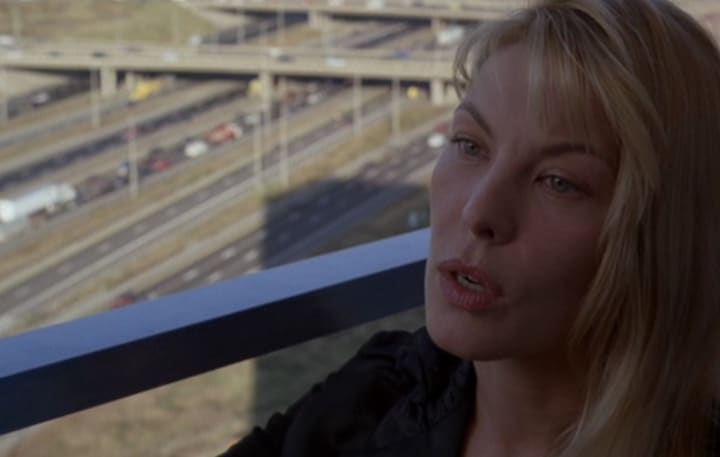
Ballard, a film producer, performs his first act in the film by emerging from behind the near-perfect derriere of a camera girl (Lucy Poon). His wife, Catherine (Deborah Kara-Unger), strips on the chassis of a small plane while being made love to by an anonymous personage that never makes another appearance. The sex is detached, functional; in Catherine’s case, she seems to be posing for a camera crew that isn’t there. She’s an extension of the design beauty of the airplane; here, nothing is real, as Hasan-i Sabbah observed.
Everything is permitted as a shockier high, or buzz, to break the zombified boredom of affluent, Godless (in the Nietzschean sense of the term) modern life. Ballard and wife seek fulfillment—spiritual, physical, psychological satiation—in endless sexual trysts and conquests. Below them, the ever-present crawl of traffic is like the constant energy or lifeblood of a concrete world—a colony civilization when viewed from the balcony of their posh apartment. Unger lifts her skirt, revealing herself slowly; her voice is detached, the manner a flat affect of narcissistic boredom. Ballard seems desperate, a man trapped in a hell of non-beingness or lack of actualization. Is the world around him sensation that simply plays or fails to excite his jaded nervous system?
Spader kills the husband of Helen Remington (Holly Hunter), a spunky, fashionable, and cynical woman who rips her blouse, revealing her breast to Spader immediately ere her husband goes crashing through Spader’s car window. Thus, the car crash is indeed the fertilizing agent of lust, of insectile passion, that is cold and seeks the next high of predatory sexual intensity.
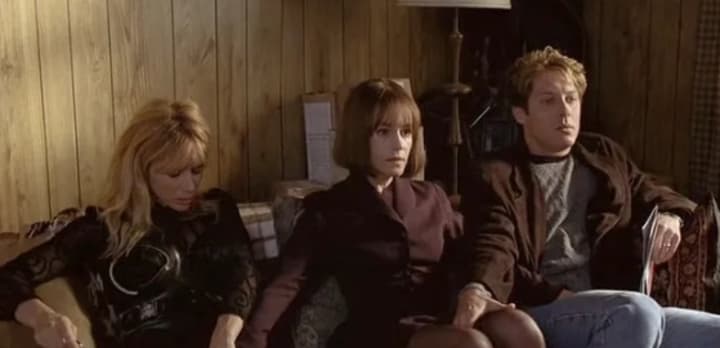
In hospital, Ballard and Remington become aware of Vaughn (E. Elias Koteas), a strange, scarred man who seems to be inordinately interested in the car crash wounds of Ballard and Remington. But does he work there? Is he a doctor? He seems to be an impostor.
Vaughn has a small cult of people who help him recreate, clandestinely it seems (law enforcement comes rolling up after a show), famous car crashes, such as the James Dean crash and Jayne Mansfield. His follower Colin Seagrave (Peter MacNeill) aids him in this. MacNeill’s girlfriend, Gabrielle, wears the fishnet, mini, and leg-braces combination. She looks as tired and bored, as detached as the rest, but with a certain sly sexuality that is prankish. Her leg wounds become fetishized later by Ballard.
The cult resides in Vaughn’s remote cottage, Remington and Ballard joining the haggard yet handsome Vaughn and his believers in watching car crash videos and films of crash-test dummies, Vaughn gloating over his collection of grisly accident photos. “Vaughn makes everything look like a crime,” Gabrielle says. Anyone who has ever viewed crime scene photos or similar images knows the strange grey area in which horror and titillation roost.
Crash the novel presents us with characters that are little more than cyphers—they are moved, like soap opera characters, through miniature story arcs and scenarios that test their mettle and display them in various staged poses and frames of reference. These are abandoned for fresh, more exciting territory in the soap opera, and in Crash; sexual situations and sexualization of car crash fatalities are thrust upon the reader (here, viewer), practiced, held up for consideration, and discarded before the characters move on. Vaughn speaks obliquely of the “benevolent psychopathology” of the late Twentieth that “beckons.” His concept of how technology “changes the human form,” as if it were an extension of human evolution, is “just the cover story [...] it sits on the surface and doesn’t frighten anyone.”
Crash Clip - The Reshaping of the Human Body
Vaughn is interested in the sexualization of trauma, pain, and death. Pure and simple. There is no higher purpose. How can there be with creatures that are detached cyphers, who can only break free from their seeming somnambulance by careening headlong into a Lincoln Convertible going eighty-five miles an hour?
How has the car changed us? How has it affected human evolution, our erotic landscape, what we fetishize, sexualize? Camus, Kennedy, Mansfield, Dean—icons of the bloody road to dreamlike Hollywood archetypes.
If we pull back, we see endless scenes, both in this cold, analytical, sterile, stillborn conceptual pornography, and in real life. We see our tiny vehicles out along the tarmac channels, the veins and arteries of the vast beast that we are. The planet is a drop in space, but it is a living organism, tiny silver microbes racing across the surface of a bit of rock which, fortunately, has yet to ever crash.
Yet.
Crash [1996] Official Trailer
Author's website
Author's YouTube
Read my book: Cult Films and Midnight Movies: From High Art to Low Trash Volume 1 by Tom Baker
Ebook
Read my book; Silent Scream! Nosferatu, The CAbinet of Dr. Caligari, Metropolis, and Edison's Frankenstein--Four Novels by C. Augustine
Ebook
Read my book: Theater of the Worm: Essays on Poe, Lovecraft, Bierce, and the Machinery of Dread by Tom Baker
About the Creator
Tom Baker
Author of Haunted Indianapolis, Indiana Ghost Folklore, Midwest Maniacs, Midwest UFOs and Beyond, Scary Urban Legends, 50 Famous Fables and Folk Tales, and Notorious Crimes of the Upper Midwest.: http://tombakerbooks.weebly.com
iOS & Core ML: Best Practices for Deploying ML Models in iOS App Development
Let’s face it, users expect their apps to be smart. They want apps that anticipate their needs, recommend content, and feel intuitive. That’s where machine learning in iOS comes in. From photo tagging to predictive text, ML is transforming how apps interact with users.
By Emily Cartera day ago in Futurism




Comments
There are no comments for this story
Be the first to respond and start the conversation.