
Hybrid Solar Wind Systems Market to Reach USD 2.3 Billion by 2034
Hybrid Solar Wind Systems Market: Growth Trends, Key Segments, and Global Outlook to 2034
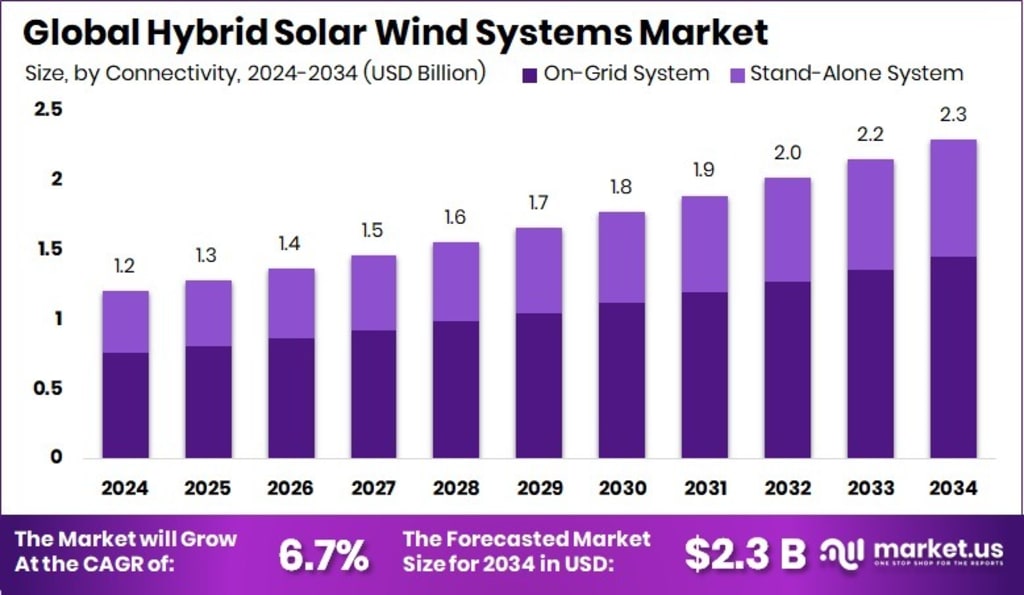
The Global Hybrid Solar Wind Systems Market, valued at USD 1.2 billion in 2024, is projected to reach USD 2.3 billion by 2034, growing at a CAGR of 6.7% from 2025 to 2034. The Asia Pacific region led the market in 2024, holding a 43.8% share worth approximately USD 0.5 billion.
Hybrid Solar Wind Systems combine solar photovoltaic (PV) panels and wind turbines to deliver reliable electricity. By leveraging the complementary nature of solar energy — generated primarily during the day — and wind energy — often stronger at night or under overcast conditions — these systems provide consistent power output, reducing dependence on diesel generators or grid electricity, particularly in remote and off-grid areas.
The market is expanding steadily, driven by the global push for sustainable, decentralized energy solutions. Rising electricity demand in rural areas, where grid expansion is costly or impractical, has increased the appeal of hybrid systems. Supportive government policies and clean energy targets across both developing and developed nations are further accelerating growth, alongside significant reductions in the cost of solar panels, wind turbines, and battery storage.
Stricter environmental regulations and climate change commitments are also key catalysts. As countries work to cut carbon emissions and transition away from fossil fuels, hybrid systems are becoming increasingly central to rural electrification, microgrid development, and disaster-resilient infrastructure. Notable recent investments include Tata Power securing USD 4.25 billion from the Asian Development Bank for clean energy projects, and ACME Renewtech receiving ₹19.88 billion in financing for a 300 MW wind-solar hybrid project.
Key Takeaways
- The Global Hybrid Solar Wind Systems Market is expected to grow from USD 1.2 billion in 2024 to USD 2.3 billion by 2034, at a CAGR of 6.7%.
- Solar Photovoltaic (PV) Panels held a 38.4% share of the component segment in 2024.
- On-Grid Systems dominated the connectivity segment with a 63.1% market share.
- The Commercial segment led end-use demand, capturing 44.2% of total installations.
- Asia Pacific remained the global leader, supported by strong renewable energy initiatives and a market value of USD 0.5 billion.
Market Segments
By Component
Solar PV Panels led the component segment in 2024 with a 38.4% share. Their dominance reflects high efficiency, falling costs, and seamless integration with wind turbines and storage systems. PV panels perform particularly well in sun-rich regions, providing consistent daytime power that complements the variability of wind energy. Their modular design suits applications ranging from small residential installations to large commercial off-grid projects, and ongoing advances in cell efficiency ensure solar PV remains central to hybrid energy infrastructure.
By Connectivity
On-grid systems held a 63.1% share of the connectivity segment in 2024, favored in urban and semi-urban areas with reliable grid infrastructure. These systems blend renewable generation with grid electricity, optimize energy usage, and allow excess power to be fed back to the grid — reducing costs and ensuring supply stability during peak demand or adverse weather. Net metering policies and government incentives have further accelerated their adoption across commercial, industrial, and residential sectors.
By End Use
The commercial sector accounted for 44.2% of hybrid solar wind installations in 2024. Offices, retail chains, hospitals, and data centers are increasingly turning to these systems for reliable, cost-effective power. Rising energy costs, carbon reduction pressures, available rooftop space, and favorable government incentives — including tax benefits — are all driving commercial adoption. As businesses continue to prioritize energy resilience and sustainability, the commercial sector is well positioned to maintain its market leadership.
Regional Analysis
Asia Pacific dominated the global market in 2024, commanding a 43.8% share valued at USD 0.5 billion. Growth is supported by favorable government policies, rural electrification programs, and strong demand for decentralized energy in countries such as India and China. The region's abundant solar and wind resources further boost hybrid system deployments in off-grid and semi-urban settings.
North America and Europe remain significant markets, with a focus on sustainability and grid modernization, though both trail Asia Pacific in overall scale. The Middle East, Africa, and Latin America are emerging as growth regions, with rising interest in hybrid solutions for remote communities, supported by pilot projects and international funding.
Top Use Cases
- Rural Electrification: Hybrid systems provide reliable power to remote villages without grid access, supporting homes, schools, and health clinics while reducing dependence on costly diesel generators.
- Commercial Applications: Businesses use hybrid systems to meet high energy demands, lower electricity costs, and achieve sustainability targets — particularly in grid-connected urban environments with net metering support.
- Agricultural Irrigation: Hybrid systems power irrigation infrastructure in rural areas, with solar panels generating daytime energy and wind turbines operating during windy nights, supporting consistent water supply for crops.
- Telecom Towers: In remote or grid-unstable locations, hybrid systems ensure uninterrupted connectivity for telecom infrastructure, with battery storage providing backup during generation gaps.
- Disaster-Resilient Infrastructure: Hybrid systems power emergency shelters, hospitals, and communications hubs in disaster-prone areas, maintaining critical operations during outages and extreme weather events.
Notable Company Developments
- Siemens Gamesa is advancing utility-scale hybrid projects, integrating its wind turbines with solar PV and storage to create more reliable, dispatchable power plants.
- UNITRON Energy Systems has developed inverters and charge controllers capable of intelligently managing multiple input sources — solar, wind, grid, and diesel — to ensure uninterrupted 24/7 power supply.
- Polar Power has expanded its "Polar Hybrid" series, combining solar panels and small wind turbines with patented DC generators and lithium-ion battery storage for highly reliable off-grid deployments in telecom and military applications.
- Windstream Energy Technologies continues to advance its SolarMill SE platform, an integrated unit that combines vertical-axis wind turbines with solar panels and smart energy management on a single structure.
- Alpha Devraj Renewable Energy is growing its hybrid EPC and consultancy portfolio, designing customized solar-wind solutions for industrial and agricultural clients.
Conclusion
Hybrid Solar Wind Systems are reshaping energy access by delivering reliable, sustainable power across a wide range of applications. As technology matures and costs continue to fall, these systems are set to play an increasingly important role in rural electrification, commercial sustainability, and resilient infrastructure — contributing to a cleaner, more decentralized global energy future.
About the Creator
Hayden Kulas
I am blogger, digital marketing pro since 5 years and writes for Market.us. Computer Engineer by profession. I love to find new ideas that improve websites' SEO. He enjoys sharing knowledge and information about many topics.
Keep reading
More stories from Hayden Kulas and writers in Futurism and other communities.
Flywheel Energy Storage Systems Market Worth USD 1003.3 Million by 2034 at 9.3% CAGR
Overview The Global Flywheel Energy Storage Systems (FESS) Market is on a robust growth trajectory, with projections indicating a rise from USD 412.3 million in 2024 to USD 1,003.3 million by 2034. This expansion represents a steady CAGR of 9.3% throughout the forecast period from 2025 to 2034. A significant catalyst for this growth is North America's USD 204.9 million investment in grid modernization, which has substantially accelerated the adoption of advanced FESS technologies.
By Hayden Kulasa day ago in Futurism
Apple Just Rewrote the Entry-Level Playbook: 4 Takeaways From This Week’s Surprise Releases
Apple just shattered its traditional release cadence with a "Cupertino Whirlwind"—a relentless three-day barrage of product announcements that has fundamentally disrupted the company’s hardware and pricing hierarchy. Starting with the budget-conscious iPhone 17E and culminating in the shock release of the MacBook Neo, this flurry was more than a series of updates; it was a calculated market offensive. With everything hitting shelves on March 11, the speed of these releases signals a pivotal shift in how Apple intends to capture the next generation of users.
By Mohammad Hamidabout 7 hours ago in Futurism
AI Agents Market to Hit USD 139.12 Billion By 2033
AI Agents Market Overview The global AI Agents Market is experiencing strong expansion as organizations adopt intelligent automation tools capable of performing complex tasks with minimal human intervention. The market is projected to reach USD 139.12 Billion by 2033, rising from USD 3.66 Billion in 2023, which reflects a significant CAGR of 43.88% during 2024 to 2033. In 2023, North America accounted for the leading regional position, capturing more than 37.92% of the total market share and generating approximately USD 1.3 Billion in revenue. The rapid adoption of artificial intelligence, increasing enterprise automation initiatives, and expansion of cloud computing infrastructure are contributing to this strong market growth.
By Roberto Crumabout 14 hours ago in Futurism
A Knight of the Seven Kingdoms Series Review (Season 1)
As one of the biggest properties in fantasy, A Song of Ice and Fire remains immensely popular with audiences. After reaching far into the past with House of the Dragon, a second spin-off was on the cards. A Knight of the Seven Kingdoms serves up a bite-sized slice of action and drama, but it still claims a spot among the best small-screen titles.
By Robert Cain7 days ago in Geeks


Comments
There are no comments for this story
Be the first to respond and start the conversation.