
I Let ChatGPT Build My Startup Prototype
Then Wondered If It Still Needed a Founder


How handing my idea to an AI in one weekend forced me to question what “building” a startup actually means
A weekend experiment with "I let ChatGPT build my startup prototype" turned into an identity crisis about what a founder is for in the age of AI.
I was sitting in front of a blank Figma file, cursor blinking like it was mocking me, when the thought slid in:
“What if I just…ask ChatGPT to do this?”
I’d been stuck for three weeks.
The startup idea was there. The rough user flow was there. The pressure of rent, savings, and my own ego was very much there.
What wasn’t there was an actual product.
So I did the thing you’re not supposed to admit out loud if you want to be taken seriously as a founder:
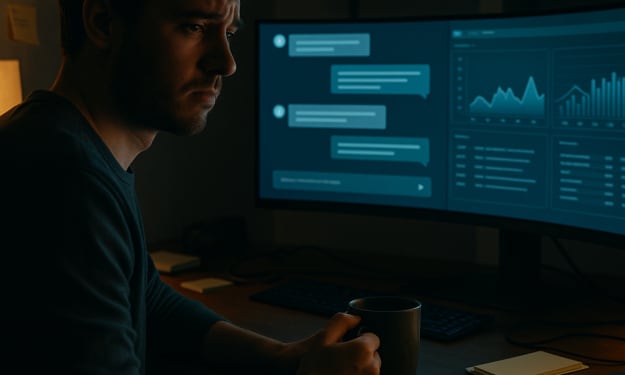
I opened a new browser tab, typed a prompt, and let an AI start building what I couldn’t get myself to start.
How I Let ChatGPT Build My Startup Prototype In One Weekend
The project was simple in theory: a lightweight web tool to help solo founders track customer interviews and turn them into product decisions.
Nothing earth-shattering.
Just the thing I wished I’d had in my last failed startup.
I’d been bouncing between:
Obsessing over the tech stack
Avoiding cold outreach
Redesigning the landing page headline 27 times
The usual productive-procrastination loop disguised as “daily founder habits.”
That Friday night, exhausted and low-key ashamed of my lack of progress, I wrote:
“You are a senior full-stack engineer and product designer. Help me design and build a working prototype for a web app that…“
And I poured the entire idea out: features, target users, rough user stories, the pain I was trying to solve.
Within seconds, ChatGPT shot back:
A suggested tech stack
A file structure
A basic data model
Wireframe descriptions for each screen
It was like watching someone clean your room in fast-forward.
By Saturday morning, I had:
A plain but functional landing page
A login/signup flow
A dashboard layout
A “new interview” form wired to a basic database
All generated, step-by-step, through conversational prompts.
I wasn’t copy-pasting blindly. I was debugging, tweaking, asking follow-ups.
But the heavy lifting—what I had mentally labeled “the hard part”—was being done by an AI that never got tired, never got distracted, and definitely never doom-scrolled Twitter instead of writing code.
The Surprising Moment When I Realized The Prototype Was…Good
On Sunday afternoon, I clicked through the app.
It worked.
I could:
Create a fake founder profile
Add mock customer interviews
Tag insights
See a simple summary of patterns
It wasn’t pretty, but it wasn’t embarrassing either.
If a stranger had told me, “Yeah, I hacked this together last week,” I would’ve believed them.
And that’s when a thought hit me so hard I physically leaned back in my chair:
“If ChatGPT can build this in a weekend with my prompts…do I even matter?”
I’d just experienced one of those hyper-productive, AI-assisted, “future of work” weekends that tech Twitter worships.
But under the productivity high was something else: a very real sense of being replaceable.
Why Did Letting AI Build My Prototype Feel Like a Threat To My Identity?
On paper, nothing had changed.
I still:
Came up with the idea
Defined the user
Decided which features mattered
Evaluated the output
ChatGPT wasn’t waking up with a knot in its stomach about runway or wondering if people would judge it for pivoting too early.
But emotionally, it felt like the part of founding I’d always used to justify my value—“I can build things”—was suddenly downgradeable to a weekend prompt-fest.
There’s this unspoken story a lot of us carry:
“I deserve to be a founder because I can do what most people can’t or won’t.”
Ship faster.
Work longer.
Figure out the tech.
So when an AI can take a messy idea and spit out a working MVP in 48 hours, that story wobbles.
If the “building” is automated, what’s left for the builder?
What Does A Founder Actually Do When AI Can Build The Product?
This is where I had to get painfully honest with myself.
I realized I’d been hiding behind the code and the UI.
“Working on the product” is socially acceptable procrastination. No one questions you when you say you’re fixing bugs. They do question you when you admit you’re scared to email your first 50 potential users.
When ChatGPT removed the excuse of “I’m still building,” the uncomfortable stuff floated to the surface:
Who am I building this for, really?
Do I actually want to talk to users every day?
Am I ready to be told my idea is mediocre?
If this somehow works, do I even want the life that comes with it?
AI didn’t just accelerate the code.
It accelerated the confrontation I’d been avoiding.
And it forced me to see what a founder’s job becomes once the act of building a prototype is no longer the bottleneck.
Here’s what I landed on, and it stung a little:
The job isn’t “type code no one else can type.”
It’s “own the questions no one else is willing to sit in.”
Why “I Let ChatGPT Build My Startup Prototype” Is Only Half The Story
A weird thing happened after that weekend.
Instead of feeling like a 10x founder, I felt like a product manager who’d found a really good intern.
A relentless, obedient, brilliant intern, sure.
But still an intern.
I had to:
Decide which ideas were worth testing
Choose between competing features
Push back when ChatGPT suggested something that felt off
Inject context it couldn’t possibly see
In other words: the direction was still on me.
It started to dawn on me that saying “I let ChatGPT build my startup prototype” is like saying “I let Figma design my app” or “I let Excel do my financial model.”
You didn’t.
You used a tool.
The difference is that this tool talks back like a teammate, so it tricks your brain into inflating its role and shrinking your own.
Why Do So Many AI-Built Startup Prototypes Still Fail?
Here’s the uncomfortable truth I ran into:
Most AI-built products don’t fail because the code is bad.
They fail because the questions are bad.
People also ask things like:
“Can AI start a business for me?”
“Can ChatGPT build an app and make money?”
“Will AI replace startup founders?”
Technically?
AI can generate:
A decent landing page
A functional web app
A basic marketing plan
Even rough investor outreach templates
What it can’t do is:
Sit in a Zoom call with a user and feel the awkward silence where the real problem lives
Notice that a customer’s voice tightens when they describe their boss, and realize that’s the friction to build around
Decide to ignore the obvious market because your gut knows a smaller niche is more honest, more specific, and more likely to care
Most startups die not from lack of code, but from lack of:
Reality-based conversations
Painful prioritization
Clear boundaries
Emotional stamina
AI doesn’t get tired or scared.
But it also doesn’t get obsessed.
Founders do.
That’s the difference.
The Secret Role Of The Founder In An AI-First Startup
If AI is the engine now, then the founder is no longer the mechanic hunched under the hood.
The founder becomes:
The editor of reality
You’re not there to produce more text, code, or mockups.
You’re there to choose what survives.
The holder of the “why”
AI can remix patterns.
It can’t decide which pain you care about enough to lose sleep over.
The buffer between hype and humans
You see the gap between “we can automate everything” and the actual, messy people who will have to live with what you ship.
The one who pays the emotional bill
AI doesn’t flinch when experiments fail.
You do.
And you’re the one who has to keep going anyway.
A founder in an AI-first era is less “builder of everything” and more “curator of what matters.”
That sounds less heroic on a pitch deck.
But it feels much closer to the truth.
Can You Still Call Yourself A Founder If AI Built Half Your Product?
I asked myself this more times than I want to admit.
It felt like cheating.
We’re still culturally attached to the myth of the solo mastermind in the garage, wrestling with code until dawn.
There’s status in hardship.
Suffering is weirdly part of the brand.
So when a machine does in hours what used to take weeks, a quiet shame creeps in:
“Did I earn this?”
But here’s what landed for me after a few weeks of sitting with it:
No user will ever ask, “Did you personally write this code?”
They will ask:
“Does this solve my problem?”
“Do I trust you with my data?”
“Will you still be here in six months?”
Investors and partners might care how you built it.
Users mostly care why you built it and whether you’ll stick around when things break.
Using AI doesn’t make you less of a founder.
Hiding behind AI so you never have to risk rejection—that’s what quietly kills the role you’re supposed to be playing.
The Biggest Mistake I Was Making With AI As A Founder
My mistake wasn’t that I used ChatGPT.
My mistake was that I secretly hoped it would spare me from the parts of founding that terrify me:
Asking for money
Asking for feedback
Admitting I don’t know what I’m doing
I wanted AI to replace the grind.
What I actually tried to do was outsource the vulnerability.
It doesn’t work.
No matter how advanced the tools get, someone still has to:
Put their name on the thing
Attach their reputation to decisions
Stand in front of real people and say, “I made this, what do you think?”
AI can write those emails for you.
It cannot feel what happens when you hit send.
That’s still your job.
How I Use ChatGPT Now Without Losing Myself As A Founder
After the weekend sprint and the identity hangover, I didn’t abandon AI.
I just changed how I relate to it.
Now I treat it like:
A fast, opinionated junior engineer
A brainstorming buddy that never runs out of ideas
A rough draft machine for landing pages, pitch decks, and outreach
But I keep a few rules so I don’t lose the plot:
I do the first messy thinking myself.
I sketch the idea on paper before I ask AI to tidy it.
If I can’t explain it simply to myself, I’m not ready for ChatGPT.
I never skip direct contact with users.
AI can help craft questions.
It cannot replace the moment someone sighs and tells you what’s actually wrong.
I rewrite anything important in my own words.
Investor email? Landing page hero copy?
AI gives me a starting point, but the final version has to sound like a human who cares, not a machine predicting the next best sentence.
I use AI to remove excuses, not responsibility.
If I catch myself thinking, “I don’t know how to do X,” I ask AI to teach me or generate a first pass.
But I don’t let that be the reason I avoid the work altogether.
So…Does A Startup Still Need A Founder?
After that weekend, I realized the question “Does this still need a founder?” is really two questions:
Can AI assemble the pieces of a product?
Yes. Shockingly well.
Better and faster than a lot of junior devs, honestly.
Can AI care enough to hold an idea through confusion, boredom, and fear?
Not even close.
The world we’re walking into will be full of AI-built prototypes, AI-generated pitch decks, AI-assisted “founders” who treat companies like side quests or content for their personal brand.
Most of those projects will fizzle out not because of tech, but because no one was truly willing to stand in the uncomfortable space between “this might work” and “this might be nothing.”
A startup still needs a founder for the same reason any risky, human-centered thing does:
Someone has to decide the thing matters enough to keep going when it makes no sense on paper.
ChatGPT built my prototype.
But when the browser tabs are closed, the hard questions are still mine.
And for better or worse, that’s the part that actually makes me a founder.
About the Creator
abualyaanart
I write thoughtful, experience-driven stories about technology, digital life, and how modern tools quietly shape the way we think, work, and live.
I believe good technology should support life
Abualyaanart
Keep reading
More stories from abualyaanart and writers in Futurism and other communities.
I Built a GPT Store Side Project and Realized the Agent Didn’t Need Me Anymore
A side project in the GPT Store was supposed to give me leverage. Instead, it gave me a weird identity crisis. I built what I thought was a simple AI agent, and somewhere between shipping version one and refreshing analytics at 2:17 a.m., I realized something I wasn’t ready for:
By abualyaanart2 days ago in Futurism
Australia Silicon Wafer Market: Domestic Solar Manufacturing, Local Supply Chain Expansion & Semiconductor Demand Growth
According to IMARC Group, the Australia silicon wafer market reached USD 263.8 Million in 2025 and is projected to grow to USD 370.1 Million by 2034, exhibiting a compound annual growth rate (CAGR) of 3.70% during 2026–2034. The steady expansion reflects Australia’s strategic push to strengthen domestic manufacturing capabilities, particularly in solar photovoltaic (PV) production and semiconductor supply chains. As the country accelerates renewable energy adoption and digital infrastructure development, silicon wafers are emerging as a critical input across multiple high-tech sectors in Australia. Establishment of local polysilicon production facilities and efforts to enhance supply chain sovereignty are further strengthening Australia silicon wafer market share within the global materials ecosystem.
By Kevin Cooper4 days ago in Futurism



Comments
There are no comments for this story
Be the first to respond and start the conversation.