
Microcontroller Market Trends: IoT Integration, Smart Devices & Forecast to 2034
How expanding IoT ecosystems, rising adoption of smart consumer devices, and advancements in embedded processing technologies are driving growth in the global microcontroller market.

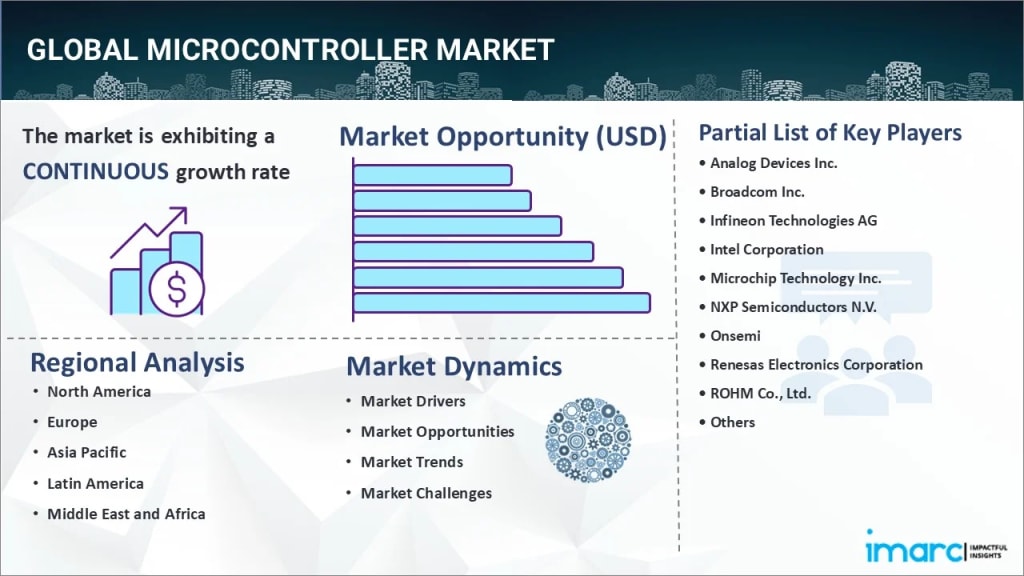
Rapid expansion of IoT connectivity, the electrification of vehicles, and the relentless push toward smarter industrial automation are fundamentally reshaping demand for microcontrollers worldwide. These tiny chips now sit at the heart of billions of devices — from factory robots and EV powertrains to medical monitors and smart home hubs. According to IMARC Group's latest data, the global microcontroller market size reached USD 28.7 Billion in 2024. Looking forward, IMARC Group expects the market to reach USD 58.3 Billion by 2033, exhibiting a growth rate (CAGR) of 7.55% during 2025-2033. Asia Pacific currently dominates the market with the largest revenue share, fueled by high-volume electronics manufacturing hubs across China, Japan, South Korea, and Taiwan.
Microcontrollers — compact integrated circuits combining a processor, memory, and I/O peripherals on a single chip — have evolved from basic control components into sophisticated platforms capable of running real-time AI inference at the edge. The market spans segments including 8-bit, 16-bit, 32-bit, and 64-bit product types, architectures such as ARM, AVR, PIC, and 8051, embedded and external memory configurations, and applications across automotive, consumer electronics, industrial automation, and medical devices. With 32-bit microcontrollers already commanding over half the market and ARM-based architectures accounting for the dominant architecture share, manufacturers are racing to integrate advanced capabilities — edge AI, RISC-V cores, ultra-low power modes — into increasingly affordable chips.
Microcontroller Market Growth Drivers:
• Surging Adoption of IoT-Connected Devices
IoT is arguably the single biggest demand driver for microcontrollers right now, and the numbers tell a compelling story. Connected endpoints are on track to exceed 20 billion units globally by 2030, and every one of those devices needs an MCU at its core. Smart thermostats, industrial sensors, precision agriculture monitors, and wearable health trackers all rely on microcontrollers to read data, make decisions, and communicate results. Sectors from healthcare to logistics are deploying connected infrastructure at scale, and this wave shows no sign of cresting anytime soon.
• Automotive Electrification and ADAS Expansion
The shift toward electric and autonomous vehicles is dramatically increasing the number of microcontrollers packed into every car. Modern EVs can contain over 100 MCUs managing everything from battery management and motor control to advanced driver-assistance systems (ADAS). The automotive segment already accounts for roughly 30% of global MCU revenue, and that share is climbing fast. Regulatory mandates for functional safety across Europe and North America are pushing OEMs to qualify more MCUs per vehicle. Infineon, which holds around 23% of the global market, saw its automotive MCU revenue reach USD 13 billion by 2030 in analyst projections.
• Industry 4.0 and Smart Manufacturing Rollout
Factories worldwide are embracing automation, predictive maintenance, and real-time process control — all of which require embedded intelligence at the machine level. Microcontrollers are the enabling technology for this industrial transformation, managing PLCs, motor drives, and sensor fusion systems. Infineon Technologies received German federal government funding approval for a new Smart Power Fab in Dresden, with over EUR 5 billion being invested to serve growing demand from industrial, automotive, and renewable-energy sectors — a clear signal that governments see semiconductor capacity as strategic infrastructure critical to the Industry 4.0 transition.
Microcontroller Market Trends:
• Edge AI Integration Becoming Mainstream
Artificial intelligence is moving off the cloud and onto the chip itself. Microcontroller vendors are embedding neural network accelerators and machine learning inference engines directly into MCU silicon, enabling real-time decision-making without a network connection. STMicroelectronics launched its Stellar P3E — the first automotive MCU with an embedded neural network accelerator — delivering inference efficiency up to 30 times better than traditional cores. Similarly, Innatera's neuromorphic Pulsar chip claims up to 500 times lower energy consumption versus conventional AI processors, pointing toward a future where intelligence is woven into billions of tiny, power-constrained devices.
• RISC-V Architecture Gaining Serious Ground
Open-architecture RISC-V is moving from academic curiosity to commercial reality in the MCU space. Because RISC-V eliminates royalty costs associated with ARM or MIPS licenses, it's particularly attractive for high-volume, cost-sensitive applications. Infineon Technologies announced plans to introduce an automotive MCU family based on RISC-V under its AURIX brand, and demonstrated a RISC-V virtual prototype kit at Embedded World 2025 — a clear statement of commercial intent. Industry data shows RISC-V-based MCU solutions growing at roughly 15% annually, and as ecosystem tooling matures, adoption is expected to accelerate across industrial and consumer segments.
• Miniaturization and Ultra-Low-Power Design Leadership
As wearable health monitors, implantable sensors, and sub-compact IoT nodes proliferate, the pressure to shrink chip footprints and slash power budgets has never been greater. Texas Instruments unveiled a new MCU that is 38% smaller than any previous offering in its class, specifically targeting medical wearables and personal electronics. Renesas responded with its RA4L1 group — 14 new ultra-low-power MCUs built around an 80-MHz Arm Cortex-M33 core — designed for water meters, smart locks, and IoT sensors where battery replacement is impractical. These launches signal that competitive differentiation increasingly hinges on power efficiency, not just raw processing performance.
Recent News and Developments in Microcontroller Market
• February 2026:
STMicroelectronics unveiled the Stellar P3E, becoming the first company to bring a production-intent automotive microcontroller with an embedded neural network accelerator to market. With 500 MHz Arm Cortex-R52+ cores and AI inference efficiency up to 30 times beyond traditional MCU architectures, the chip targets X-in-1 Electronic Control Units, predictive maintenance, and always-on edge AI in hybrid and electric vehicles. Start of production is planned for Q4 2026.
• March 2025:
Texas Instruments launched the world's smallest microcontroller — 38% smaller than any previous smallest offering — targeting compact medical wearables and personal electronics. The new chip broadens TI's MSPM0 portfolio, which focuses on improving sensing and control in embedded systems while simultaneously reducing cost and design complexity for engineers building space-constrained products.
• March 2025:
Infineon Technologies announced it would become the first semiconductor company to introduce an automotive microcontroller family based on the open RISC-V instruction set architecture, integrated into its established AURIX brand. The company demonstrated a RISC-V virtual prototype starter kit at Embedded World 2025, enabling partners to begin pre-silicon software development — a significant step in accelerating the ecosystem around royalty-free, open-standard automotive MCU designs.
• August 2025:
Microchip Technology advanced its U.S. operations by releasing next-generation 32-bit microcontrollers optimized specifically for consumer electronics and edge computing applications, with a strong emphasis on low-power efficiency for smart devices. The launch reinforces Microchip's strategy of addressing the growing overlap between consumer-grade performance expectations and industrial-grade reliability requirements in edge deployments.
Note: If you require specific details, data, or insights that are not currently included in the scope of this report, we are happy to accommodate your request. As part of our customization service, we will gather and provide the additional information you need, tailored to your specific requirements. Please let us know your exact needs, and we will ensure the report is updated accordingly to meet your expectations.
About the Creator
Suhaira Yusuf
I specialize in Consumer Insights, focusing on transforming detailed market data into strategic business solutions that accelerate growth and improve customer engagement.
Keep reading
More stories from Suhaira Yusuf and writers in Futurism and other communities.
Video Conferencing Market Trends: Remote Work Adoption, AI Features & Forecast to 2034
Growing demand for remote and hybrid work, the rapid spread of high-speed internet, and the push by organizations to cut travel costs are fueling strong momentum in the video conferencing space. According to IMARC Group's latest data, the global video conferencing market size was valued at USD 13.8 Billion in 2025. Looking forward, IMARC Group estimates the market to reach USD 31.4 Billion by 2034, exhibiting a CAGR of 9.60% from 2026-2034. North America currently dominates the market, holding a market share of over 39.8% in 2025.
By Suhaira Yusufabout 7 hours ago in Futurism
Apple Just Rewrote the Entry-Level Playbook: 4 Takeaways From This Week’s Surprise Releases
Apple just shattered its traditional release cadence with a "Cupertino Whirlwind"—a relentless three-day barrage of product announcements that has fundamentally disrupted the company’s hardware and pricing hierarchy. Starting with the budget-conscious iPhone 17E and culminating in the shock release of the MacBook Neo, this flurry was more than a series of updates; it was a calculated market offensive. With everything hitting shelves on March 11, the speed of these releases signals a pivotal shift in how Apple intends to capture the next generation of users.
By Mohammad Hamid5 days ago in Futurism
Australia Deodorants Market: Premium Brands, Natural Formulations & E-commerce Growth
According to IMARC Group, the Australia deodorants market reached a value of USD 618.5 Million in 2025 and is projected to reach USD 848.9 Million by 2034, growing at a compound annual growth rate (CAGR) of 3.58% during 2026–2034. The market is expanding steadily as consumers increasingly prioritize personal hygiene, premium grooming products and environmentally conscious lifestyle choices. Rising demand for high-quality deodorants offering long-lasting freshness, skin-friendly ingredients and appealing fragrances is encouraging product innovation across the personal care industry. At the same time, growing awareness about sustainability and health-conscious lifestyles is driving interest in natural and organic deodorant formulations. In addition, the rapid expansion of e-commerce platforms and subscription-based personal care services is making deodorant products more accessible to consumers across Australia. As purchasing habits evolve and consumers seek personalized grooming solutions, the deodorants market continues to adapt through premium offerings, natural ingredients and digitally driven retail strategies.
By Kevin Cooperabout 11 hours ago in Futurism
Writing To Succeed
If you want to find something that will help readers find your writing, possibly expand your audience, and maybe even get you noticed for other things, then you’re not alone. But how can you get it done in a world full of want-to-be writers? Look less at what you’re writing now, and more at what other writers have used to boost their views and reads.
By Jason Ray Morton 4 days ago in Writers



Comments
There are no comments for this story
Be the first to respond and start the conversation.