
Smart Home Technology: What Life Looks Like When Your Home Can Actually Think
The rise of intelligent living spaces that support your wellbeing and adapt in real time to how you live

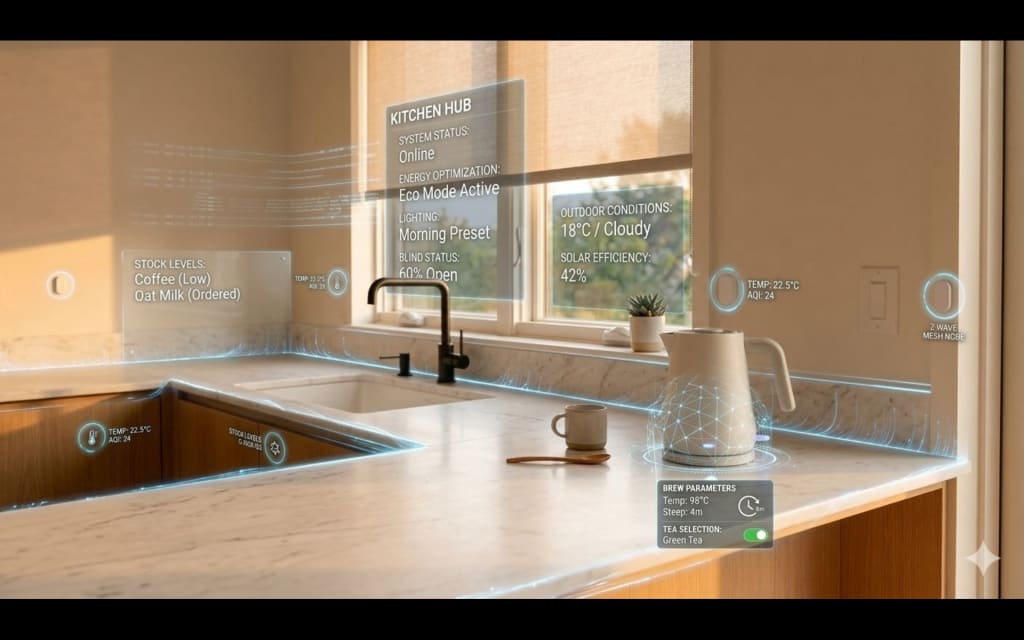
It is seven in the morning and the kitchen already knows. The blinds have lifted just enough to let in soft light without waking anyone who is still sleeping. The kettle began heating two minutes ago.
The temperature in the hallway shifted quietly overnight, nudging two degrees warmer before the alarm even sounded. Nobody pressed a button. Nobody asked.
This is what smart home technology looks like in 2026. Not a collection of gadgets you have to manage, but a living space that has genuinely started to understand you.
From Gadgets to a Genuinely Thinking Home
For a long time, the promise of the smart home felt slightly hollow. Clever speakers that could play music on request. Thermostats you could adjust from your phone. Useful, certainly. But not exactly intelligent.
What has changed is the arrival of home AI systems that actually learn. Rather than following pre-set schedules, the newest generation of smart home platforms builds a detailed picture of how a household actually lives. When people wake up. When rooms are used. When energy is needed and when it can be quietly saved. The home starts making decisions on its own, and getting better at them over time.
Homeowners have followed closely, noting how the shift from programmed smart homes to genuinely adaptive ones represents one of the most meaningful changes in how people relate to the spaces they live in.
The Home That Learns While You Sleep
Machine learning now sits at the heart of the best smart home systems. Sensors throughout the home feed data back to a central platform that builds a constantly updating model of household behaviour.
After a few weeks, the system knows which rooms are occupied on weekday mornings and which are empty. It knows that the living room lights are always dimmed at a certain point in the evening. It learns that one occupant tends to feel cold while another runs warm.
The result is a home that adjusts itself without being asked. Heating that finds the right balance before anyone notices it is off. Lighting that shifts with the natural rhythm of the day. Door locks that check themselves at night so nobody has to.
For families and households of all sizes, this kind of quiet attentiveness adds up to something genuinely valuable. Less friction in the morning. More comfort in the evening. A home that feels, somehow, like it is on your side.
Wellbeing Built Into the Walls
One of the most compelling directions in smart home development is the growing focus on health and wellbeing. Homes are beginning to monitor air quality in real time, adjusting ventilation automatically when carbon dioxide levels rise or humidity tips out of the ideal range. Some systems track sleep quality through non-intrusive sensors and use that data to fine-tune overnight temperature and light levels.
Morning routines are becoming genuinely personalised. Lighting that mimics sunrise to help the body wake naturally. Sound systems that introduce gentle audio cues calibrated to the household's schedule. Kitchen displays that offer hydration reminders or suggest a moment to step outside based on the weather and how the day has unfolded so far.
Energy That Thinks for Itself
Smart energy management has taken a significant leap forward. Homes connected to intelligent energy systems can now shift power usage automatically to take advantage of lower-cost, greener periods in the grid. Appliances run when it makes most sense. Battery storage systems built into the home hold energy when supply is plentiful and release it when demand peaks.
Solar panels paired with AI-managed home batteries are transforming how households relate to energy altogether. The home monitors its own consumption patterns, predicts upcoming needs based on the week ahead, and makes adjustments that a busy household would never have time to calculate manually.
Younger generations, particularly Gen Z homeowners and renters, are engaging with these systems enthusiastically. The combination of lower bills and a more sustainable footprint fits naturally with the values many of them bring to how they want to live.
Designing Spaces That Feel Human
Architects and interior designers are now building with smart technology in mind from the very beginning. Walls with integrated sensor arrays. Flooring that can detect falls and alert a nominated contact.
Windows that adjust their tint based on sunlight angle and room temperature. Kitchens where surfaces double as displays, showing recipes, schedules, and household updates without a separate screen in sight.
The design philosophy behind the best smart homes of 2026 is essentially invisible technology. The goal is not to fill a home with devices that demand attention. It is to build spaces where the technology disappears entirely into the background, making life feel effortless rather than managed.
That distinction matters. A home that constantly asks for input starts to feel like another inbox to maintain. A home that simply works feels like rest.
What Comes Next Is Already Being Built
The pace of development in smart home technology shows no signs of slowing. Predictive maintenance systems that detect when an appliance is beginning to wear before it breaks down. Refrigerators that track their own contents and update shopping lists automatically. Homes that communicate with the wider city around them, adjusting energy use in coordination with neighbourhood-level grids.
The homes being designed and built today are laying the groundwork for a relationship between people and their living spaces that will feel extraordinary within the next decade. Not because the technology will be more visible, but because it will be so deeply woven into everyday life that living any other way will seem strange.
The smartest thing about the smart home of 2026 might be that you barely notice it is there at all. It is simply home. Only better.
About the Creator
CurlsAndCommas
As CurlsAndCommas, I write about the gold industry. My dad spent 30 years in the mines. I grew up hearing stories at the dinner table. Now I write about the industry that raised me. All angles, sometimes tech, science, nature, fashion...
Keep reading
More stories from CurlsAndCommas and writers in Futurism and other communities.
5G Enterprise Market to hit USD 152.7 Billion By 2035
5G Enterprise Market Overview The Global 5G Enterprise Market is projected to reach approximately USD 152.7 Billion by 2035, rising from USD 7.3 Billion in 2025, reflecting a strong CAGR of 35.5% during the forecast period from 2026 to 2035.
By Roberto Crumabout 21 hours ago in Futurism
Digital Out-Of-Home Advertising Market to hit USD 60 Billion By 2033
The Global Digital Out-Of-Home (DOOH) Advertising Market is projected to reach approximately USD 60 Billion by 2033, increasing from USD 19 Billion in 2023, growing at a CAGR of 11.8% during the forecast period from 2024 to 2033. This significant growth is fueled by the rising demand for dynamic, interactive, and data-driven advertising solutions that engage consumers in high-traffic outdoor environments. As digital screens, interactive kiosks, and other forms of digital signage continue to replace traditional static billboards, DOOH advertising is becoming a dominant force in the advertising landscape.
By Roberto Crum2 days ago in Futurism


Comments