habitat
The natural home and environment for all things sci fi, including future homes and territories.
Euclid and the Precision Era of Dark Cosmology
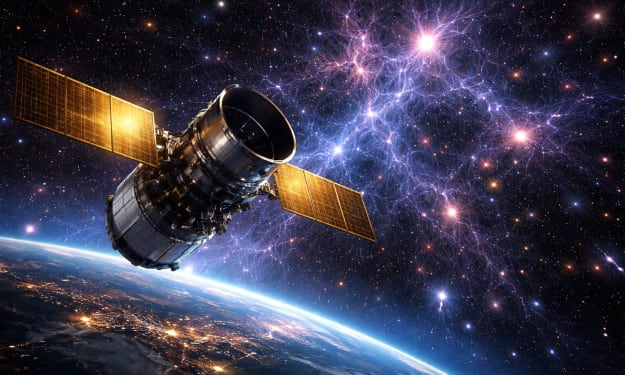
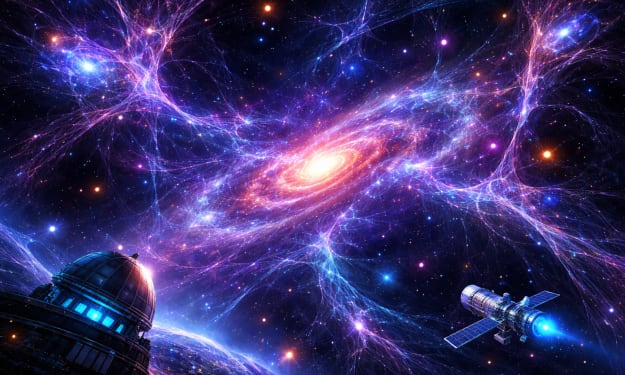
In 2023, the European Space Agency launched Euclid with a sharply defined objective: to map the geometry of the Universe and determine, with unprecedented precision, how dark matter and dark energy shape cosmic evolution. Rather than focusing on individual spectacular objects, Euclid operates as a large-scale cartographer. Its mission is statistical and structural. It surveys billions of galaxies across a third of the sky to reconstruct a three-dimensional map of the cosmic web stretching over 10 billion years of cosmic history.
By Holianyk Ihor3 days ago in Futurism
Launch and Scientific Impact of NASA’s Nancy Grace Roman Space Telescope (2026)
In 2026, NASA is preparing to launch one of the most ambitious space observatories of the decade: the Nancy Grace Roman Space Telescope. Designed to survey the universe at an unprecedented scale in near-infrared light, Roman is expected to reshape modern astrophysics by combining high resolution with an extraordinarily wide field of view. If the Hubble Space Telescope revealed the fine details of the cosmos, Roman will provide the panoramic context.
By Holianyk Ihor3 days ago in Futurism
Space Discoveries Powered by Machine Learning
Over the past decade, machine learning has evolved from a useful analytical tool into a central engine of discovery in astronomy. Modern observatories no longer produce manageable datasets measured in gigabytes—they generate petabytes of images, spectra, and time-series signals. Human analysis alone is no longer sufficient. In many areas of space research, algorithms now act as the first line of discovery.
By Holianyk Ihor4 days ago in Futurism
Exoplanets with Signs of Active Geology: Worlds That Refuse to Stay Still
For decades, exoplanets were little more than data points—subtle dips in starlight, faint radial velocity shifts, abstract entries in astronomical catalogs. Today, they are increasingly understood as dynamic worlds with atmospheres, climates, and in some cases, signs of active geology. For planetary science and astrobiology, that distinction is critical. A geologically active planet is not static. It has internal heat, material circulation, and potentially long-term environmental stability.
By Holianyk Ihor4 days ago in Futurism
How Fast Have Humans Really Accelerated Objects — and How Much Does Time Slow Down at Those Speeds?
Humanity has not yet built a starship that cruises at a significant fraction of the speed of light. However, we have accelerated certain objects to velocities so extreme that time itself measurably slows down. The answer to the question “What is the fastest object humans have ever accelerated?” depends on what we mean by “object.” For spacecraft, the numbers are impressive but not relativistic. For subatomic particles, the story becomes profoundly different.
By Holianyk Ihor10 days ago in Futurism
10 Mind-Blowing Space Stories School Never Told You
For many of us (especially if you grew up watching Star Trek), space truly feels like the final frontier. Sure, school taught us about planets, gravity, and maybe a little about rockets. But what we got was just a glimpse of the safe, simplified version.
By Areeba Umair12 days ago in Futurism
AI as a Reflective Surface
Much of the confusion surrounding artificial intelligence comes from treating it as an agent rather than a surface. When people speak about AI “doing the thinking,” “creating the ideas,” or “speaking for someone,” they are often projecting agency onto a system that does not possess intention, belief, or understanding. This projection obscures what is actually happening in many real-world uses. In those cases, AI is not acting as a source of meaning, but as a surface that reflects, redirects, and reshapes what is already present.
By Peter Thwing - Host of the FST Podcast15 days ago in Futurism
I Thought They Might Eat Me
I’ve never seen such a bunch of mean people in my life. I don’t even know if I should call them people. They looked like humans, but their eyes looked like cat, or reptile eyes. They wore these tight fitting black synthetic suits that made them all look fit and slim. I wondered if they were all built that way or if the suit made them look like that.
By Om Prakash John Gilmore16 days ago in Futurism
Exoplanets That Can Preserve Their Atmospheres for Billions of Years
When astronomers talk about potentially habitable worlds, the discussion often centers on surface temperature, liquid water, and orbital distance. Yet there is a more fundamental requirement that receives less public attention: atmospheric longevity. A planet may lie in the so-called habitable zone, but if it cannot retain its atmosphere over geological timescales, its prospects for long-term stability diminish dramatically.
By Holianyk Ihor16 days ago in Futurism
The Surprisingly High Abundance of Water Worlds
For years, water worlds were treated as an exotic possibility — scientifically plausible, but statistically rare. Planets dominated by deep global oceans, wrapped in thick atmospheres and layered with high-pressure ice, seemed like outliers in the cosmic inventory. The search for exoplanets focused primarily on “Earth-like” rocky worlds with thin atmospheres and moderate climates. However, as observational data have accumulated, a different picture has emerged. Water-rich planets may not be exceptional at all. They could be one of the most common planetary types in our galaxy.
By Holianyk Ihor16 days ago in Futurism
Unexpected Properties of Dark Matter Revealed in 2026
For decades, dark matter has remained one of the most persistent enigmas in modern astrophysics. Invisible to telescopes and undetectable through direct electromagnetic interaction, it nonetheless shapes the Universe on the largest scales. Galaxies rotate faster than their visible mass allows, galaxy clusters remain gravitationally bound, and the cosmic web itself depends on an unseen framework. Until recently, dark matter was largely treated as a silent, passive component—cold, inert, and interacting only through gravity. However, research published and analyzed in 2026 significantly challenged this simplified view.
By Holianyk Ihor17 days ago in Futurism
The Most Mysterious Signals from Deep Space Detected in 2026
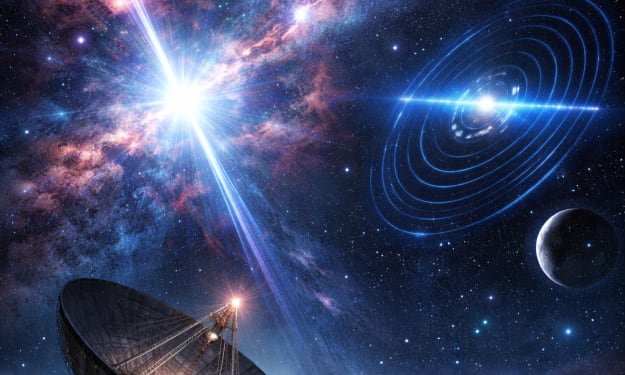
The year 2026 has reinforced a long-standing truth in astronomy: the deeper we listen to the Universe, the stranger it becomes. Modern telescopes no longer simply observe distant stars and galaxies — they intercept brief, powerful, and often inexplicable signals that arrive from billions of light-years away. Some last only milliseconds, others pulse with eerie regularity, and a few originate from epochs when the Universe itself was still young.
By Holianyk Ihor17 days ago in Futurism