
Vinyl Record Market Trends: Music Collectibles, Analog Revival & Forecast to 2034
How growing interest in retro music formats and collector culture is reviving global demand in the vinyl record market despite the dominance of digital streaming platforms.

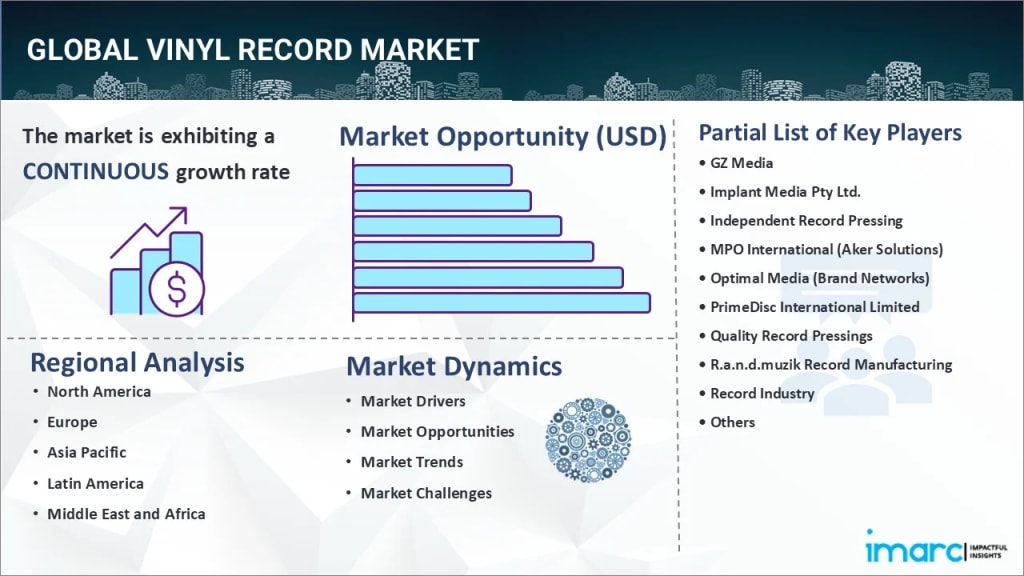
Vinyl is no longer a relic of the past — it's one of the most exciting growth stories in the global music industry. Fueled by nostalgia, the enduring appeal of analog sound, and a passionate collector community, the global vinyl record market is on a firm upward trajectory. According to IMARC Group's latest research, the global vinyl record market size reached USD 2.1 Billion in 2025. Looking ahead, IMARC Group expects the market to reach USD 3.6 Billion by 2034, exhibiting a CAGR of 6.50% during 2026-2034. Asia Pacific currently dominates the global market, driven by growing middle-class spending, flourishing indie music scenes, and strong collector culture across the region.
What was once dismissed as a niche hobby has turned into a full-scale market movement. In the US alone, vinyl unit sales grew 8.6% year-over-year to reach 47.9 million units, according to Luminate's latest data. Key Production, Europe's largest physical music manufacturing agency, reported a 50% surge in vinyl orders in the first half of 2025 compared to the same period the year before — and that growth is coming from independent artists, not just major labels. This is a market firing on all cylinders.
Vinyl Record Market Overview
The vinyl record market spans a broad range of product types, consumer demographics, and distribution channels. Based on product type, the market is split between LP/EP Vinyl Records and Single Vinyl Records — with singles currently holding the largest market share. By feature, the market covers Colored, Gatefold, and Picture variants, with colored vinyl dominating due to its visual appeal and limited-edition status. Gender-wise, men represent the largest segment, though female listenership is growing steadily. The 26–35 age group is the dominant consumer segment — millennials who straddle the digital and analog worlds and are driving the bulk of purchases.
Application-wise, the private segment leads, as consumers embrace vinyl as a personal, immersive listening ritual rather than a background format. On the distribution side, independent retailers hold the top spot — record stores remain cultural hubs that offer curation, expertise, and community that online platforms simply can't replicate. That said, online stores and e-commerce are increasingly important, with roughly 1 in 3 physical music purchases now happening online.
Vinyl Record Market Growth Drivers:
Nostalgia and Cultural Revival
Vinyl's comeback is rooted in something deeply human: the desire to reconnect with how music once felt. Older generations are rediscovering records they grew up with, while younger listeners — particularly Gen Z — are actively choosing vinyl as a deliberate counterpoint to the disposability of streaming. The Recording Industry Association of America (RIAA) reported 43.2 million LPs/EPs sold in the US, up from under a million in 2006. UK vinyl album sales notched their 17th consecutive year of growth in 2024. This isn't a trend — it's a structural shift in how people want to experience music.
Advancements in Technology and Manufacturing
Far from being stuck in the past, vinyl manufacturing has seen meaningful technological upgrades that are expanding its appeal. Modern pressing plants are producing 180-gram and 200-gram audiophile-grade records with better sound characteristics and durability. Sony Music Entertainment committed USD 25 million to expanding its vinyl manufacturing capacity. GZ Media, the world's largest vinyl producer, opened a new Nashville pressing plant targeting 85,000 records per day in its first year, aiming to reach 140 million pieces annually. These investments signal long-term confidence in vinyl as a premium, high-quality format rather than a passing novelty.
Growing Independent Music Scene and Collector Culture
Independent artists and labels are a major force behind vinyl's resurgence. Key Production's data shows that average vinyl order quantities per independent artist grew 41% in the first half of 2025, proving the format's pull goes well beyond blockbuster releases. Record Store Day generated over 1 million album sales in a single week — one of only 12 times in the past decade that milestone has been hit. Vinyl sales grew 19% in 2021, generating USD 467 million, and that momentum has only continued. The culture around vinyl — fairs, exclusive releases, limited pressings — keeps engagement high and buying habitual.
Vinyl Record Market Trends:
Premiumization and Special Edition Releases
Vinyl buyers aren't just buying music — they're buying objects. Colored vinyl now makes up around 22% of the market, with splatter, swirl, and picture disc variants commanding premium prices. About 31% of consumers specifically seek out limited-edition releases, while 38% say premium packaging is a key purchase driver. Artists and labels are capitalizing on this, bundling exclusive artwork, lyric inserts, and remastered audio to elevate the product experience. Rough Trade, the UK's iconic indie chain, reported vinyl sales up 24% year-on-year in Q3 2025, with premium and exclusive titles leading the way.
Eco-Friendly Production and Sustainable Packaging
Sustainability is becoming a real conversation in the vinyl industry. Traditionally made from polyvinyl chloride (PVC), pressing plants and labels are now exploring alternatives including metallic resins, recycled cardboard, and bio-based materials. Around 17% of new vinyl products are now using recycled or eco-certified packaging materials. Key Production, certified as a B Corp, has embedded sustainability practices throughout its supply chain. Consumer and regulatory pressure is turning eco-friendly production from a nice-to-have into a competitive differentiator — especially among younger buyers who care as much about how a record is made as how it sounds.
Omnichannel Retail and Digital Integration
Vinyl's retail footprint is expanding beyond the traditional record store. Online stores now account for roughly 28.5% of physical music sales, driven by e-commerce platforms and direct-to-consumer channels — the latter growing to represent over 10% of the market. Meanwhile, brands are integrating NFC chips and QR codes into records to unlock exclusive digital content, blending the analog and digital experience. Subscription vinyl services account for 24% of recurring purchases. Alliance Entertainment has taken this further, launching a certified premium vinyl collectibles platform with NFC-enabled authentication — a signal that the format is evolving into a full premium product ecosystem.
Recent News and Developments in the Vinyl Record Market
• June 2025: Key Production, Europe's largest physical music manufacturing agency, reported a 50% increase in vinyl manufacturing orders in the first five months of 2025 compared to the prior year period. Average order quantities per independent artist grew 41%, reflecting broadening demand beyond major labels.
• February 2026: Alliance Entertainment reported selling over 16.3 million vinyl records in calendar year 2025, a 5% increase in unit volume year-over-year. CEO Jeff Walker described the vinyl and CD businesses as 'extremely strong,' citing upcoming releases from major artists as key demand drivers. The company also launched Alliance Authentic, a premium certified vinyl collectibles platform with NFC authentication.
• 2025 (Full Year): US vinyl unit sales reached 47.9 million for the year, growing 8.6% year-over-year according to Luminate. More than 4 in 10 vinyl records were sold through independent record stores, underscoring the continued importance of indie retail in the vinyl ecosystem.
• Q3 2025: Rough Trade, the UK's leading independent record chain, posted its best-ever Q3 result, with vinyl sales up 24% year-on-year and footfall up 26%. The retailer attributed the strong performance to the Oasis reunion tour, growing Gen Z engagement in record shops, and a strategic focus on keeping vinyl accessible through competitive pricing.
• June 2023: GZ Media opened its third record pressing plant in Nashville, USA, targeting production of 85,000 records per day in its first year and an eventual annual capacity of 140 million units across its US operations. The expansion is a direct response to sustained global demand and long pressing lead times affecting independent labels.
Note: If you require specific details, data, or insights that are not currently included in the scope of this report, we are happy to accommodate your request. As part of our customization service, we will gather and provide the additional information you need, tailored to your specific requirements. Please let us know your exact needs, and we will ensure the report is updated accordingly to meet your expectations.
About the Creator
Suhaira Yusuf
I specialize in Consumer Insights, focusing on transforming detailed market data into strategic business solutions that accelerate growth and improve customer engagement.
Keep reading
More stories from Suhaira Yusuf and writers in Futurism and other communities.
Game-Based Learning Industry Trends: AR/VR Adoption, Mobile Learning & Forecast 2034
Global education sector is undergoing a massive shift as traditional rote learning is replaced by interactive, game-driven methodologies that prioritize engagement and skill retention. Once a niche tool for primary education, game-based learning has become a critical strategic asset for both K-12 institutions and corporate training programs worldwide. According to IMARC Group’s latest data, the global game-based learning market size reached USD 24.5 Billion in 2025. Looking forward, IMARC Group estimates the market to reach USD 88.6 Billion by 2034, exhibiting a CAGR of 14.59% during 2026-2034. North America currently dominates the market, supported by a highly developed digital infrastructure and the rapid adoption of advanced EdTech solutions in both schools and workplaces.
By Suhaira Yusufa day ago in Futurism
Jack Dorsey’s Block Cuts Nearly Half Its Workforce in Major AI Shift
Jack Dorsey’s financial technology company Block has eliminated more than 4,000 jobs — nearly half of its workforce — in what executives describe as a strategic shift toward artificial intelligence-driven operations.
By Behind the Tech7 days ago in Futurism
📢 Raise Your Voice Thread: 03/05/2026
Our “Raise Your Voice Threads” are hosted most alternating Thursdays at 12PM ET to offer creators more avenues to uncover exceptional stories on Vocal. As we are continuously searching for fresh creators and inspiring stories, this thread provides an opportunity to exchange and discuss the stories that have moved and motivated us on Vocal.
By Raise Your Voice by Vocalabout 21 hours ago in Resources




Comments
There are no comments for this story
Be the first to respond and start the conversation.