
How DevOps Culture Is Evolving Beyond Automation?
What began as a movement to bridge development and operations through automation scripts and deployment pipelines is now transforming into something broader and more strategic — a cultural reorientation around accountability, platform thinking, cognitive load reduction, security ownership, and organizational design in an era where software underpins nearly every business function.

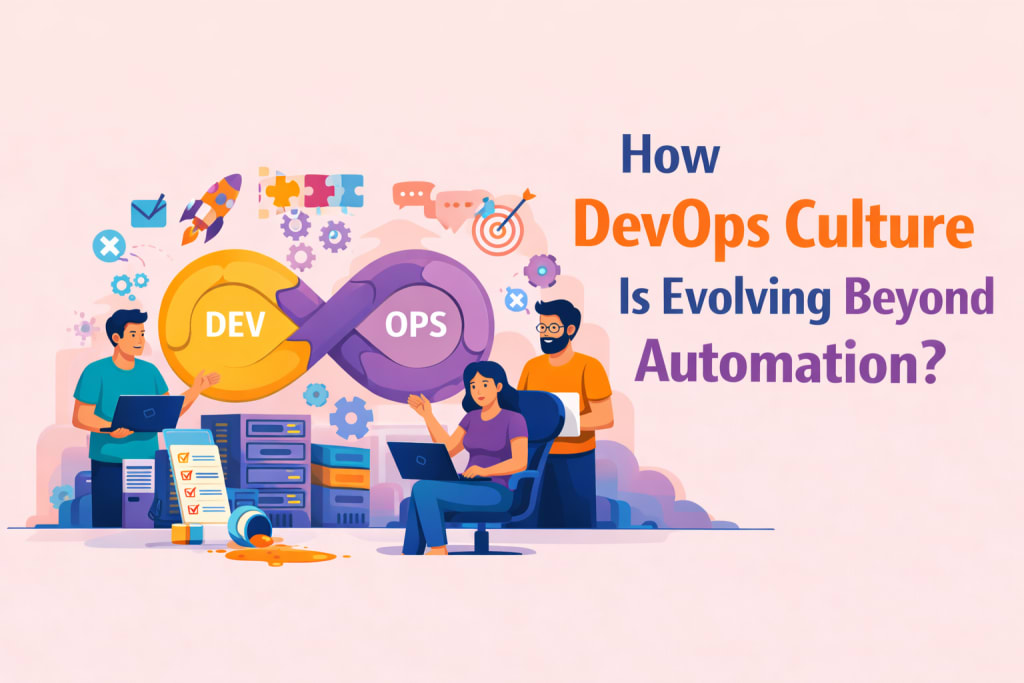
There was a time when “DevOps transformation” meant one thing: faster deployments.
Continuous integration. Continuous delivery. Automated testing. Infrastructure as code.
If release frequency increased and outage minutes decreased, leadership declared success.
In 2026, that definition feels narrow.
Automation remains important, but it is no longer the center of gravity. DevOps culture is shifting toward questions that are less about tooling and more about structure: Who owns reliability? How much cognitive load can teams sustain? Where should platform responsibilities sit? How does security integrate into daily workflows?
The evolution reflects the reality that software systems have grown more interconnected, more distributed, and more business-critical than they were when DevOps first entered mainstream conversation.
From Deployment Speed to System Resilience
Early DevOps adoption focused on eliminating bottlenecks between developers and operations teams. Automation pipelines reduced manual errors and accelerated release cycles.
The 2025 State of DevOps Report from Google Cloud found that elite-performing teams deploy code 127 times more frequently than low-performing teams and recover from incidents significantly faster. Those metrics once defined DevOps maturity.
Yet deployment speed alone does not ensure stability.
The same report indicates that high-performing organizations also invest heavily in reliability engineering, observability, and structured incident response processes.
The conversation has shifted from “How fast can we ship?” to “How resilient is the system we are shipping into?”
Reliability is no longer a byproduct of automation. It is a strategic priority.
Platform Engineering and the Internal Product Model
One of the most visible evolutions in DevOps culture is the rise of platform engineering.
Instead of each team independently configuring infrastructure, organizations increasingly build internal platforms — standardized environments that abstract infrastructure complexity behind reusable tools.
Gartner predicts that by 2027, more than 70% of enterprises will operate internal platform teams to provide curated developer experiences, up from less than 25% in 2022.
This shift reflects recognition that automation alone cannot solve scaling challenges. Without structured platforms, cognitive load increases as systems multiply.
Platform teams operate like product teams. They maintain roadmaps, gather internal feedback, and measure adoption.
DevOps becomes less about scripting deployments and more about designing developer ecosystems.
Cognitive Load and Sustainable Engineering
As microservices, containers, and distributed architectures proliferated, operational complexity increased.
A survey conducted by Atlassian in 2026 found that 61% of engineering teams report feeling overwhelmed by the number of tools required to maintain production systems.
Too many dashboards. Too many alerts. Too many integration points.
DevOps culture is responding by prioritizing cognitive load reduction. Standardization of workflows, consolidation of monitoring tools, and clearer ownership boundaries are replacing the earlier emphasis on tool proliferation.
Sustainable engineering practices now sit at the heart of DevOps maturity.
Burnout metrics increasingly influence architectural decisions.
Security as Shared Responsibility
Security was once treated as a separate function — often consulted late in the release cycle.
Modern DevOps culture incorporates security directly into pipelines.
The 2026 GitLab DevSecOps Survey reports that 74% of organizations now integrate security scanning into continuous integration workflows. Yet only 48% believe their teams possess sufficient security training.
Automation can detect vulnerabilities, but cultural alignment determines response speed.
Security ownership has expanded beyond specialists. Developers are expected to understand threat modeling, dependency management, and compliance frameworks.
DevOps evolves into DevSecOps not merely through tools, but through mindset shifts.
The Rise of Observability as Cultural Practice
As systems become distributed, understanding system behavior requires more than basic logging.
The observability market has expanded rapidly. IDC estimates that global spending on observability tools will exceed $4 billion by 2027, reflecting demand for real-time insight into production systems.
Yet tooling alone does not guarantee visibility.
Organizations are adopting “blameless postmortems” and shared incident reviews to cultivate transparency. Cultural norms around accountability determine whether teams treat outages as learning opportunities or reputational threats.
DevOps culture increasingly emphasizes shared understanding over isolated troubleshooting.
Business Alignment and Product Thinking
Software is no longer a support function. It is central to revenue generation across industries.
A 2026 McKinsey enterprise technology study found that 58% of non-technology companies now identify software performance as directly tied to competitive positioning.
DevOps teams are responding by aligning more closely with product strategy.
Instead of measuring success solely through deployment frequency, organizations track customer impact metrics — uptime during peak demand, latency during transactions, and recovery times during service disruptions.
DevOps maturity now intersects with business literacy.
Engineering teams are expected to understand the economic consequences of downtime and latency.
Hybrid and Multi-Cloud Complexity
Cloud environments have diversified.
Flexera’s 2026 cloud survey indicates that 87% of enterprises operate multi-cloud strategies, while 65% maintain hybrid infrastructure that includes on-premise systems.
Managing these environments requires orchestration beyond simple automation scripts.
DevOps culture increasingly incorporates governance frameworks that define where workloads run, how costs are tracked, and how compliance standards are maintained across providers.
Automation supports these processes, but coordination defines success.
Developer Experience as Competitive Advantage
Developer experience (DX) has emerged as a focal point within DevOps evolution.
Research from Stripe indicates that companies losing developer productivity due to poor tooling can experience delays equivalent to 40% of potential output.
Internal friction slows innovation.
Organizations building applications — including those engaged in mobile app development Portland — benefit from streamlined pipelines, standardized environments, and accessible documentation.
DevOps culture now prioritizes removing internal friction as much as external downtime.
AI-Assisted Operations
Artificial intelligence is reshaping operational practices.
AI-driven monitoring systems detect anomalies faster than traditional rule-based alerts. Predictive maintenance models identify infrastructure risks before outages occur.
A survey by Dynatrace in 2026 found that 67% of enterprises use AI-assisted observability tools to manage complex environments.
Yet reliance on AI introduces new questions about oversight and accountability.
DevOps culture must evolve to manage automated decision-making responsibly.
Organizational Structure and Ownership
Perhaps the most profound evolution lies in organizational design.
Traditional silos between development, operations, and security have blurred. Cross-functional squads own services end-to-end.
Spotify’s “squad” model influenced early DevOps thinking. Today, many organizations extend this structure by assigning clear service ownership across lifecycle stages.
Ownership clarifies accountability.
DevOps is no longer a team. It is an operating philosophy embedded across departments.
Beyond Tools, Toward Trust
Automation remains foundational. Continuous delivery pipelines and infrastructure as code are standard practice.
Yet the defining feature of modern DevOps culture is trust.
Trust between teams during incident response.
Trust in shared responsibility models.
Trust in standardized platforms.
Without trust, automation amplifies friction rather than reducing it.
A Broader Cultural Maturity
DevOps in 2026 reflects a broader cultural maturity within technology organizations.
Speed still matters. Automation still accelerates workflows. But the focus has expanded.
Reliability, cognitive sustainability, platform design, and business alignment now define success.
The shift signals recognition that automation alone cannot address the scale and complexity of modern software systems.
DevOps began as a reaction to bottlenecks.
It is evolving into a framework for resilience.
And resilience, more than velocity, may define the next phase of software development.
About the Creator
Mike Pichai
Mike Pichai writes about tech, technolgies, AI and work life, creating clear stories for clients in Seattle, Indianapolis, Portland, San Diego, Tampa, Austin, Los Angeles and Charlotte. He writes blogs readers can trust.
Keep reading
More stories from Mike Pichai and writers in FYI and other communities.
Why Inference Optimization Is Becoming a Core Engineering Discipline?
As artificial intelligence moves from experimentation into production systems, a new engineering focus is emerging: inference optimization. While early AI development emphasized model training and experimentation, today’s real-world applications depend heavily on how efficiently models run after deployment. Inference — the process of generating predictions or responses from trained models — has become one of the most critical performance bottlenecks in modern software systems.
By Mike Pichai13 days ago in FYI


Comments
There are no comments for this story
Be the first to respond and start the conversation.