
A 4,400-Year-Old Priestess Tomb Discovered in Egypt
Archaeologists uncover the ancient burial site of a high-ranking priestess near the pyramids of Giza, revealing rare artwork and insights into Egypt’s Old Kingdom society.

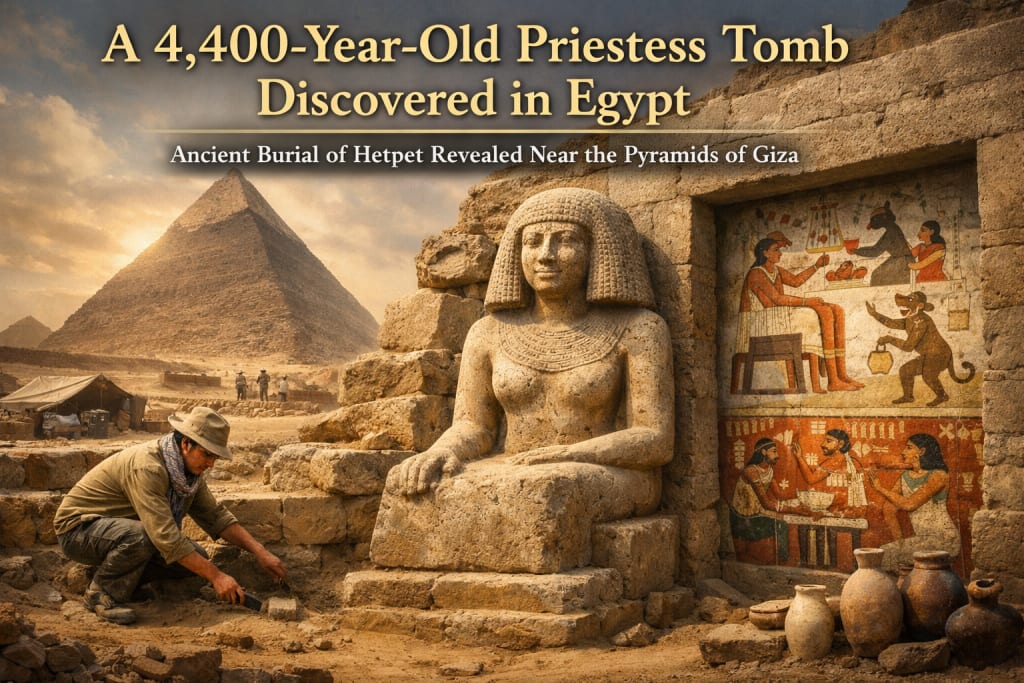
Archaeologists in Egypt have uncovered the remarkable tomb of a priestess that dates back approximately 4,400 years, offering new insight into religion, culture, and daily life during the height of the ancient Egyptian civilization. The discovery was made near the famous pyramids on the Giza Plateau, one of the most important archaeological areas in the world. Experts believe the tomb belonged to a high-ranking priestess named Hetpet, who lived during Egypt’s Fifth Dynasty, around 2400 BC. 
The tomb was discovered by an Egyptian archaeological mission working in the western cemetery of Giza, an area historically reserved for nobles and high officials of the Old Kingdom. The excavation team, led by archaeologist Mostafa Waziri from Egypt’s Supreme Council of Antiquities, revealed a well-preserved structure decorated with colorful wall paintings and inscriptions that have survived thousands of years. 
According to Egypt’s Ministry of Antiquities, Hetpet served as a priestess of Hathor, the ancient Egyptian goddess of fertility, motherhood, and love. Priestesses like Hetpet played important roles in religious rituals and temple ceremonies. Historical evidence suggests that she also had close connections with Egypt’s royal palace, indicating that she likely belonged to the elite class of society. 
One of the most fascinating features of the tomb is its remarkably preserved wall paintings. These colorful scenes portray Hetpet in various activities that were important in ancient Egyptian beliefs about the afterlife. In one painting, she is shown sitting before a large table receiving offerings from her children, symbolizing the respect and devotion of her family. Other scenes depict her hunting and fishing, activities that Egyptians believed would continue in the afterlife. 
Perhaps the most unusual images discovered in the tomb involve monkeys. One painting shows a monkey harvesting fruit, while another shows a monkey dancing in front of musicians. Archaeologists say such scenes are rare in Egyptian tomb art and may represent pets or animals that held symbolic meaning in ancient Egyptian culture. These lively images provide a rare glimpse into the everyday environment and entertainment of the ancient elite. 
The structure of the tomb itself is also significant. The entrance leads to an L-shaped shrine containing a purification basin engraved with the priestess’s name and titles. The presence of such features indicates the importance of ritual purification in Egyptian religious practice. The inscriptions and reliefs help confirm the identity of the tomb’s owner and offer valuable information about the religious hierarchy of the Old Kingdom period. 
Interestingly, Hetpet’s name was not entirely unknown to archaeologists before this discovery. Fragments and artifacts bearing her name had been discovered in the same area as early as 1909 by a German expedition. Those objects were later transported to museums in Europe. However, the rediscovery of her tomb more than a century later has allowed researchers to better understand her life and status in ancient Egyptian society. 
The Fifth Dynasty, during which Hetpet lived, was a time when Egypt’s centralized government was strong and monumental architecture flourished. The pyramid complexes and royal tombs built during this era demonstrate the advanced engineering and artistic skills of the civilization. The discovery of Hetpet’s tomb adds another piece to the puzzle of how ancient Egyptian society functioned during this influential period. 
Beyond its artistic and historical importance, the discovery also highlights how much remains hidden beneath Egypt’s sands. Archaeologists believe that many more tombs of officials and priests still lie buried in the Giza necropolis. Continued excavation could reveal further information about religious practices, social structure, and daily life in ancient Egypt. 
For historians and archaeologists, discoveries like this are invaluable because they bring humanity closer to understanding one of the world’s oldest and most fascinating civilizations. The colorful paintings, inscriptions, and artifacts preserved in the tomb offer a direct window into the beliefs and traditions of people who lived more than four millennia ago.
As excavations continue, researchers hope that additional chambers, artifacts, or burial objects related to Hetpet may still be found. Each new discovery has the potential to deepen our knowledge of ancient Egypt and its complex religious culture.
The 4,400-year-old tomb of the priestess Hetpet stands as a powerful reminder that even after thousands of years, the mysteries of ancient Egypt continue to inspire curiosity and wonder across the world.
About the Creator
Irshad Abbasi
Ali ibn Abi Talib (RA) said 📚
“Knowledge is better than wealth, because knowledge protects you, while you have to protect wealth.
Keep reading
More stories from Irshad Abbasi and writers in History and other communities.
A 2,000-Year-Old Sphinx Statue Discovered in Egypt
Archaeologists in Egypt have uncovered an extraordinary ancient statue shaped like a sphinx that dates back roughly 2,000 years, providing historians with fresh insight into Egypt’s long and complex past. The discovery was announced by Egypt’s Ministry of Tourism and Antiquities after an archaeological mission unearthed the statue during excavation work near the Temple of Hathor in Dendera, located in Qena Province in southern Egypt.
By Irshad Abbasi a day ago in History


Comments
There are no comments for this story
Be the first to respond and start the conversation.