
Aristotle and Alexander: How a Philosopher’s Lessons Helped Shape World History
The unique relationship between Aristotle and Alexander the Great shows how ideas and education can influence empires and transform the course of human civilization.

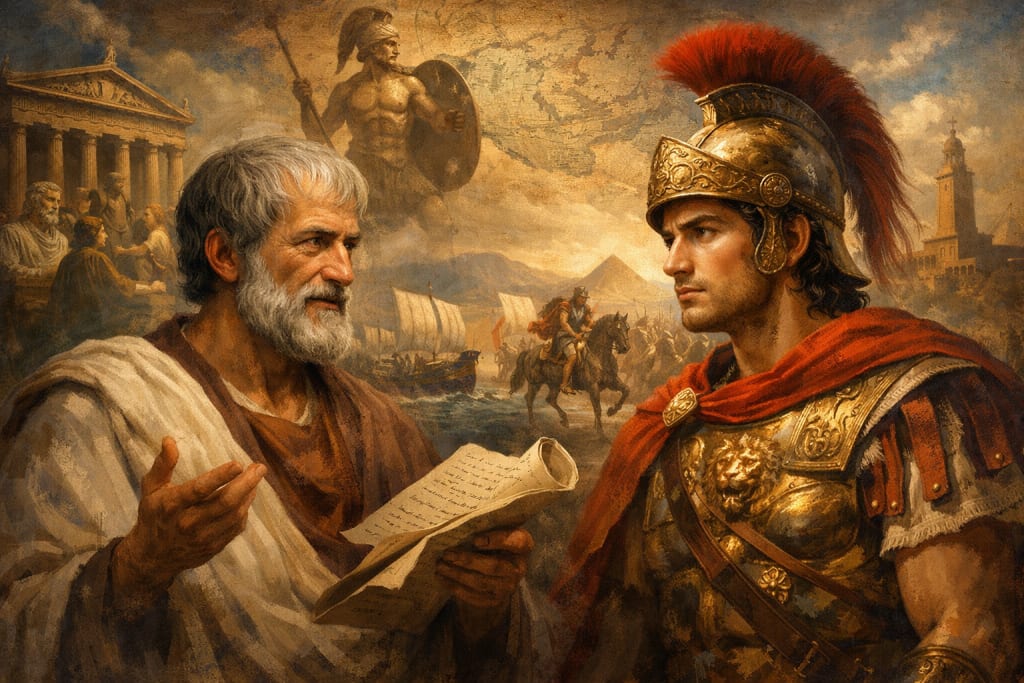
History often remembers kings, conquerors, and great battles. Yet behind many powerful rulers stand teachers whose ideas quietly shape the future. One of the most famous examples of this relationship is the connection between Aristotle, one of the greatest philosophers in history, and his student Alexander the Great, the young Macedonian king who built one of the largest empires the world had ever seen.
Their relationship is more than a simple story of a teacher and a student. It is a fascinating example of how education, philosophy, and ideas can influence world events.
A Young Prince and a Great Philosopher
In 343 BCE, King Philip II of Macedon, Alexander’s father, wanted the best possible education for his son. He invited Aristotle to become Alexander’s personal tutor. Aristotle was already famous in the Greek world as a brilliant philosopher and a student of Plato.
Alexander was only about 13 years old when Aristotle began teaching him. The lessons took place in a quiet place called the Temple of the Nymphs in Mieza, far from the noise of the royal court. There, Alexander studied alongside a small group of noble Macedonian boys who would later become his closest generals and companions.
Aristotle did not simply teach Alexander how to rule a kingdom. His education was broad and intellectual. He taught the young prince philosophy, ethics, politics, science, medicine, literature, and geography. Aristotle believed that a good ruler should not only be powerful but also wise.
The Influence of Greek Culture
One of Aristotle’s most important lessons to Alexander was the importance of Greek culture and knowledge. Aristotle admired the achievements of Greek civilization and believed that spreading Greek ideas could benefit the world.
Alexander absorbed this belief deeply. When he later began his conquests across Asia, he did not only aim to defeat enemies. He also tried to spread Greek language, art, and culture throughout the territories he conquered.
This process later became known as Hellenization—the spread of Greek culture across the eastern Mediterranean and parts of Asia. Greek cities were founded, Greek language became widely used, and Greek ideas mixed with local traditions.
In many ways, Aristotle’s teachings helped inspire this cultural transformation.
Love for Knowledge and Exploration
Aristotle also encouraged curiosity about the natural world. He was one of the earliest thinkers to study biology, animals, plants, and the structure of the Earth.
Alexander carried this curiosity with him during his campaigns. As his army marched through Egypt, Persia, and even into India, he reportedly sent back plants, animals, and scientific observations to Aristotle and other scholars in Greece.
These efforts helped expand Greek knowledge of geography and nature. Alexander’s conquests, combined with Aristotle’s scientific spirit, indirectly contributed to the growth of knowledge in the ancient world.
The Power of Stories and Heroes
Another important influence on Alexander was Greek literature, especially the epic poems of Homer. Aristotle reportedly introduced Alexander to the Iliad, the legendary story of the Trojan War.
Alexander became fascinated with the hero Achilles, whom he admired greatly. According to historical accounts, Alexander even carried a copy of the Iliad during his military campaigns.
The stories of heroic warriors and great deeds inspired Alexander’s ambition. He wanted to achieve glory similar to the heroes of ancient legend.
In this way, literature and storytelling played a surprising role in shaping one of history’s greatest conquerors.
A Complex Relationship
Despite their early connection, the relationship between Aristotle and Alexander later became complicated. As Alexander’s empire grew larger and more diverse, his policies sometimes differed from the traditional Greek ideas Aristotle supported.
For example, Aristotle believed Greeks were culturally superior to others, while Alexander increasingly tried to unite different peoples within his empire. He adopted some Persian customs and encouraged cooperation between cultures.
This difference shows that while teachers influence their students, students ultimately develop their own ideas.
Ideas That Changed the World
Alexander the Great died in 323 BCE at the age of only 32, yet his empire stretched from Greece to Egypt and deep into Asia. The cultural exchange that followed his conquests transformed the ancient world and helped create the Hellenistic Age, a period when Greek culture spread widely and mixed with many other civilizations.
Although Alexander is remembered as a brilliant military leader, the influence of Aristotle reminds us that ideas can be as powerful as armies.
The story of Aristotle and Alexander demonstrates a timeless truth: education and knowledge have the power to shape leaders, guide decisions, and ultimately change history itself.
In the end, the lessons of a philosopher helped inspire a conqueror whose actions reshaped the world.
About the Creator
Irshad Abbasi
Ali ibn Abi Talib (RA) said 📚
“Knowledge is better than wealth, because knowledge protects you, while you have to protect wealth.
Keep reading
More stories from Irshad Abbasi and writers in History and other communities.
The Lost Coins of Alexander the Great: A Mysterious Discovery in Gaza
Few historical figures have captured the imagination of the world as powerfully as Alexander the Great. Known for building one of the largest empires in ancient history before the age of 32, Alexander’s campaigns stretched from Greece to Egypt and as far as India. Yet even today, more than two thousand years after his death, discoveries connected to his era continue to intrigue historians and archaeologists. One such mystery revolves around a remarkable discovery in the ancient city of Gaza—a hoard of coins believed to be linked to Alexander’s time, which later vanished under mysterious circumstances.
By Irshad Abbasi about 12 hours ago in History
The Year 1987 in Review: Fun Facts, Trivia, and Historic Highlights
This quick read is a collection of fun facts, trivia, and historic events from the year 1987. Discover the year’s top news stories, most influential people, sports facts, computer and Internet trivia, entertainment news, and much more.
By Gregory DeVictorabout 6 hours ago in History




Comments
There are no comments for this story
Be the first to respond and start the conversation.