
Ashoka: The Emperor Who Turned Conquest into Compassion
How a Mauryan ruler transformed imperial power into one of history’s earliest visions of ethical governance and moral civilization.

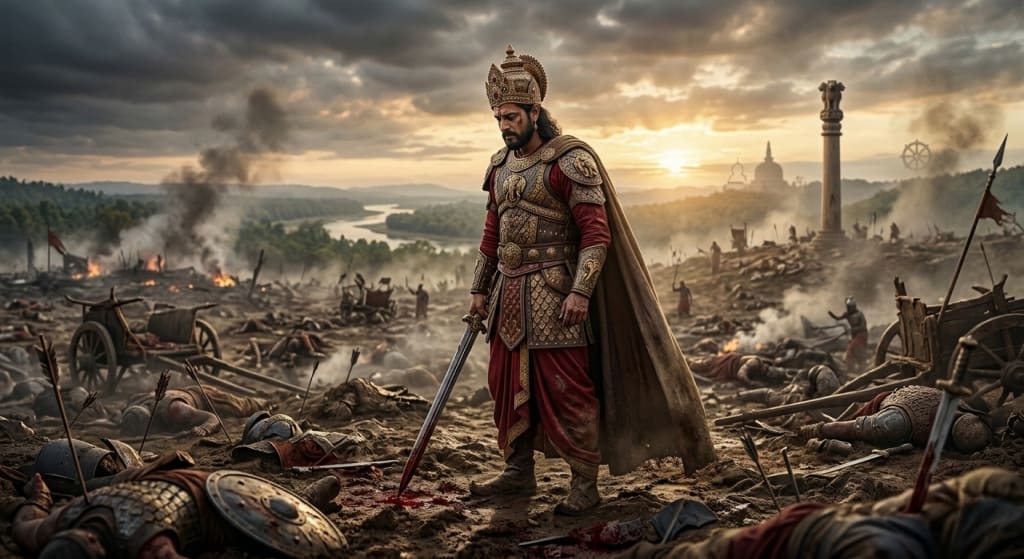
History remembers many conquerors, emperors, and rulers who built vast empires through military strength and strategic brilliance. Names such as Alexander the Great, Julius Caesar, and Augustus often dominate the narrative of ancient political power. Yet among these figures stands a ruler whose legacy is unique not because of conquest alone, but because of a profound moral transformation that reshaped the very meaning of governance.
Emperor Ashoka of the Mauryan Empire is widely regarded as one of the greatest rulers in world history. His significance lies not merely in ruling one of the largest empires of the ancient world, but in redefining how power could be exercised. Ashoka transformed imperial authority into a force for ethical governance, social welfare, and moral responsibility toward humanity.
More than two thousand years later, his ideas about compassion, tolerance, and responsible leadership remain deeply relevant.
The Rise of the Mauryan Empire
The story of Ashoka begins with the rise of the Mauryan Empire, one of the earliest large centralized states in the Indian subcontinent.
The empire was founded around 322 BCE by Chandragupta Maurya, a remarkable leader who overthrew the powerful Nanda dynasty. With the strategic guidance of Chanakya (also known as Kautilya), Chandragupta built a highly organized administrative system and established a powerful imperial state with its capital at Pataliputra (present-day Patna).
Under Chandragupta and later his son Bindusara, the Mauryan Empire expanded across vast territories of the subcontinent. By the time Ashoka ascended the throne in the third century BCE, the Mauryan state had already become a major political power.
However, it was under Ashoka’s reign that the empire reached both its greatest territorial expansion and its most profound philosophical transformation.
Ashoka’s Early Rule and Imperial Expansion
Ashoka ascended the Mauryan throne around 268 BCE. Early accounts portray him as a capable but formidable ruler determined to consolidate and expand imperial authority.
Like many rulers of the ancient world, Ashoka initially followed the path of conquest and military expansion. Through administrative efficiency and military strength, the Mauryan Empire expanded into one of the largest political entities of the ancient era.
At its height, the empire stretched across most of the Indian subcontinent, covering territories in present-day India, Pakistan, Afghanistan, Bangladesh, and Nepal.
Despite this immense power, a single event would fundamentally transform Ashoka’s worldview.
The Turning Point: The Kalinga War
Around 261 BCE, Ashoka launched a military campaign against the independent kingdom of Kalinga on the eastern coast of India.
The war proved devastating.
Historical inscriptions attributed to Ashoka describe the immense human suffering caused by the conflict. Tens of thousands of soldiers and civilians were killed, while many more were displaced and enslaved.
What makes Ashoka extraordinary in world history is not the war itself—but his reaction to it.
Unlike most conquerors who celebrated victory, Ashoka expressed deep remorse for the destruction caused by the campaign. In his own inscriptions, he openly acknowledged the pain inflicted upon the people of Kalinga.
This moment marked a dramatic transformation in his life and political philosophy.
Embracing the Path of Dharma
Following the Kalinga War, Ashoka turned toward the ethical teachings of Buddhism and embraced the principle of Dharma, often understood as moral law or righteous conduct.
For Ashoka, Dharma was not limited to religious doctrine. It represented a universal ethical framework grounded in compassion, justice, tolerance, and respect for all living beings.
Instead of pursuing further territorial expansion, Ashoka declared that the greatest victory was “conquest through Dharma.”
This idea represented a radical shift in the philosophy of governance.
Power was no longer simply a tool for domination—it became a means to promote moral responsibility and social welfare.
Governance Based on Ethics and Welfare
Ashoka’s reign introduced a form of governance that historians often describe as an early model of a welfare-oriented state.
His policies focused on improving the well-being of his subjects and fostering harmony across the empire.
Several initiatives illustrate this approach:
- Hospitals were established for both humans and animals.
- Roads were constructed to improve trade and communication.
- Trees were planted along major routes to provide shade for travelers.
- Wells and rest houses were built to support long-distance journeys.
Ashoka also introduced regulations aimed at protecting animals and reducing unnecessary slaughter, reflecting his broader ethical concern for all forms of life.
For the third century BCE, these policies were remarkably progressive and demonstrate a ruler deeply committed to public welfare.
The Edicts of Ashoka: Communicating with the People
One of Ashoka’s most innovative contributions to governance was his use of inscriptions to communicate directly with the population.
Across the empire, he ordered messages to be carved onto rocks and stone pillars. These inscriptions known today as the Edicts of Ashoka explained the principles of Dharma and encouraged moral behavior among citizens.
The edicts promoted values such as:
- Respect for parents and teachers
- Compassion toward all living beings
- Religious tolerance and mutual understanding
- Honesty and ethical conduct
Importantly, these messages were written in languages and scripts accessible to ordinary people, representing one of the earliest examples of public communication between a state and its citizens.
Through these inscriptions, Ashoka sought not only to rule the empire but to nurture an ethical society.
Religious Tolerance and Social Harmony
Another remarkable feature of Ashoka’s rule was his commitment to religious tolerance.
Although he personally embraced Buddhism, he never attempted to impose it on his subjects. Instead, his edicts encouraged mutual respect among followers of different religious traditions.
Ashoka emphasized that harmony between religions was essential for social stability and moral progress.
In many ways, this approach reflects ideas that resonate strongly with modern democratic values.
The Global Spread of Buddhist Thought
Ashoka’s influence extended far beyond the borders of his empire.
He sent diplomatic and religious missions to regions across Asia, including Sri Lanka and parts of Southeast Asia. These missions played a crucial role in spreading Buddhist philosophy across the continent.
Over time, Buddhism became one of the world’s major spiritual and intellectual traditions, shaping cultures throughout Asia.
Ashoka’s patronage helped transform Buddhism from a regional movement into a global civilizational influence.
The Enduring Legacy of Ashoka
The Mauryan Empire gradually declined after Ashoka’s death around 232 BCE, but his moral and philosophical legacy endured.
Centuries later, modern India adopted several symbols associated with Ashoka.
The Lion Capital of Ashoka became the national emblem of India, while the Ashoka Chakra, representing law and righteousness, appears at the center of the Indian national flag.
These symbols reflect the enduring relevance of Ashoka’s ideals of justice, ethical governance, and responsibility toward society.
Why Ashoka Stands Among the Greatest Rulers
Historians often compare Ashoka with figures such as Alexander the Great and Augustus because all three ruled powerful empires and shaped world history.
However, Ashoka’s legacy differs in a profound way.
Alexander is remembered primarily as a conqueror. Augustus is remembered as the architect of Roman imperial stability.
Ashoka, in contrast, is remembered as the ruler who transformed the meaning of power itself.
He demonstrated that political authority could be guided by compassion, moral responsibility, and a commitment to the welfare of humanity.
His reign shows that true greatness in leadership is not measured only by military victories or territorial expansion, but by the ability to elevate human values and build a just society.
A Timeless Model of Ethical Leadership
In a world where political power often struggles to balance authority with moral responsibility, Ashoka’s example offers an enduring lesson.
More than two millennia ago, he recognized that the ultimate purpose of governance is not domination but the well-being of society.
For this reason, Emperor Ashoka is remembered not only as a powerful ruler of the ancient world but as one of history’s most enlightened leaders.
His legacy reminds us that when power is guided by wisdom, compassion, and humanity, it can shape civilization for generations.
About the Creator
Arjun. S. Gaikwad
Curious mind exploring technology, society, and global change. I write on education, innovation, justice, and the future of humanity— blending science, philosophy, and real-world insights to spark awareness, critical thinking, and hope.
Keep reading
More stories from Arjun. S. Gaikwad and writers in History and other communities.
Dr. B. R. Ambedkar: Beyond Politics -The Civilizational Architect Who Rewrote the Destiny of Humanity
In the vast chronicle of human history, few individuals have transcended the boundaries of time, ideology, and politics. Among them stands Dr. Bhimrao Ramji Ambedkar, a name that cannot be confined to the narrow frame of a “politician.” To call Ambedkar merely a political figure is to diminish the cosmic scale of his thought and the transformative depth of his mission. He was not a seeker of power_ he was a creator of conscience, a builder of civilization, and a philosopher of equality whose words still echo as moral thunder across the world.
By Arjun. S. Gaikwad5 months ago in History


Comments
There are no comments for this story
Be the first to respond and start the conversation.