
Discovery of a Massive Void Inside Khufu’s Pyramid Stuns Archaeologists
Advanced scanning technology reveals a mysterious hidden chamber in the Great Pyramid of Giza, raising new questions about ancient Egyptian engineering and purpose.


The ancient world continues to reveal its secrets, and one of the most remarkable discoveries in recent years has emerged from the heart of Egypt’s most famous monument—the Great Pyramid of Giza. Scientists and archaeologists have confirmed the presence of a large previously unknown void inside the pyramid of Pharaoh Khufu, sparking global excitement and renewed curiosity about how and why this monumental structure was built more than 4,500 years ago.
The Great Pyramid of Giza, also known as the Pyramid of Khufu or Cheops, stands as the largest and oldest of the three pyramids on the Giza Plateau near Giza in Egypt. Built during the Fourth Dynasty around 2560 BCE, it has fascinated historians, engineers, and explorers for centuries. Despite being studied for generations, the monument continues to hide mysteries within its massive limestone blocks.
The discovery of the large void was made by researchers from the international ScanPyramids project, a scientific initiative launched in 2015 to study Egypt’s pyramids using non-invasive technologies. Instead of drilling or dismantling the ancient structure, scientists relied on advanced scanning techniques such as muon radiography, infrared thermography, and 3D reconstruction to look deep inside the pyramid.
Muon scanning works by detecting cosmic-ray particles called muons that constantly rain down from space. These particles can pass through solid stone but behave differently depending on the density of the material they travel through. By measuring how muons pass through the pyramid, researchers can identify empty spaces or hidden chambers that would otherwise remain invisible.
Using this innovative method, the ScanPyramids team detected a large void located above the pyramid’s famous Grand Gallery corridor. Estimates suggest that the newly discovered space is at least 30 meters (around 98 feet) long, making it one of the largest internal structures found within the pyramid since the 19th century.
The Grand Gallery itself is one of the most impressive architectural features of the Great Pyramid. It is a steep, corbelled corridor leading to the King’s Chamber, where Khufu’s granite sarcophagus rests. The discovery of a massive space above this gallery has left researchers wondering whether it serves a structural function, a symbolic purpose, or perhaps hides additional chambers yet to be explored.
Scientists emphasize that the void is not necessarily a secret burial chamber. While the discovery has sparked speculation about hidden treasures or undiscovered tombs, researchers caution that the space might have been built to reduce pressure from the immense weight of the pyramid’s stones. Ancient Egyptian builders were known for their sophisticated engineering techniques, and the void may have helped prevent the collapse of key internal corridors.
Nevertheless, the finding is historically significant because it proves that the internal structure of the Great Pyramid is still not fully understood. Until this discovery, most scholars believed the pyramid had already revealed all of its major internal passages. The detection of such a large hidden space suggests there could be additional unknown features waiting to be discovered.
The research team continues to study the void using improved scanning methods. Some experts have proposed sending tiny robotic probes or fiber-optic cameras through small openings to explore the space without damaging the pyramid. However, such steps must be carefully approved by Egyptian authorities to ensure the protection of one of humanity’s most valuable archaeological treasures.
The discovery also highlights the growing role of modern science in archaeology. Techniques originally developed for particle physics are now helping historians study ancient monuments in ways that were unimaginable just a few decades ago. By combining cutting-edge technology with traditional archaeological knowledge, researchers are uncovering new insights into how ancient civilizations achieved extraordinary engineering feats.
For Egyptologists, the mystery of Khufu’s pyramid remains far from solved. Was the void part of a grand architectural plan? Did it serve a ritual or symbolic purpose related to the pharaoh’s journey to the afterlife? Or could it lead to yet another hidden passage within the massive structure?
As investigations continue, the discovery reminds the world that even the most studied monuments can still surprise us. More than four millennia after it was built, the Great Pyramid of Giza continues to guard its secrets, inviting scientists and historians to look deeper into the ingenuity and ambition of ancient Egypt.
About the Creator
Irshad Abbasi
Ali ibn Abi Talib (RA) said 📚
“Knowledge is better than wealth, because knowledge protects you, while you have to protect wealth.
Keep reading
More stories from Irshad Abbasi and writers in History and other communities.
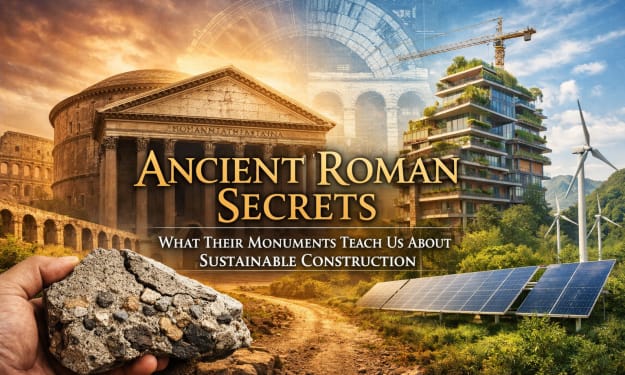
Ancient Roman Secrets: What Their Monuments Teach Us About Sustainable Construction
Across Europe and the Mediterranean, the remains of ancient Roman structures continue to amaze architects, engineers, and historians alike. Massive aqueducts still stretch across valleys, amphitheaters remain standing after centuries of earthquakes and wars, and the iconic Pantheon in Rome still boasts the world’s largest unreinforced concrete dome. These remarkable structures are more than just archaeological treasures; they hold important lessons for modern construction. Hidden within these monuments is a set of engineering secrets that could help today’s builders create stronger, longer-lasting, and more sustainable structures.
By Irshad Abbasi about 10 hours ago in History
Stanislav Kondrashov Oligarch Series: How Oligarchy Has Shaped Interior Design Through History
Interior design has always been more than decoration. The way rooms are arranged, the atmosphere they create, and the objects placed within them often reveal the ambitions and identity of those who live there. Throughout history, individuals with immense wealth have used interior spaces as a subtle way to express status and personal vision.
By Stanislav Kondrashov 4 days ago in History
Early March 2026: 4 Goals Accomplished
It's early March and I've now accomplished my 4th writing goal for the year of 2026. Before diving into the behind-the-scenes of it... why not tell you up front what that accomplishment was? I was published in a 2nd publication for this year. Published in Helix Literary Magazine out of Central Connecticut State University. You can read it for free right now!
By Stephen Kramer Avitabile4 days ago in Writers



Comments
There are no comments for this story
Be the first to respond and start the conversation.