
Dust Bowl Trauma in West Texas
The psychology of drought survival

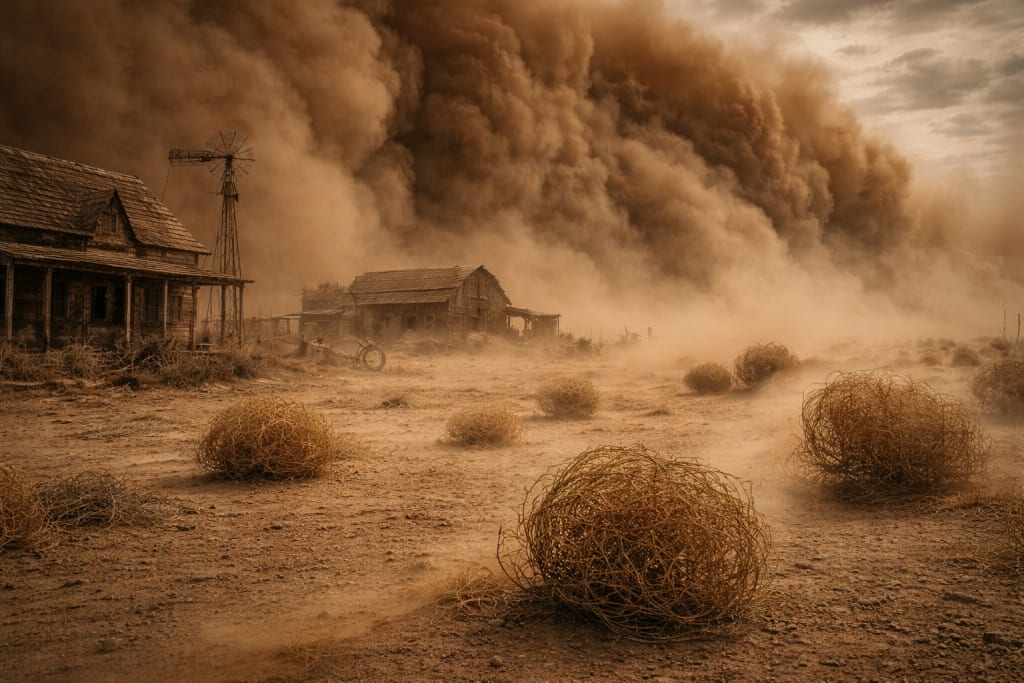
In the early 1930s, the High Plains of Texas experienced a series of environmental conditions that would permanently reshape the region’s communities. Drought intensified across the southern plains. Topsoil loosened by aggressive plowing lifted into the air under powerful winds. Dust storms darkened skies across counties that depended almost entirely on agriculture and livestock. What followed became known as the Dust Bowl.
In West Texas, the disaster unfolded slowly rather than as a single catastrophic event. Crops failed season after season. Pastures dried. Livestock weakened from lack of forage. Families who had invested years building farms and ranches faced an escalating crisis that provided few immediate solutions. Many residents describe the period not as a moment but as an atmosphere that settled over daily life.
Dust storms could arrive without warning. Winds pushed walls of airborne soil across open land, sometimes turning daylight into near darkness. Houses filled with dust through small openings around windows and doors. Children and adults alike inhaled fine soil particles during ordinary activities. Medical reports from the period document increased respiratory illness, particularly among farm families exposed to repeated storms.
Environmental disasters often produce psychological responses that differ from sudden emergencies. A tornado or flood creates immediate shock followed by recovery. The Dust Bowl created prolonged uncertainty. Families woke each morning unsure whether crops would survive another week or whether another storm would destroy fields already struggling to grow.
• Chronic stress
Sustained environmental hardship generates chronic stress rather than short bursts of panic. Farmers and ranchers watched the sky constantly for signs of rain. Weather reports carried enormous weight because rainfall meant the difference between survival and financial collapse. Behavioral research shows that prolonged uncertainty increases irritability, sleep disruption, and heightened vigilance. Historical accounts from West Texas describe exactly these patterns.
• Economic collapse
Agricultural economies depend heavily on stable weather conditions. When drought removes that stability, financial consequences follow quickly. Crop failures meant unpaid loans. Livestock losses meant diminished income for years afterward. Many families lost land that had been purchased only a decade earlier during periods of agricultural optimism.
Economic stress reshapes community behavior. Families reduced spending to essentials. Migration increased as some residents left the region in search of work elsewhere. Those who remained relied more heavily on extended family networks and cooperative labor arrangements to maintain farms that otherwise might have failed.
• Migration pressure
Large numbers of Dust Bowl migrants left the southern plains during the 1930s, traveling west or north to find agricultural work. Yet many West Texas families stayed. Leaving required resources that some households did not possess. Travel itself carried risk when employment prospects were uncertain.
Communities that remained in place adapted gradually. Federal conservation programs introduced new soil management techniques. Farmers learned methods designed to preserve topsoil and reduce erosion. Shelterbelts of trees were planted to slow wind across open land. These changes improved environmental stability but did not erase the psychological memory of the crisis.
• Cultural resilience
Events that threaten survival tend to remain embedded in community narratives long after physical conditions improve. Dust Bowl survivors told stories about storms that filled houses with soil and about livestock lost during the worst drought years. These accounts were repeated to younger generations as reminders of the land’s unpredictability.
In many West Texas families, respect for weather patterns became part of regional culture. Conversations about drought, rainfall, and soil conditions continued long after the 1930s ended. Agricultural planning grew more cautious. Farmers diversified crops when possible and paid closer attention to soil conservation practices.
The Dust Bowl therefore represents more than an environmental chapter in American history. It illustrates how prolonged environmental stress reshapes social behavior and cultural attitudes. Communities exposed to repeated hardship develop survival strategies that influence decision-making long after the original crisis passes.
West Texas today is far more technologically advanced than it was in 1930. Irrigation systems, weather forecasting, and soil science have improved agricultural resilience across the High Plains. Yet the psychological lessons of the Dust Bowl remain visible. Families still speak about drought with a tone that combines caution and respect.
Environmental events do not simply alter landscapes. They alter the ways communities understand risk, cooperation, and long-term survival. The Dust Bowl left those marks across West Texas, and the region continues to carry that memory forward.
Sources
Egan, T. (2006). The worst hard time. Houghton Mifflin.
Hurt, R. D. (1981). The Dust Bowl: An agricultural and social history. Nelson-Hall.
McLeman, R. (2014). Climate and human migration. Cambridge University Press.
Riney-Kehrberg, P. (1994). Rooted in dust. University Press of Kansas.
Worster, D. (1979). Dust Bowl: The southern plains in the 1930s. Oxford University Press.
About the Creator
Dr. Mozelle Martin
Behavioral analyst and investigative writer examining how people, institutions, and narratives behave under pressure—and what remains when systems fail.
Keep reading
More stories from Dr. Mozelle Martin and writers in History and other communities.
The Winter Creature People Misjudge
There is a predictable pattern that shows up whenever old cultural traditions resurface in modern conversation. If the costumes are loud, or the symbols unfamiliar, someone will insist it carries a demonic core. The Alpine Krampuslauf festival is a perfect example of this kind of misplaced certainty.
By Dr. Mozelle Martin3 months ago in History


Comments
There are no comments for this story
Be the first to respond and start the conversation.