
How one man saved the Entire World
How one man saved World

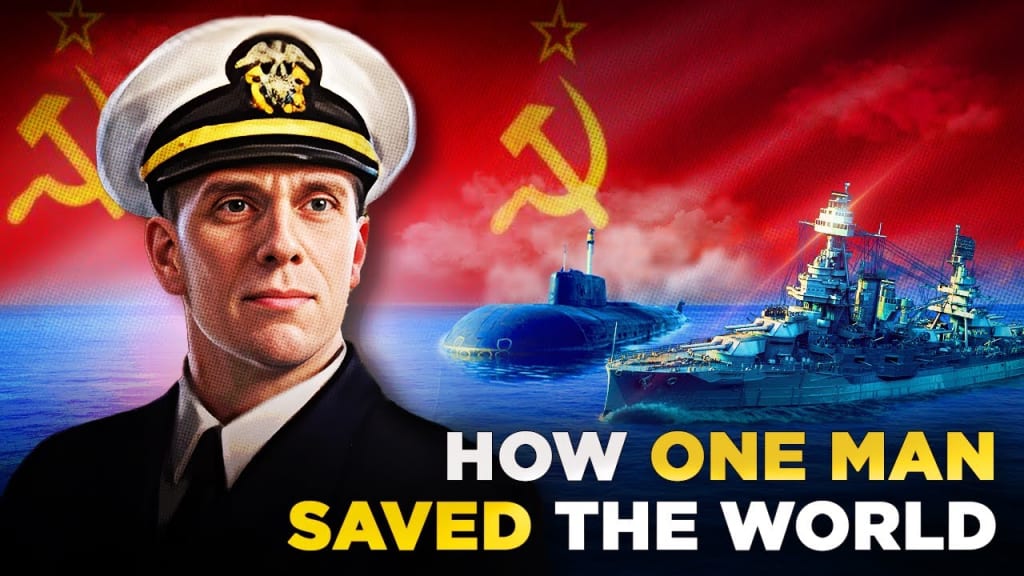
A Soviet Union B-59 submarine was hiding underwater in the Caribbean Sea, only a few kilometers away from the United States, ready to attack.
Suddenly, the U.S. Navy discovered the submarine. To force it to come to the surface, they dropped small bombs into the water.
The Soviet submarine had already lost contact with its headquarters thousands of kilometers away. Because of the explosions, the submarine’s captain believed that war had already started and that it was time to launch a nuclear torpedo missile.
This was a time when tensions between the United States and the Soviet Union were extremely high. Both countries had thousands of nuclear missiles ready to launch at the press of a button.
The captain of the Soviet submarine was about to press the button to launch the nuclear missile when suddenly something happened that saved the world from destruction.
This event occurred during the 12 days of extreme tension between the United States and the Soviet Union, known as the Cuban Missile Crisis.
After World War II, the world had already seen the devastating effects of nuclear weapons when the United States dropped atomic bombs on Hiroshima and Nagasaki in Japan.
At that time, the only country capable of challenging the United States was the Soviet Union, which had also developed nuclear technology soon after the war.
Both the United States and the Soviet Union kept nuclear weapons ready at all times—on land, in the air, and in the sea. If either side launched a nuclear attack, the other would retaliate with nuclear weapons, leading to catastrophic destruction that could wipe out up to 70% of the world’s population.
To strengthen its military position, the United States placed nuclear missiles in Turkey and Italy, both NATO allies located close to Soviet territory.
In response, the Soviet Union decided to deploy nuclear missiles close to the United States. The best location for this was Cuba, an island only about 200 km southeast of the U.S.
At the time, Cuba had a pro-communist government led by Fidel Castro. The Soviet leader Nikita Khrushchev secretly made a deal with Castro to install intercontinental ballistic missiles (ICBMs) in Cuba. In return, the Soviet Union would protect Cuba from any U.S. attack.
The missile installations were kept top secret, but rumors spread across America. To verify them, the U.S. sent a U-2 spy plane, which took photographs showing Soviet missile bases in Cuba.
When the images reached John F. Kennedy, the President of the United States, he planned air strikes to destroy the Soviet missiles and possibly invade Cuba. However, such an attack could trigger World War III.
Meanwhile, the Soviet B-59 submarine was already hidden deep in the Caribbean Sea. Its crew had the authority to launch a nuclear torpedo if war began, even without permission from Moscow.
Because the submarine had lost radio contact with Moscow, the captain believed the war had started when U.S. ships dropped signal depth charges nearby.
Before launching the nuclear torpedo, three officers had to agree.
Two officers supported launching the missile.
But one officer, Vasili Arkhipov, strongly opposed it. He argued that there was no confirmation that war had started, and launching a nuclear weapon would be extremely dangerous.
After a tense argument lasting several minutes, the officers decided to surface the submarine and re-establish contact with Moscow before taking any action.
At the same time, negotiations were taking place between the leaders of the United States and the Soviet Union. Eventually, they reached an agreement:
The Soviet Union would remove its missiles from Cuba.
The United States promised not to invade Cuba.
Secretly, the United States also agreed to remove its nuclear missiles from Turkey and Italy.
The crisis lasted 12 days, but it ended peacefully.
Historians believe that Vasili Arkhipov’s decision not to launch the nuclear torpedo saved the world from nuclear war. If that missile had been fired, it could have triggered a chain reaction leading to global nuclear destruction.
Because of his decision, many historians call Vasili Arkhipov the man who saved the world.
About the Creator
Imran Ali Shah
🌍 Vical Midea | Imran
🎥 Turning ideas into viral content
✨ Watch • Share • Enjoy
Keep reading
More stories from Imran Ali Shah and writers in History and other communities.
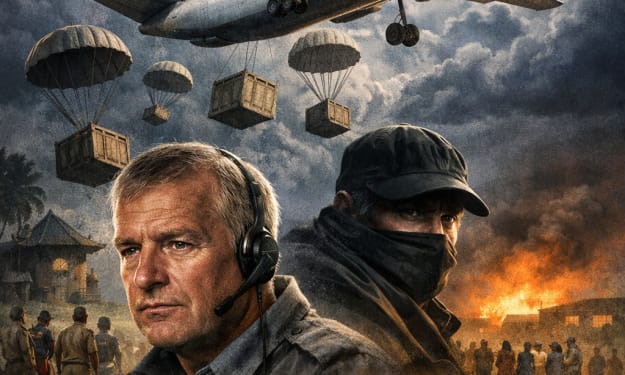
The Mysterious Arms Drop: When Weapons Fell from the Sky Over India
In the mid-1990s, one of the most mysterious and controversial arms smuggling operations in South Asia unfolded in dramatic fashion when a large cache of weapons literally fell from the sky in eastern India. The incident involved an aircraft traveling between Karachi and Dhaka, allegations of international intelligence links, and a clandestine mission that continues to raise questions about who was behind it and why.
By Irshad Abbasi 3 days ago in History
Worth the Wait: Puerto Viejo, Costa Rica
Beach bumming in a small Caribbean beach town sounded like a perfect way to end our 6-month trip through Mexico and Central America. Or so we thought. The foul, fishy stench of rotten seaweed hit our nostrils as we stepped from the cramped bus and looked out at a rather depressing, empty, and underwhelming black sand beach. It was pouring with rain, and we had to quickly fish out our ponchos. We thought, this couldn’t be it, could it?
By Sh*t Happens - Lost Girl Travel4 days ago in Wander


Comments
There are no comments for this story
Be the first to respond and start the conversation.