
The Best Bargain in History: How America Bought Alaska for a Song
From "Seward’s Folly" to a Strategic Goldmine—The $7.2 Million Deal That Reshaped the World Map

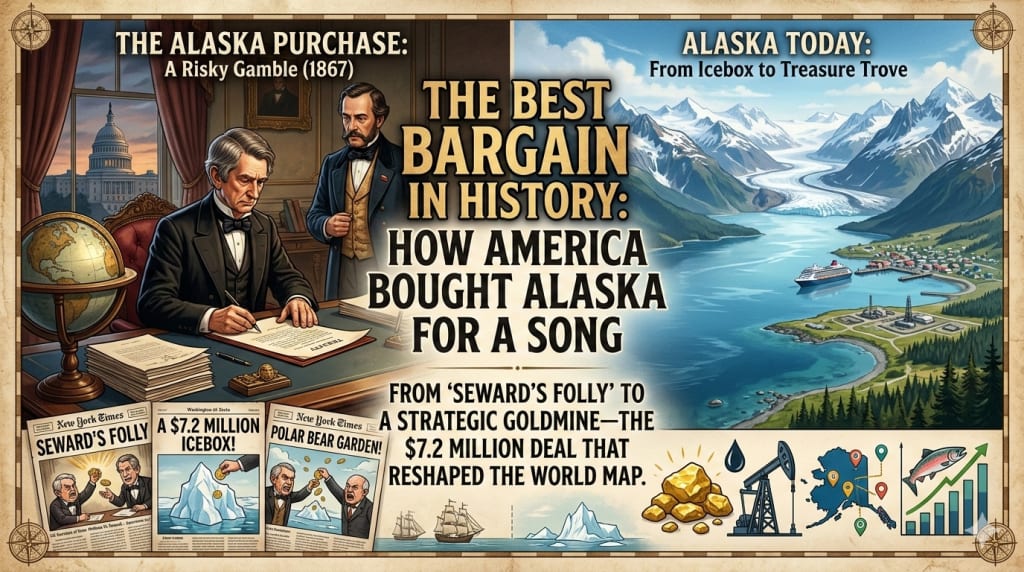
In the mid-19th century, the idea of purchasing a vast, frozen wasteland thousands of miles away from the American capital seemed like a punchline to a bad joke. Yet, on March 30, 1867, the United States signed a treaty with the Russian Empire to purchase Alaska for **$7.2 million**. At roughly two cents per acre, it would eventually be recognized as one of the most brilliant real estate deals in human history, though at the time, the American public was far from convinced.
## A Desperate Seller and a Visionary Buyer
By the 1860s, Russia was in a difficult position. Having recently lost the Crimean War to Britain, the Tsarist government was nearly bankrupt. Alaska, then known as Russian America, was a remote frontier difficult to defend and expensive to maintain. Fearing that their rival, Great Britain, might simply seize the territory from neighboring Canada, Emperor Alexander II decided it was better to sell the land to the United States than to lose it to an enemy for nothing.
On the American side, the primary architect of the deal was Secretary of State **William H. Seward**. A firm believer in "Manifest Destiny," Seward saw Alaska not as a frozen tundra, but as a strategic gateway to the Pacific and a way to sandwich British Columbia between American territories.
## "Seward’s Folly" and Public Outrage
When the news of the purchase broke, the American press was merciless. Editors and politicians, still reeling from the costs of the Civil War, couldn't understand why the government was spending millions on "icebergs and polar bear gardens." The deal was mocked across the country with derisive nicknames:
* **"Seward’s Folly"**
* **"Seward’s Icebox"**
* **"Johnson’s Polar Bear Garden"**
Critics argued that the land was uninhabitable and held no economic value. However, Seward’s persistence and a bit of "lobbying" (which some historians suggest involved Russian bribes to American congressmen) eventually led to the Senate’s approval.
## The Turning Tide: Gold, Oil, and Strategy
The skeptics were silenced sooner than expected. In the late 1890s, the **Klondike Gold Rush** brought thousands of prospectors to the region, revealing that Alaska was sitting on a literal gold mine. But the true value of the "Icebox" was only just beginning to be understood.
### 1. Natural Resources
Beyond gold, Alaska proved to be a treasure trove of copper, timber, and fish. In the 20th century, the discovery of the **Prudhoe Bay Oil Field**—the largest in North America—transformed the state into an energy powerhouse. The revenue generated from Alaskan oil has since repaid the original $7.2 million investment thousands of times over.
### 2. Geopolitical Strategy
During the Cold War, Alaska’s proximity to the Soviet Union made it the front line of American defense. Today, its location remains vital for monitoring Arctic shipping lanes and maintaining aerospace defense. Had Russia retained Alaska, the geopolitical landscape of the 20th century would have looked drastically different, with a Soviet presence firmly planted on the North American continent.
---
## Conclusion: A Lesson in Foresight
The purchase of Alaska serves as a timeless reminder that what appears "foolish" in the short term can often be a masterstroke of long-term vision. Today, Alaska is the largest U.S. state, twice the size of Texas, and a cornerstone of American environmental beauty and economic security.
What was once dismissed as a $7.2 million mistake is now celebrated as the **"Best Bargain in History."**
---
**Would you like me to create an image showing the historical signing of the Alaska Treaty or perhaps a map comparing Alaska's size to the rest of the U.S.?**
About the Creator
Irshad Abbasi
Ali ibn Abi Talib (RA) said 📚
“Knowledge is better than wealth, because knowledge protects you, while you have to protect wealth.
Keep reading
More stories from Irshad Abbasi and writers in History and other communities.
The Assassination of Lord Mountbatten: When India’s First Governor-General Was Killed by a Boat Bomb
The assassination of Louis Mountbatten in 1979 was one of the most shocking acts of political violence in modern British history. A decorated naval officer, royal family member, and the last Viceroy of British India, Mountbatten had played a key role in overseeing the partition and independence of the Indian subcontinent in 1947. More than three decades later, his life ended in a violent attack when a bomb planted on his fishing boat exploded off the coast of Ireland.
By Irshad Abbasi about 10 hours ago in History
"Scream 7" (2026): Running out of Fresh Screams
This is the seventh time we’ve had a Ghostface crisis. Scream 7 is the latest edition of the Scream franchise. Sydney Prescott and her family are under attack by another anonymous killer dressed in a Ghostface costume. While having issues with her daughter, Tatum, they run from the bloody murders, trying to determine who is behind it all.
By Marielle Sabbag5 days ago in Horror


Comments
There are no comments for this story
Be the first to respond and start the conversation.