
The Women Sparta Erased
The hidden truth of ancient warfare

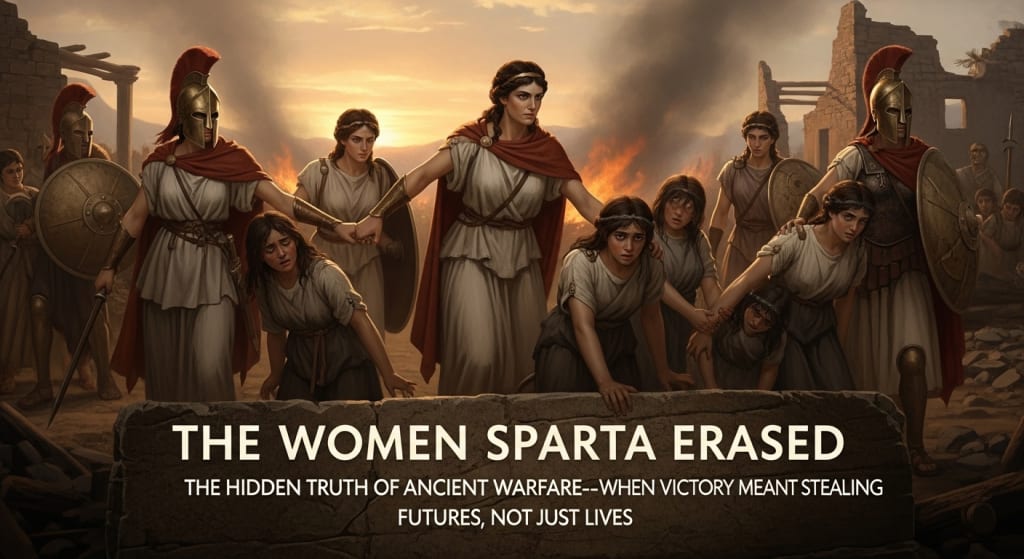
Imagine: You are twenty-six years old. Just days ago, you watched your husband die defending your city. Now you stand in the ashes of your burned home, children pressed against your chest, trying to make yourself invisible while armed men move among the survivors.
A soldier stops in front of you. He asks your age. He looks at your children. He marks something on a tablet and moves on. You don't yet know what that mark means—but soon, you will.
That night, your children are taken from you.
Your youngest cries your name as he is forcibly dragged away. You try to reach for him, but hands push you back. Around you, other mothers scream, their voices breaking in the dust. Then you are marched with hundreds of women, while behind you, the city's fire slowly dies. The war is over. But the conquest has just begun.
This is the side of ancient warfare people don't like to discuss. The battle wasn't the end—it was merely the beginning. When the walls fell, the survivors became the real prize. And Sparta, more than other Greek states, understood conquest as a system.
Sparta Was Built for War. Boys were trained from childhood to obey, to endure pain, to kill without hesitation. Sparta lived in constant fear of rebellion, because they were outnumbered. This fear shaped every decision they made—including what they did with conquered cities.
Sparta Understood a Brutal Reality: Killing warriors eliminates one generation. But if women remain free, they raise sons who remember, who resist, who seek revenge. So Sparta struck deeper than the battlefield. They targeted identity. Bloodlines. The future itself.
When a City Fell, survivors were immediately separated. Men were killed or removed. Children were divided. And women—especially those of childbearing age—were coldly assessed: age, health, social status, family connections. Wives of leaders. Daughters of nobles. Priestesses. Every detail mattered, because every woman had a different "use" in the Spartan system.
Some Were Thrown Into Forced Labor, disappearing into fields and workshops. For them, horror wasn't a moment. It was a lifetime. Endless work. No freedom. No legal protection. Children born into the same slavery. A future that belonged neither to you nor your offspring.
But for Women from Elite Families, Sparta often chose something more psychologically devastating: forced assimilation.
These women could be assigned to Spartan households by command. Not as equals. Not by choice. But as living proof that resistance has consequences. Imagine being dressed for a public ceremony while everyone knows the truth: your husband is dead, your city is destroyed, and now you are being used to show that Sparta doesn't just win wars—it rewrites lives.
The Cruelty Wasn't Just Physical. The true cruelty was being forced to play the role of "normal life" inside captivity. Managing homes for those who destroyed yours. Watching your children grow up under the conqueror's values. Seeing the next generation adopt new identities, serve new states, while your old world becomes a memory too dangerous to speak.
Ancient Writers Called This Fate "Worse Than Death," because death ends suffering. It closes the story. But what Sparta did stretched across decades—a continuous erasure, a daily reminder of loss, forced participation in the destruction of your own culture.
Fear Always Loomed Close. Sparta used intimidation and violence to maintain control, ensuring those bound in slavery never felt safe enough to organize, to resist, or even to dream openly. For women who remembered freedom, this contradiction—between what life was and what it became—turned into a living grief.
History Didn't Preserve Most of Their Names. Their pain survives only in fragments, buried within accounts focused on wars and kings. But they existed. They endured. And their stories tell us an eternal truth about warfare: enemies aren't defeated only on the battlefield. Sometimes, true victory comes later—in homes, in families, and in the stolen futures of those who survived.
The Silence Speaks Louder Than Swords.
These women's voices were never recorded. Their tears never counted in the triumphs of generals. Yet their suffering shaped the ancient world as profoundly as any battle. When we study Sparta, we must ask: whose stories are we telling? And whose are we leaving in the ashes?
The Legacy of Conquest.
Today, we remember Spartan warriors for their discipline, their strength, their legendary last stands. But we rarely ask about the women who outlived their cities. The mothers who watched their children taken. The daughters of nobility who became servants in enemy homes. Their silence is part of Sparta's victory—and part of history's failure.
What Remains.
War doesn't end when the fighting stops. For the conquered, especially women, war continues in new forms: in stolen identities, in forced silence, in generations raised to forget where they came from. Sparta understood this. They didn't just defeat enemies—they erased them.
And somewhere, in the dust of ancient ruins, their names still wait to be remembered.
About the Creator
Literary fusion
Welcome to literary fusion where art and literature intertwine to create a vibrant tapestry. I am [Abdullah Shabir], an artist and writer exploring self-expression through colors and carefully chosen words.
Keep reading
More stories from Literary fusion and writers in History and other communities.
This is the world’s most heavily secured convoy. Part 2
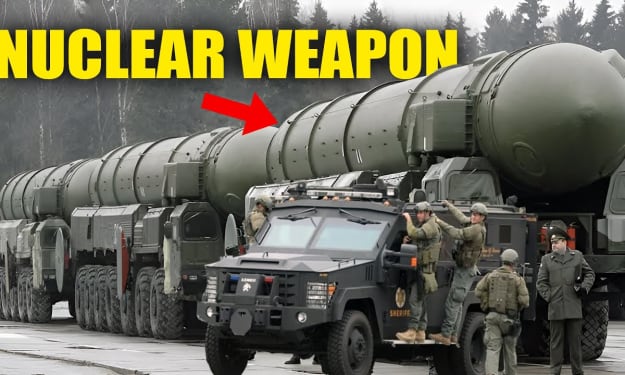
To handle this challenge, the U.S. government has created a dedicated agency whose sole job is to secure nuclear weapons. The military convoys you see are commonly used to transport nuclear weapons within the U.S. At first glance, such a convoy looks even more secure than that of a VIP—security an ordinary person can hardly imagine.
By Imran Ali Shah5 days ago in History


Comments
There are no comments for this story
Be the first to respond and start the conversation.