
What Really Happened in 1947?
The Untold Human Story of the India–Pakistan Partition Not the lines on a map, but the lines that never left people’s bodies

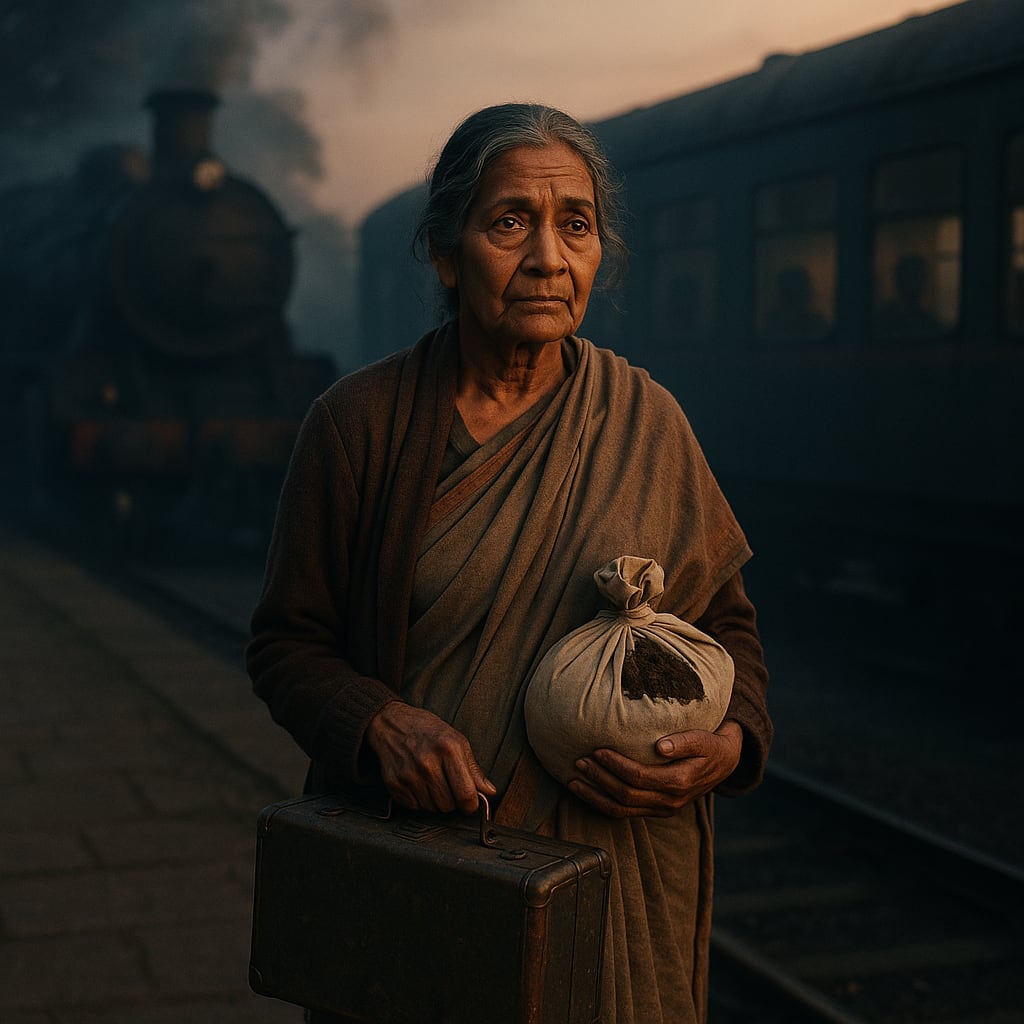
Not the lines on a map, but the lines that never left people’s bodies
The first time I realized 1947 wasn’t just a date in a textbook was in my grandmother’s kitchen.
She was standing over the stove, turning rotis with her bare hands the way only old Punjabi women can, when a siren from the street outside wailed longer than usual. She froze.
The roti in her fingers started to burn, but she didn’t move.
Her eyes weren’t in that kitchen anymore. They were somewhere else entirely—somewhere with fire, and running, and a train station that never seemed to end.
I said her name three times before she blinked and came back.
“Why are you crying?” I asked.
She looked down at her hands, red from the heat.
“These hands have seen 1947,” she said quietly. “They still remember what they were carrying.”
She never said “Partition.”
She never said “India” or “Pakistan.”
She only said “that time” and switched back to talking about salt and flour.
That was my first hint that what really happened in 1947 wasn’t the neat story we’re told about independence and freedom and the birth of nations.
It was something messier, quieter, and far more personal.
It was about the weight people carried in their hands and never put down again.
The official story of the India–Pakistan Partition—and the one nobody told us
In school, the India–Pakistan Partition is usually a clean paragraph.
“On August 15, 1947, India gained independence from British rule, leading to the creation of two nations: Hindu-majority India and Muslim-majority Pakistan.”
If your textbook was generous, it might add one more sentence:
“This resulted in the largest mass migration in human history and widespread communal violence.”
That’s it.
No mention of what it feels like to leave a house you built brick by brick, knowing you will never touch its walls again.
No description of the sound a train full of refugees makes when it pulls into a station and nobody gets off alive.
No space for the women who disappeared and were never spoken of, as if silence could rebuild their dignity.
We’re taught the names of politicians and borders.
We’re not taught the names of the children who vanished on the roads between Lahore and Amritsar.
And somewhere inside that gap, millions of ordinary lives are quietly buried.
A grandmother’s suitcase and the things she didn’t say
Years later, after my grandmother died, my mother brought out an old metal suitcase that had been sitting at the back of a cupboard for decades.
“This is all she brought with her in ’47,” she said.
Inside were things that didn’t make sense at first.
A brass key with no matching door.
A small cloth bundle of soil, tied carefully with thread.
A photograph of a house with a mango tree, the edges so worn the image was almost a ghost.
“Why did she keep soil?” I asked.
My mother shrugged.
“Maybe so she’d remember the smell.”
That sentence did something to me.
I had grown up thinking Partition was about religion, politics, power.
But here was something more primal: a woman carrying soil across a burning subcontinent because she knew her nose might forget the exact way “home” smelled.
India–Pakistan Partition wasn’t an abstract event anymore.
It was my grandmother choosing, in the chaos of leaving, to pick up a handful of dirt and say, “This, at least, is mine.”
What we’re not told about 1947: the scale of the wound
When people talk about Partition casually, they say, “A lot of people died.”
That phrase is a kind of violence too.
Historians estimate that around 10 to 15 million people were displaced in 1947.
Up to 2 million people were killed in the riots, massacres, and revenge killings that followed.
These are numbers so big our brains slide right off them.
So let’s slow down.
Imagine your city.
Now imagine almost everyone you know—your neighbors, your co-workers, your random barista, the lady who sells vegetables on the corner—suddenly walking down a highway with everything they own on their heads.
Imagine half of them never making it.
Imagine people who lived side by side for generations suddenly seeing each other as enemies, overnight.
That’s what “largest mass migration in history” really meant.
It meant miles of walking.
It meant bodies in wells.
It meant people killing, not because they woke up evil one day, but because fear, rumor, and grief braided themselves together into something monstrous.
And it meant that for every dead body, there was someone left alive who loved them—and had to keep living.
Hindus, Muslims, Sikhs: how neighbors became strangers
My grandmother grew up in what is now Pakistan.
Her village had Hindus, Muslims, and Sikhs all tangled up in the same fields and markets and gossip.
“On Eid, we’d eat sheer khurma at our Muslim neighbor’s house,” she once told me. “On Diwali, they lit lamps with us. Who was Hindu, who was Muslim—it mattered, but not like it did later.”
Then came the rumors.
There was going to be a line.
Nobody knew exactly where.
All they knew was this: suddenly, your religion decided which side of that invisible line you were allowed to live on.
Men in her village started whispering in corners.
The women stopped going out alone.
“First, the neighbors stopped sending their daughters to our house,” she said. “Then they stopped coming themselves.”
It didn’t happen like a switch flipping.
It was slower. More insidious.
A thousand small decisions made out of fear.
People telling themselves, “Just for now, I’ll stay away. Just in case.”
By the time the violence arrived, the bridges of trust were already gone.
This is one of the cruelest things about Partition.
The killing gets the headlines, but the quiet betrayal is what people remember on sleepless nights.
Not just, “They attacked us,” but, “He knew my father’s name and still raised a knife.”
The trains that became moving graves
If you’ve heard anything about Partition, you’ve probably heard about the trains.
Refugees packed into them, leaving Lahore for Delhi, Amritsar for Karachi, hoping the tracks would carry them to safety.
Sometimes they did.
Sometimes the trains arrived at their destination completely silent.
No noise.
No crowd.
Just carriage after carriage full of bodies.
The phrase people used was “ghost trains.”
It sounds like folklore, but it’s not.
One of my grandfather’s brothers worked at a station that received a train like that.
By the time the story reached me, it was stripped of details, like everyone involved had agreed not to say too much.
All I was told was this:
He stopped working for weeks afterward.
He barely spoke for months.
And every time he heard a long whistle, he went pale.
That’s the thing about 1947.
It didn’t just split land and families.
It splintered people inside.
Some of them never came back to themselves.
They learned to function, to work, to marry, to gossip, to watch cricket—but a part of them stayed on that platform, staring at a train that should have been full of life.
Women’s stories: the ones swallowed by silence
If you ask family elders about Partition, there’s often a sudden stillness when women’s stories come up.
You feel the air in the room change.
Everyone knows something, but nobody wants to say it.
Women were not just victims of violence during the India–Pakistan Partition; they were turned into battlefields.
Abductions, rapes, forced conversions, forced marriages—it happened on all sides.
Sometimes, families killed their own daughters and sisters rather than risk the “dishonor” of what might happen if the mobs, or the soldiers, reached them.
Think about that for a moment.
Parents, who once saved their children from falling off beds, were told by the world around them that killing those same children could be an act of protection.
Even after the governments of India and Pakistan started “recovery operations” to bring abducted women back across the new borders, the horror didn’t end.
Many women were rejected by their own families.
“You died in 1947,” they were told, in one form or another.
So they lived new lives with strangers, carrying the knowledge that somewhere, on the other side of a line drawn by people they had never met, there was a house that did not want them anymore.
This is the part that often goes missing in patriotic speeches.
Because where do you fit a story like that into narratives about freedom and independence?
The afterlife of 1947: ghosts in living rooms and on WhatsApp
The thing about a trauma that massive is it doesn’t stay in 1947.
It slips into the cracks of everything that comes after.
It’s in the way your grandfather flinches at certain words.
It’s in the way your parents panic a little more than seems reasonable when you stay out late.
It’s in the “jokes” people make about the other community.
It’s in the maps shared on WhatsApp trying to prove whose ancestors owned which piece of land centuries ago.
Many of us in the subcontinent grew up with these ghosts without realizing where they came from.
We just knew certain topics made the room tense.
We heard stories about “the other side” that were always drenched with either nostalgia or suspicion, sometimes both.
And then, if we were lucky, we met actual people from “the other side” and were forced to reconcile the monster in our minds with the very ordinary, slightly awkward person in front of us.
I once met a Pakistani woman at a conference abroad.
We were both nervous, both far too excited to hear familiar accents in a foreign place.
Within an hour, we were comparing notes on grandparents, recipes, slang.
We realized, slowly and then all at once, that her grandmother’s village and mine were less than 50 kilometers apart.
The same soil my grandmother had tied into that little cloth bundle was under her grandmother’s feet too.
We sat there, two strangers in a hotel lobby thousands of miles away, feeling homesick for places neither of us had ever seen.
This is another truth about Partition: it created a generation of people who belong to places they will never visit.
Why we still get 1947 wrong
If you scroll through social media on Independence Day in India or Pakistan, you’ll see a familiar pattern.
Flags.
Anthems.
Vintage photos of leaders, smiling for cameras.
Maybe a passing mention of “Partition violence,” followed swiftly by “but look how far we’ve come!”
What’s missing is a very basic question:
Who gets to tell the story?
For a long time, the story of the India–Pakistan Partition was told mostly by politicians, journalists, and historians.
They talked about negotiations, treaties, meetings, maps.
Necessary stuff, sure.
But they often treated ordinary people as anonymous background scenery.
In recent decades, scholars and projects focusing on oral histories—conversations recorded with those who actually lived through 1947—have started to change that.
When you listen to those voices, the story shifts.
It’s not about “Hindus versus Muslims” in some grand, abstract sense.
It’s about specific people, on specific streets, faced with impossible choices.
It’s about neighbors who hid each other in basements when the mobs came.
It’s about strangers offering water to the thirsty on long, endless roads.
It’s about the aunt who still keeps a key to a door that doesn’t exist anymore.
If we tell the story only as a clash of religions and nations, we inevitably repeat the logic that made the violence possible.
We start to think in blocks—“they did this,” “we suffered that”—instead of individual human beings who hurt, feared, chose, and sometimes protected.
The small, stubborn acts of kindness that history books forget
My grandmother’s stories were not just about loss.
Every time she reluctantly opened the door to “that time,” kindness slipped in too.
On the night her family left their village, a Muslim neighbor came to their house.
He pressed a small bag of money into her father’s hands.
“Keep this for the journey,” he said. “You can return it when we meet again.”
They both knew they probably never would.
Then he walked through the house one last time, touching the walls like he was saying goodbye to them too.
In the chaos of Hindu–Muslim tensions, here was a man who refused to become an enemy.
There are thousands of stories like this.
People hiding families from the “other community” in their barns.
Farmers guiding refugees through back paths to avoid mobs.
Midwives delivering the babies of women who technically belonged to the “wrong” religion now.
These acts don’t cancel out the horror.
They don’t make Partition some secret story of “human triumph.”
What they do is complicate the narrative, in the best possible way.
They remind us that even in moments when the world seems to have gone mad, individuals still have choices.
Someone still decides whether to open their door or bolt it shut.
What 1947 asks of those of us who came after
If you were born decades after Partition, the temptation is to treat 1947 like ancient history.
A black-and-white event, frozen in grainy photographs.
But if you’ve ever felt a sudden, irrational fear of people from a different community, or if you’ve ever swallowed a story you didn’t tell because “no one wants to hear that now,” then you’re touching the edges of what 1947 left behind.
The question is: what do we do with that inheritance?
We can keep using Partition as fuel.
To stoke anger.
To claim victimhood.
To prove that our suffering justifies our cruelty.
Or we can do something harder.
We can sit with the discomfort of knowing our own side was not purely innocent.
We can listen to the elders in our families—not just for the parts that confirm our biases, but for the parts that make us uneasy.
We can admit that people like our grandparents were capable of both kindness and cowardice, just like we are.
And we can make a quiet, personal promise that if we ever find ourselves standing at a metaphorical border, holding someone else’s safety in our hands, we will remember those stories.
The ones where someone chose to protect instead of betray.
The ones where someone shared water on a burning road.
The ones where someone, in the middle of a world being torn apart, decided to be human first and everything else second.
The takeaway that doesn’t fit on a flag
When my grandmother died, we scattered her ashes in the country she ended up in, not the one she began in.
The soil from her childhood, tied in that little bundle, was buried with her.
It felt strangely right.
She was, in some way, reunited with a place she hadn’t seen since she was a teenager.
Standing there, I realized something that haunts me in a quiet, insistent way:
For all our big talk about India and Pakistan, most people who lived through 1947 weren’t fighting for nations.
They were just trying to keep their families alive.
They wanted their children to wake up the next morning.
They wanted a roof, a meal, a scrap of dignity.
Everything else—the flags, the speeches, the spinning of suffering into national pride—came later.
So when we ask, “What really happened in 1947?” maybe the answer is simpler and harder than we think.
Families were broken.
Kindness survived in strange corners.
Fear won some days, courage won others.
And millions of people carried a version of home in their hands and hearts, into lands they had never seen, hoping to build something livable out of the rubble.
We inherit that unfinished work.
Not just as Indians or Pakistanis or members of any community, but as human beings who live in a world that still loves drawing lines—on maps, in minds, between “us” and “them.”
What we do with their stories is, in some small way, our answer back to 1947.
Do we repeat the wound?
Or do we finally, slowly, begin to stitch?
About the Creator
abualyaanart
I write thoughtful, experience-driven stories about technology, digital life, and how modern tools quietly shape the way we think, work, and live.
I believe good technology should support life
Abualyaanart
Keep reading
More stories from abualyaanart and writers in History and other communities.
Oscar 1973: Marlon Brando refused the statuette, Sasheen Littlefeather spoke and John Wayne was furious
Marlon Brando, who won the Oscar for Best Actor in the film The Godfather, refused to accept the award. Instead, 26-year-old aspiring actress and Native American activist Sacheen Littlefeather took the stage, dressed in traditional Native American deerskin attire and moccasins. Her short speech sparked a storm of emotions: boos, applause, and fury from legendary actor John Wayne. However, this act of protest was far from just a Hollywood bid for attention.
By Elvira Diggory7 days ago in History
Tatt~Master
— Assembly Line Tatt Machine ~ Impressions to Impress — As I begin to understand more about the Tattoo Phenomenon. I've written silly, yet verbatim, dating site anecdotes in 'Frazzled.' So let me ask you: Would you be More attracted to someone slathered with tattoos, or Less?
By Jay Kantora day ago in Humor


Comments
There are no comments for this story
Be the first to respond and start the conversation.