
Which War Caused More Destruction: World War I or World War II?
World war (1914_1918)_(1939-1945)

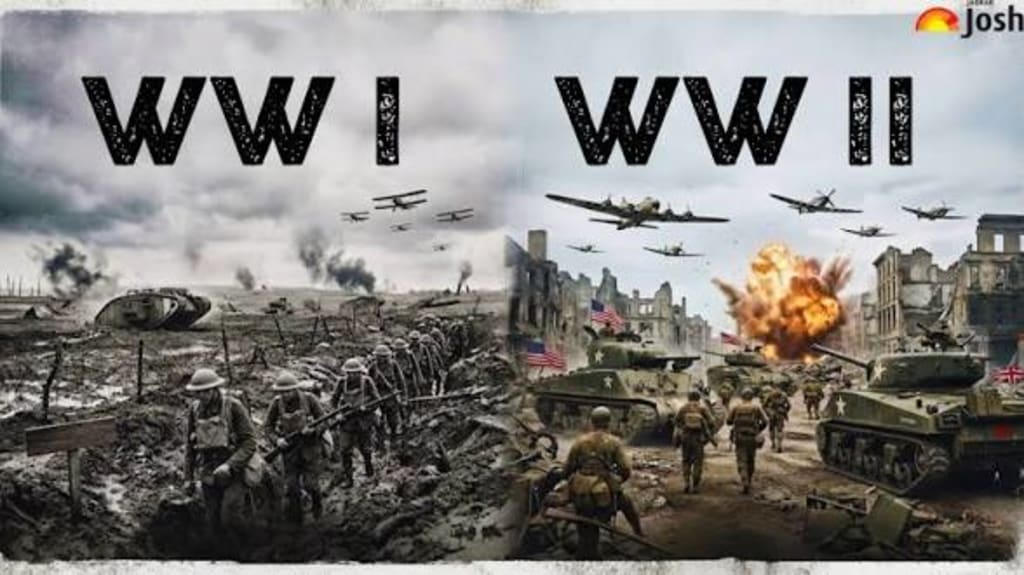
The two largest conflicts in modern history are World War I (1914–1918) and World War II (1939–1945). Both wars changed the course of human history and caused enormous destruction across many countries. Millions of soldiers and civilians lost their lives, cities were destroyed, and economies collapsed. However, historians generally agree that the Second World War caused far greater damage and loss of life than the First World War. By examining the number of deaths, the scale of destruction, and the impact on civilians, it becomes clear why World War II is considered the deadliest conflict in history.
Death Toll in World War I
World War I began in 1914 after the assassination of Archduke Franz Ferdinand of Austria. The conflict quickly spread across Europe and eventually involved many nations around the world. The two main sides were the Allied Powers—such as United Kingdom, France, and Russia—and the Central Powers, including Germany, Austria-Hungary, and the Ottoman Empire.
The war lasted four years and resulted in massive casualties. Historians estimate that about 15 to 20 million people died during World War I. Around 9 to 10 million soldiers were killed on the battlefield. Another 6 to 10 million civilians died due to famine, disease, and military actions.
World War I introduced new and deadly technologies such as machine guns, poison gas, and heavy artillery. Trench warfare made battles extremely brutal, and soldiers often fought in terrible conditions. Despite these horrors, the destruction was mostly concentrated in Europe, and the overall death toll, while shocking, was still smaller than what would occur in the next global war.
Death Toll in World War II
Only about twenty years later, the world faced an even more devastating conflict: World War II. This war began in 1939 when Adolf Hitler and Nazi Germany invaded Poland. Soon, many nations joined the war. The main Allied Powers included the United States, United Kingdom, and the Soviet Union, while the Axis Powers included Germany, Japan, and Italy.
World War II lasted from 1939 to 1945 and caused unimaginable destruction across Europe, Asia, and other regions. The total number of deaths is estimated to be between 60 and 70 million people, making it the deadliest conflict in human history.
Out of these deaths, about 25 to 27 million were soldiers, while over 40 million were civilians. Civilians suffered greatly because the war spread into cities and towns. Bombings destroyed homes, industries, and infrastructure. Entire populations were affected by hunger, disease, and violence.
One of the most tragic parts of World War II was the The Holocaust, in which about six million Jews were killed by the Nazi regime. In addition, millions of other civilians from different ethnic and political groups also died during this genocide.
Another shocking event of World War II was the use of nuclear weapons. In 1945, the Atomic bombings of Hiroshima and Nagasaki by the United States caused the immediate deaths of around 200,000 people, with many more dying later from radiation effects. This marked the first and only time nuclear weapons were used in war.

Comparing the Two Wars
When comparing the two conflicts, the difference in destruction becomes clear. World War I caused around 15–20 million deaths, while World War II caused approximately 60–70 million deaths. This means that the Second World War killed three to four times more people than the First World War.
There are several reasons for this difference. First, World War II involved more countries and larger armies. Second, military technology had become far more destructive, including advanced bombers, tanks, and nuclear weapons. Third, civilians became direct targets of warfare through bombings and genocide.
World War II also destroyed entire cities such as Warsaw, Berlin, and Tokyo. Economic systems collapsed, millions of people became refugees, and the political map of the world changed dramatically after the war ended.
Conclusion
Both World War I and World War II were tragic events that caused massive human suffering and destruction. However, World War II was far more devastating in terms of deaths, damage, and global impact. With an estimated 60 to 70 million deaths, it remains the deadliest war in human history.
About the Creator
shaoor afridi
“I am a passionate writer dedicated to sharing informative, engaging, and well-researched articles. My goal is to provide valuable content that educates, inspires, and adds real value to readers.”
Keep reading
More stories from shaoor afridi and writers in History and other communities.
Balloonfest 1986
Balloonfest 1986 was meant to be a joyful celebration. It was planned as a world record attempt and a symbol of hope, fun, and community spirit. Instead, it became one of the most famous examples of how a good idea can go wrong when nature is underestimated.
By shaoor afridi2 months ago in History



Comments
There are no comments for this story
Be the first to respond and start the conversation.