
Architecture of the Scythe Pt. 3/5
The Interrogation

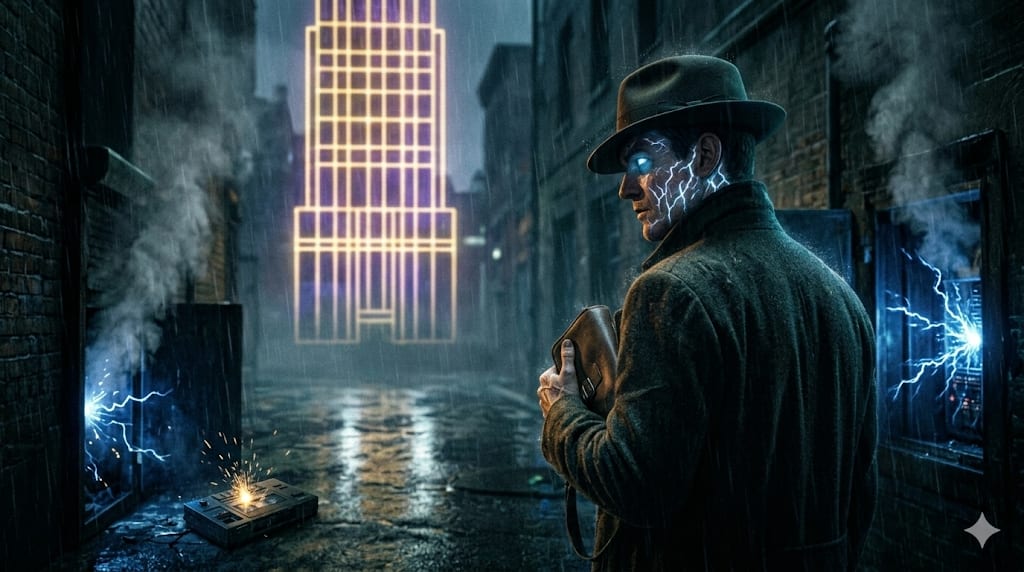
The Architecture of a Lie
The city has a remarkable, almost biological capacity for forgetting.
My efforts and warning were all for not; sure enough: the digital scrolls of the *Daily Ledger*, you’ll see the narrative being woven in real-time, smoothed over like fresh concrete. "Maya Vane, 19, Perishes in Canyon Crash; Mechanical Failure Blamed." They’ve already run the op-eds about the "Vane Curse," the "Fragility of Fame," and the "Poetic Symmetry" of a daughter following her mother into the dark. To the three million souls living under the smog of this metropolis, Maya is just another beautiful ghost, a tragic face on a commemorative magazine cover.
They believe the "Mechanical Failure" narrative because it’s a structural necessity. If people realized that their reality was held together by the blood of icons, the buildings would start to lean. They believe the "Accidental Drowning" of Elena because the coroner’s report was signed by a man with a gold star on his chest and a pension fund managed by the Vane Foundation.
But I am the only one who sees the blueprints of the crime. I am the only one who knows that in this city, "Accident" is just the word the Order uses for a successful harvest.
I sat in my basement, the air thick with the smell of damp concrete and the copper tang of my own fear. The Static in my head wasn't a hum anymore; it was a high-pitched, vibrating requiem for a girl I couldn't save. I had failed the Architect’s first rule: I hadn't accounted for the wind-shear of a conspiracy. I had pushed Maya away from the subway tracks only to send her running into the arms of a waiting sedan. I had seen the Smoke, but I hadn't been fast enough to blow it away. I was a man who understood the physics of steel but was utterly illiterate in the physics of fate.
The Sound of the Blue Veil
The boots on the stairs didn't sound like law enforcement. They sounded like a demolition crew.
In my former life, I could identify the weight of a person by the way the floor joists groaned. I knew the tensile strength of the pine and the way the vibration traveled through the masonry. But as I sat huddled over Maya’s satchel, the footsteps descending into my basement weren't just physical—they were seismic.
The Static in my head, usually a manageable gray drizzle when the gin was in my system, flared into a blinding, electric white. It was the color of a short circuit. It was the color of a lie being told with a clinical, terrifying calm. My nervous system felt like it was being scraped by a wire brush. This is what the lightning left behind: the ability to feel the "Structural Echoes" of a death before the body is even cold.
The door didn’t burst open. That would have been too messy. Instead, the lock clicked—a professional, surgical intrusion—and the door swung wide on silent hinges.
Detective Miller stepped in first, followed by Officer Kael. They weren't wearing their tactical gear. They were dressed for a funeral they had just finished officiating—charcoal suits, silk ties, and eyes like polished obsidian. Miller looked at me with a pity that felt like a razor blade across the throat.
"Silas," Miller said, his voice a smooth, bourbon-soaked baritone. "You look terrible. Even for a man who lives in a hole. You're vibrating, Silas. I can hear your teeth chattering from the doorway."
The Calibration of Fear
I tried to stand, but my legs were made of wet salt. The "Clear-Head" was gone, and the gin was a distant memory in my gut. My nervous system was a raw wire, exposed to the air. My skin was crawling with the "Static" of Maya’s death—a lingering, residue that seemed to coat the very walls of my room. It felt like walking through cobwebs made of static electricity.
"You killed her," I rasped, my throat feeling like it had been scrubbed with glass. "You took the last of them. Was the canyon crash part of the original design, or did you have to improvise when I ruined the subway push?"
Miller didn't answer immediately. He walked across the room with the practiced ease of a man who owned every square inch of the city's floor plan. He stopped at my drafting table, looking down at the blueprints of the Blackwood Bridge I still kept pinned there—the map of my own public execution. He traced the lines of the suspension cables with a manicured fingernail.
"The girl had a tragic accident, Silas. A faulty brake line. A steep grade. It’s a tragedy that will haunt this city for weeks," Miller said, his eyes landing on the Sony tape deck. "But we’re not here to talk about the dead. We’re here to talk about the 'Inheritance.' We’re here to talk about why you were seen harassing a traumatized heiress moments before her final drive. The Foundation is concerned, Silas. They’re concerned your mental state is... deteriorating."
Kael moved behind me. I couldn't see him, but I could feel his Static. It was cold. A deep, abyssal blue that sucked the heat out of the room. He placed a hand on my scarred shoulder—the one that had been crushed when the bridge gave way. It wasn't a gesture of comfort; it was a measurement. He was checking my pulse, gauging how much of the "Frequency" I could take before I broke.
"The public believes in the curse, Silas," Kael whispered in my ear. "They believe the Vane women were just... unlucky. They like it that way. And right now, you’re the only piece of the puzzle that doesn't fit the picture. We need to make you fit. Or we need to discard you like a misprinted blueprint."
The Interrogation: The Tithe and the Toll
Miller pulled out a chair—a spindly thing I’d salvaged from a dumpster—and sat across from me. He leaned in, and for the first time, I saw the "Tithe" he wore. It wasn't a badge. It was a small, lapel pin made of blackened gold, shaped like a shattered record.
"You think you’re a prophet," Miller said. "You think the lightning gave you a gift. But you’re just a broken circuit, Thorne. To the world, you’re the drunk who blew up a bridge. If you start talking about 'secret societies' and 'ritual harvests,' they won't put you in a cell. They’ll put you in a padded room and lose the key. And the Foundation? We’ll be the ones paying for your care. Just like we’ve been paying for those little blue pills you buy in the alley."
My heart hammered against my ribs. "How do you know about the pills?"
"We *are* the pills, Silas," Miller said, his voice dropping to a confidential hum. "Who do you think controls the black market in the District of Rust? We provide the poison and the antidote. We keep the world in a state of 'Planned Obsolescence.' Your mother, your career, your sanity... they were all designed to fail at a specific interval to make room for something else."
"I saw the water on Elena," I spat, the words catching in my lungs. "I saw the smoke on Maya. You didn't just watch them die. You 'tuned' the room. You used the Foundation to isolate them until the only thing left was the 'accident' you prepared. You're not policemen. You're architects of misery."
Miller smiled, and the Static around him flickered like a dying neon sign. "That’s the beauty of it, isn't it? As an architect, you should appreciate the craftsmanship. We don't pull the trigger. We just adjust the humidity. We loosen a bolt. We suggest a certain route home. We let the universe do the heavy lifting. The public *needs* tragedies like the Vanes. It gives them something to cry about while we keep the lights running and the subways moving. It’s a closed system, Silas. And you’re an unauthorized entry."
He reached out and tapped the tape deck. "Now. Give us the tape Maya dropped. Give us the last piece of Elena's 'confession,' and we’ll make sure your 'Clear-Head' prescription is filled for the next decade. No more Static. No more ghosts. Just the silence you’ve been begging for since the bridge went down."
The Withdrawal and the Echoes
The withdrawal hit me then—a wave of cold fire that turned my skin into a sheet of ice. My vision began to fray at the edges. I saw the air in the room start to ripple, like heat rising off asphalt. These weren't ghosts. They were **Shadow-Traces**—jagged, flickering distortions in the air where the "harvest" had left a hole in the world. They were thickest around Miller, like a swarm of invisible flies feeding on the energy he had stolen from the Vanes.
I knew what was on that tape. Elena hadn't just left a confession; she had left a "Frequency." She was a singer who understood how sound could shatter glass. She knew that if she recorded the "Final Note" while the Order was in the room, the tape would capture the vibration of their presence. It was a forensic map of the occult. It was the only evidence that wouldn't burn in a car crash or drown in a tub.
"I can't give it to you," I whispered.
Kael’s grip tightened. I felt a rib crack—a sharp, sickening snap that mirrored the bridge's failure. "Why not, Silas? It’s just plastic and magnetic strip. Maya is gone. There’s no one left to save."
"Because," I said, a jagged laugh tearing through my chest, "if I give it to you, then the 'accident' is real. As long as I have this, they were murdered. As long as I have this, I’m not a drunk, and you’re not a hero. I am the Architect of the Truth, Miller. And your foundation is built on sand."
Miller’s face hardened. The mask of the "helpful detective" fell away. The air in the room grew heavy, the pressure increasing until my ears began to bleed. The Static turned a violent, bruised purple.
"Search the room," Miller commanded. "If the tape isn't here, we’ll take the Architect to the 'Foundation's' basement. I wonder how loud the Static gets when you’re being buried alive in the very concrete you once poured. We'll tell the papers you finally succumbed to the 'Thorne Curse' and ended it all."
The Revelation
Kael began to ransack the room with a cold, mechanical fury. Blueprints were shredded—the work of my life turned into confetti. Bottles were smashed, the smell of gin rising like an incense of failure. My life was being reduced to rubble for the second time. But they were looking for an object. They weren't looking for a frequency.
In the chaos, my hand brushed against the "Play" button on the tape deck. I hadn't put the tape in yet—it was still tucked in the waistband of my jeans—but the machine was old, and it hissed with a pre-loaded white noise.
The sound filled the room.
To Miller and Kael, it was just the hiss of an empty deck. But to me, the Static in the room began to organize. The white noise from the speakers acted like a filter. Suddenly, the deep blue of Kael’s aura and the bruised purple of Miller’s Tithe began to bleed together.
I saw it then. The "Grand Design."
The secret society didn't just gain monetarily from the estate. They were using the "Icons" of the city to stabilize the very fabric of the reality they controlled. The "Vane Estate" wasn't a bank account; it was a load-bearing pillar of the city’s occult structure. By killing the women at the peak of their fame, they were "capping" the pillar, capturing the collective grief of the public and using it as a mortar to hold their empire together.
The public saw a tragedy. I saw a foundation stone being laid.
The Escape
"It’s not here!" Kael shouted, throwing my drafting table onto its side. The heavy oak slammed into the floor, a sound like a gavel.
Miller turned to me, his face a mask of cold fury. He reached into his coat and pulled out a heavy, snub-nosed revolver. He didn't point it at my head. He pointed it at my heart.
"You’re a faulty design, Silas. Time for a demolition."
But just as his finger tightened on the trigger, the Static in my head did something it had never done before. It didn't just hum. It **pulsed**.
A surge of kinetic energy—the same energy I had seen on Maya—tore through me. I didn't think. I didn't plan. I moved with the speed of the lightning that had once tried to kill me. I lunged not for the door, but for the broken bottle of gin.
I didn't use it as a weapon. I threw the glass shard into the exposed electrical panel I had been meaning to fix for months.
The basement erupted in a shower of sparks and darkness. The Static turned into a blinding strobe light. In the confusion of the blackout, I heard Miller fire—the muzzle flash a roar of orange light that briefly illuminated the oily Shadow-Traces swarming around his head. The bullet thudded into the oak table where I had been sitting a second before.
I scrambled through the dark, my fingers finding the satchel and the tape. I didn't go for the stairs; Miller would be waiting there. I went for the coal chute—a narrow passage that led to the alley. I crawled into the soot, my lungs burning, my rib cage screaming with every movement.
The Night Air
I burst out into the rain-slicked alley of the District of Rust, my lungs burning with the sudden intake of fresh, cold air. I was shaking, my vision a kaleidoscope of gray and white, but I was out.
I leaned against a brick wall, clutching Elena’s tape to my chest. The "Clear-Head" withdrawal was peaking, and the world was beginning to melt into a sea of vibrating shadows.
The city looked exactly the same as it had an hour ago. The neon signs hummed. The sirens wailed in the distance. To everyone else, the world was a safe, predictable place where people occasionally had "bad luck."
But as I looked up at the Vane Foundation skyscraper—the tallest building in the city, glowing like a monolith on the hill—I saw the Static. It was no longer gray. It was gold. The color of the estate. The color of the blood they had used to buy another ten years of control.
Maya was dead. Elena was dead. But I was still the Architect. I had spent my life building things that were meant to last forever. Now, for the first time, I was going to design something meant to fall.
I fumbled in my pocket and found the last pill—the one I had been saving for the end. I swallowed it dry. The Static didn't go away, but it sharpened. It focused.
"I see you," I whispered to the empty alley, and for a second, the Shadow-Traces in the air seemed to bow.
The Prophet was hunted. The Architect was homeless. But the Scythe had missed a stroke. And I was going to make them pay for every inch of the foundation.
About the Creator
Nathan McAllister
I create content in the written form and musically as well. I like topics ranging from philosophy, music, cooking and travel. I hope to incorporate some of my music compositions into my writing compositions in this venue.
Cheers,
Nathan
Keep reading
More stories from Nathan McAllister and writers in Horror and other communities.
Architecture of the Scythe
The Glass King I was a man of cold lines and hard angles. I was Silas Thorne, the "Architect of the New Century," a title bestowed upon me by critics who mistook my arrogance for vision. My face looked back at me from the gloss of Architectural Digest; my hands had drafted the shimmering glass spires that defined this city’s skyline. I didn't just build offices; I built altars to human ego. I believed in structural integrity, in the unshakeable laws of physics, and, most fervently, in my own untouchable prestige.
By Nathan McAllisterabout 10 hours ago in Horror
"Scream 7" (2026): Running out of Fresh Screams
This is the seventh time we’ve had a Ghostface crisis. Scream 7 is the latest edition of the Scream franchise. Sydney Prescott and her family are under attack by another anonymous killer dressed in a Ghostface costume. While having issues with her daughter, Tatum, they run from the bloody murders, trying to determine who is behind it all.
By Marielle Sabbag6 days ago in Horror
The Signal From Tomorrow
The signal arrived at 2:46 AM. Dr. Adrian Cole had been staring at the monitors for hours inside the silent control room of the Orion Deep Space Observatory. Most nights were uneventful—just endless waves of cosmic noise drifting through space.
By Baseer Shaheen a day ago in Horror


Comments
There are no comments for this story
Be the first to respond and start the conversation.