
Double Trouble
The Hitchhiker Season 1, Episode 2, and Freddy's Nightmares Season 1, Episode 7.

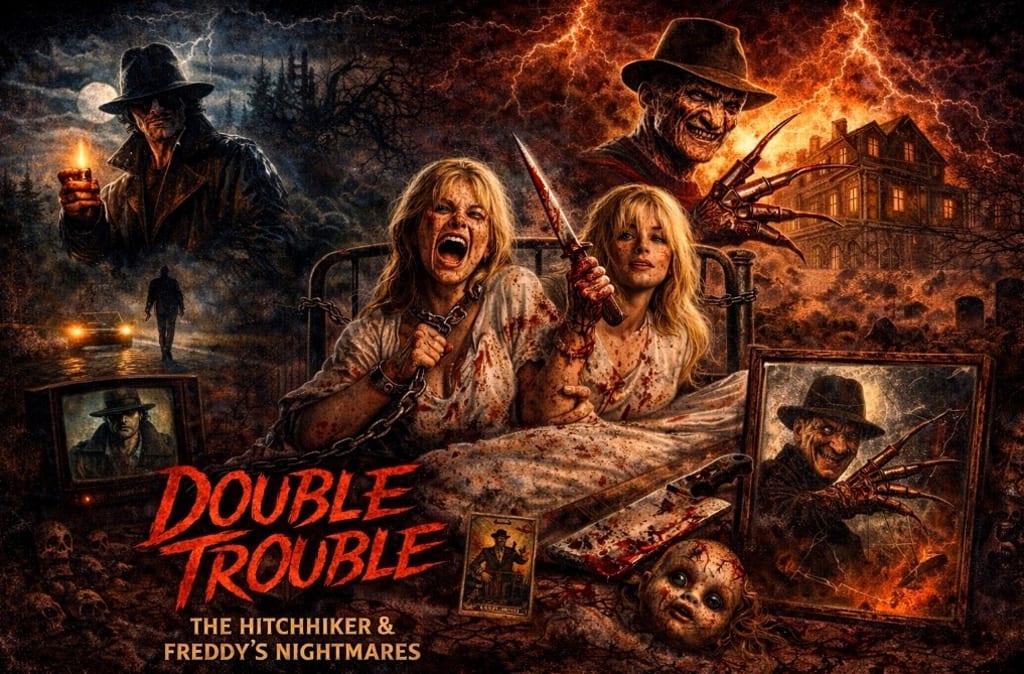
"The Hitchhiker" and "Freddy’s Nightmares," two Eighties anthology horror sleaze series that epitomize the era’s vast anxieties about rapidly changing social norms, each feature first-season episodes that hint at dark, twisted psychological mechanisms. No surprise there. Each, in its own way, opens up the mental sewer below the viewer, revealing the catarrhal slop that flows, like feculent sludge, beneath the conscious mind, in that dark netherworld of the limbic system where monsters dwell.
Split Decision (1983)
Episode 2 of "The Hitchhiker," Season One, which did not noticeably feature the taut, succulent man buns of the sexy-bad mojo Paige Fletcher (as “The Hitchhiker”) but instead the preceding Hitch, one Nicholas Campbell, was called “Split Decision,” and it first aired on cable back around the Good Year 1983. The opening segment of the lion’s share of Hitchhiker episodes, BTW, featured a butt-level view of Paige Fletcher’s tautly wrapped-in-denim derriere, a delectable and most entrancing sight for the viewer who was invited to follow the horror heartthrob on his trip through barren desert plains to deliver the opening monologue on his twisted tales of karmic comeuppance and cosmic retribution. Or somesuch.
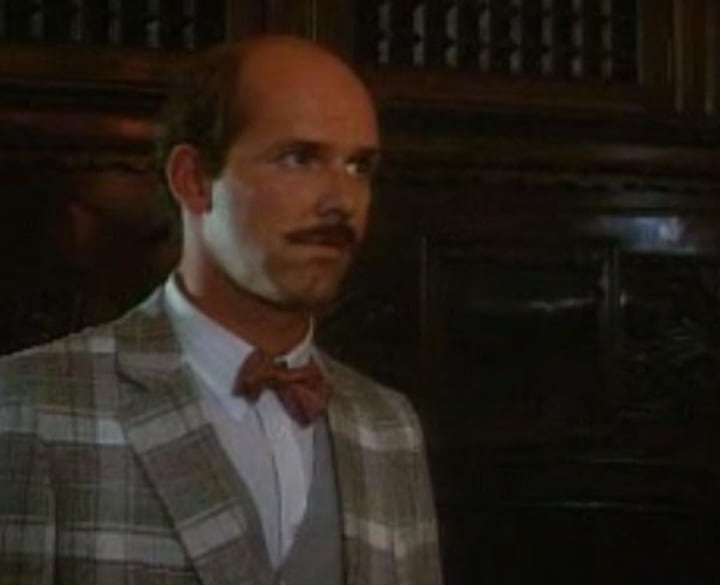
Getting back to it, “Split Decision” is a whomping good tale of a real estate agent named McElhaney (Jackson Davies) who is sworn to sell an old manse once lived in by a magician. The magician, who has since departed this Earth for other realms, left behind twin daughters — his sexily costumed assistants who look identical (played by the Landers sisters, Audrey and Judy). Which is which? You might ask. It hardly matters.
They relate a tale of owning a nice little dolly as little girls. They could never decide whose dolly it actually was. So, the simple solution? Divide the dolly in half (a similar solution was once suggested by none other than King Solomon).
The Hitchhiker TV series Both Intros
Split right down the middle. The magic of dividing it in halves. Split personality. The hidden mystery of twins.
McElhaney begins an affair with one of the sisters, securing a new, hip residence for her. And then, also, the other sister. But this is most decidedly a Wrong Turn.
The sisters, much as with their childhood dolly, cannot decide which one of them McElhaney really belongs to. Thus, they set him up to be ritualistically divided. We can say no more.
The Magician, incidentally, is a trickster, a master of deception in the Tarot (er, I mean terror, heh-heh). The doubleness of twindom is a kind of illusion in which two separate entities most assuredly resemble the mirrored selves of each other — a metaphor for spiritual schizophrenia. The Magician, the first and initial spark beyond the Zero represented by the unnumbered Tarot trump of The Fool, is a trickster par excellence and often the harbinger of ill will.
And illusions.
And what could be more magical than dividing what was once whole into two, creating the synthetic twin of something in an act of genesis showing supreme mastery over the material world?
Sister’s Keeper (1988)
“Sister’s Keeper,” Season 1, Episode 7 of the short-lived "Freddy’s Nightmares: A Nightmare on Elm Street: The Series," (which made colons do double duty), also features a pair of twins (I have to follow synchronous themes in my writing and viewing when they come up), these the blonde, beautiful Lisa and Merit (Gry and Hili Park), who both begin to get the same visitation by the razor-tipped, burnt-over walking mass of greenish, wisecracking scar tissue, Monsieur Fred K (as always, the redoubtable Robert Englund). The crux of the story seems to revolve around the strange twist of identity experienced wherein Merit claims to be Lisa, Lisa is institutionalized due to Freddy-itis, and both girls (who sleep in twin beds with old-fashioned iron headboards that look like prison bars) find that they can enter each other’s dreams and do combat with the Fredster.
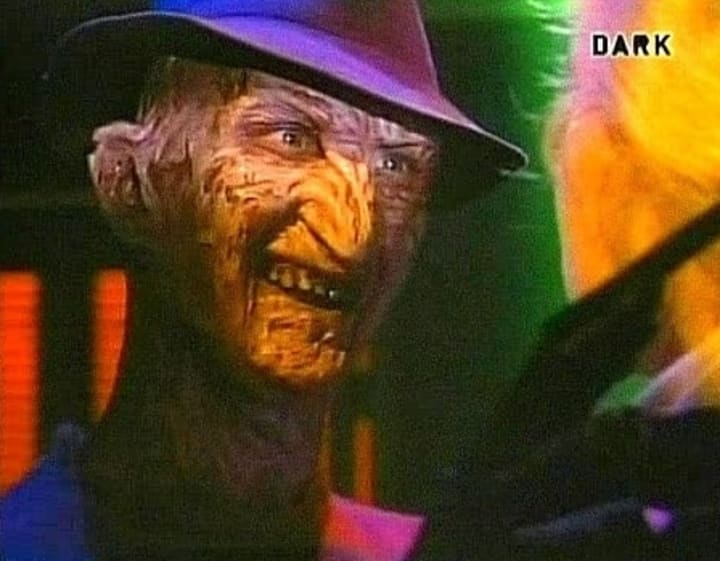
The Curse of Elm Street was visited upon them, incidentally, because their father — The Cop, the symbol of American middle-class bourgeois righteousness — hunted down the child-killing Freddy as part of the obviously enormous lynch mob and BURNED HIM ALIVE. Now, the mercurial Freddy, who resides in his other-dimensional boiler room cum hellscape like some horror Hephaestus, is stalking the daughters, who are schizophrenically divided between the Good Girl, Merit, and the Mental Menace, Lisa.
The failure to integrate the Shadow Self leads to Freddydom: he’s like a walking sexual disease, a greenish-skinned, razor-tipped-fingered rapist, the flipside of Lisa and Merit’s existence with their cold, distant, uber-professional yuppie 1980s Reaganite sharkskin Mama, who, at one point, can’t tell them apart (and the viewer begins to wonder if Merit is not simply imagining a twin, Lisa, as the repository of her guilt and fractured identity).
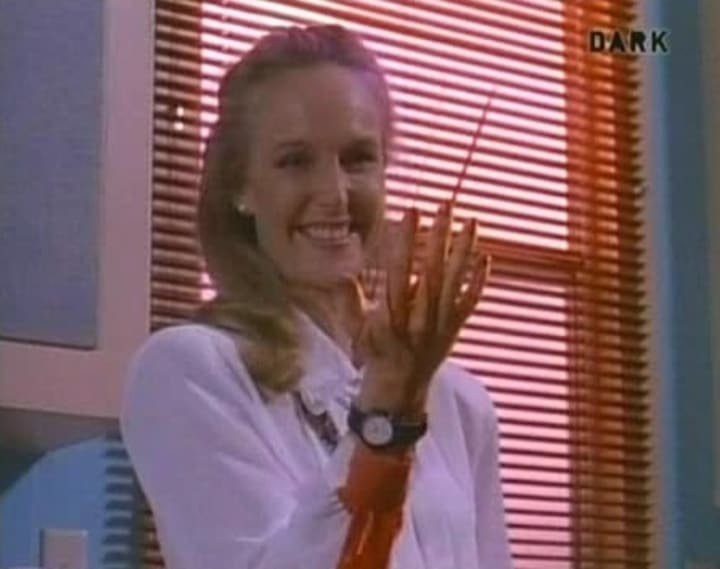
Identity plays a key role here — the bearded Sixties teacher, who, according to one of the sisters, knows “all kinds of weird stuff,” mentions identity and the dual nature of twindom (twins, identical twins, are often said to share curious and inexplicable traits, such as peculiar likes and coincidental circumstances, even if they only meet years later). Lisa and Merit are hypnotized together, but the real kicker is when they decide to go into the dream, à la the first Nightmare movie, and “get Freddy.”
The episode features a few top-notch gore shockers, effects work au naturel in an era before CGI and AI. How they got such stuff on television back in those days is a mystery.
The subtext here, like nearly all Nightmare on Elm Street stories, is the inversion of the Reagan-era ideal: the social malaise hidden beneath the well-clipped lawns and white picket fences of suburban White America — a world that was already beginning to disappear then and is now even more gone (though the resultant backlash cannot be denied as regards the political and social landscape). Mental illness, sexual deviancy, drug addiction, and teen suicide are all subtexts, with Freddy representing the anti-affluence and the drudgery of the common, ugly, lascivious, socially diseased grunt worker — underclass, wisecracking, and perverse. Freddy is the fear of blue-collar slums and the reality of a life many thought they were escaping. All of that in an era of anxiety, where Soviet missiles were aimed at suburban lawn jockeys with presumably unerring precision.
Freddys Nightmares "Sisters Keeper" Promo
It was an era of high anxiety: culturally, morally, and financially, the winds were shifting in the world. The Sovs would soon fold up their tents and go home. Iran-Contra had already burned over a lot of disillusioned Americans; it didn’t seem as if the “trickling down” was trickling. And values were becoming something completely different. Gay rights, urban crime, racial strife — you name it, we had it.
And along came TV horror. And as a safety valve for fears and dreams, it was par excellence.
It promised all of the grue, and none of the pain.
Like a good, stiff drink.
I’ll have a double.
In closing, it’s important to remember the scene in the original Nightmare film when Nancy (Heather Langenkamp) gets a call from a Freddy phone with a long tongue. She repeats, “This is just a dream, it isn’t real!” before Freddy comes bursting through from a mirror. In this episode, “Sister’s Keeper,” Freddy is likewise seen in a mirror — which offers the reflection of the viewer, his or her “twin,” except in inversion. A dark backward. A twin that, if not evil, is ultimately, like Freddy, inwardly scarred.
C’est la vie.
Author's website:
Author's YouTube
Read my book: Cult Films and Midnight Movies: From High Art to Low Trash Volume 1
Ebook
Read my book: Silent Scream! Nosferatu, The Cabinet of Dr. Caligari, Metropolis, and Edison's Frankenstein--Four Novels.
Ebook
Print book
About the Creator
Tom Baker
Author of Haunted Indianapolis, Indiana Ghost Folklore, Midwest Maniacs, Midwest UFOs and Beyond, Scary Urban Legends, 50 Famous Fables and Folk Tales, and Notorious Crimes of the Upper Midwest.: http://tombakerbooks.weebly.com
Killing him slowly
There’s an intruder in my house again. He stumbles through the door, wet carrier bags in hand. He’s bought me offerings. I show my appreciation, letting him caress my beautiful body. He wants to touch me. I rub myself against his legs. He sighs, dropping the bags. He can’t resist touching me. Running his hand slowly down my spine, I arch my back towards his caress, let out a low purr. It’s what we both need.
By N J Delmas28 days ago in Horror

Comments
There are no comments for this story
Be the first to respond and start the conversation.