
The Homes Flagged for Follow-up
Corporate Noir | Care Industry Dread | Bureaucratic Thriller

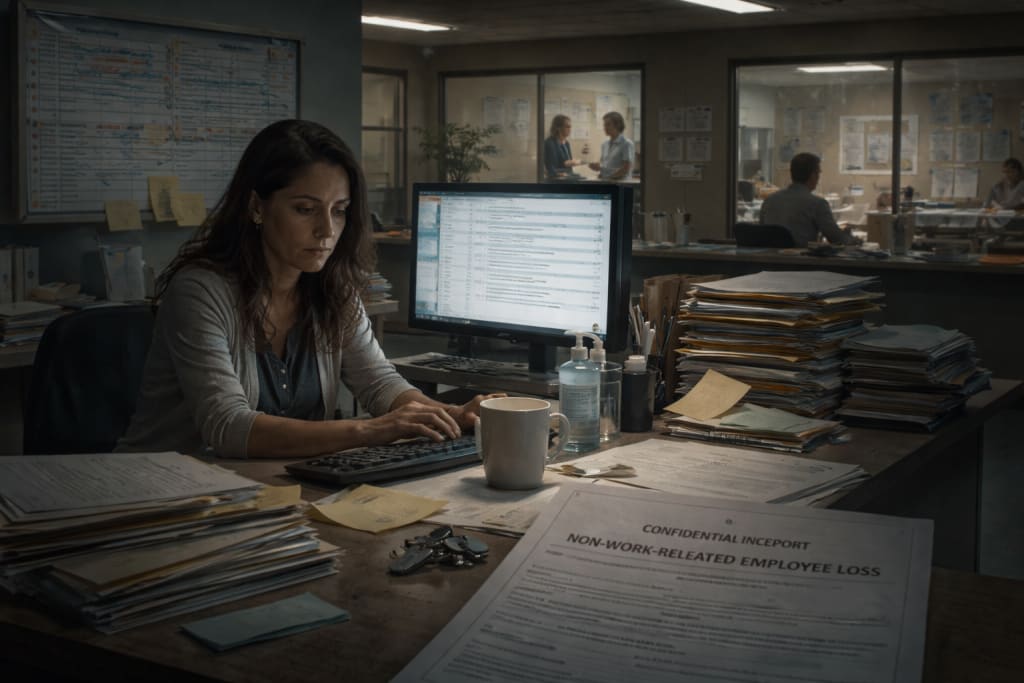
By eight each morning, our office smelled of coffee, disinfectant wipes, and printer heat, which is to say it smelled like concern that had learned to invoice. I unlocked the care-management dashboard and began assigning fifteen people to the homes where they would bathe strangers, sort pills, warm soup, and sign for it in blue ink.
We called ourselves a caregiver company because “liability router with empathy language” would not have fit on the door. There were fifteen of us if you counted the owner, which she did when it helped and did not when payroll was due. The reward for doing well was more trust, by which I mean more access: alarm codes, lockbox notes, garage entries, medication routines, the unphotogenic interiors of other people’s decline. We were encouraged to treat this as professionalism. Professionalism is a useful word. It can mean dignity, restraint, and never noticing the knife drawer has been left open in a house where the client cannot stand.
My job title was Care Coordinator, though most of the coordination involved making ugliness line up with a calendar. If a caregiver asked too many questions, Diane from HR praised their passion and removed them from premium shifts. If they nodded and signed the updated privacy acknowledgment without reading it, they were said to be aligned. We loved alignment. It kept the hallway quiet.
The little rituals came naturally after that. We corrected one another’s wording. We did not say a client had been frightened after a break-in; we said they had an “acute overnight disruption.” We did not say a widower had been found dead in his den after reporting that someone was entering his house between visits; we said his case had closed unexpectedly. When Marisol mentioned that three burglaries in two months had all occurred in homes whose access notes had recently been edited, Diane smiled the kind of smile that belongs in training slides and thanked her for “not escalating emotion into operations.” Marisol apologized. That was considered mature.
Then we hired Evan.
He was the new overnight float, broad-shouldered, soft-spoken, the sort of man who wiped the break-room counter before setting down his lunch. His habit was washing his hands twice before touching any shared keyboard. His condition, as described by Diane in the onboarding packet, was a recent divorce and “a tendency toward private thinking.” That last phrase should have impressed me more. In our office, privacy was treated like mold: not always visible, rarely welcome.
I first noticed him in the supply room, where the spare gloves, gait belts, and adult briefs were stacked by brand and reimbursement code. He stood very still with a printout in his hand, reading the service logs the way a priest might read a list of sins if he expected duplicates. “These timestamps don’t match,” he said.
“They do in the final version,” I told him.
He looked at me the way decent people look at soup that has developed a skin. “Three homes reported attempted entry. One client was killed. Another was tied up. And the employee access notes were opened from the office before each shift.”
“Not killed,” I said. “Deceased. There’s an incident taxonomy.”
That was when he made the mistake. He carried the page into Diane’s office instead of back into his own skull.
The afternoon stretched itself around the problem. Diane invited him to sit. She praised his thoroughness. She thanked him for protecting the company. She asked whether this concern might be related to stress from the divorce. In the hall, one of the aides answered a question with a compliment. Another took the paper from Evan’s hand and folded it without comment. At four, Diane sent a team-wide reminder about “careful handling of speculative narratives.” At four-fifteen, she added a cheerful note about our quarterly pizza lunch. It is difficult to sustain moral panic while being offered pepperoni on company funds. This is one of management’s older sciences.
Evan kept going. He called two clients directly to confirm recent lockbox changes. He asked why old access codes were preserved in the audit trail but new ones were being exported to a spreadsheet no caregiver was supposed to see. He asked why one of our field supervisors, Lyle, had been near three of the burglarized properties off the clock. He asked, most offensively, whether anyone intended to report it outside the company.
That evening, in the parking lot, Lyle told him not to confuse concern with disloyalty. He said it mildly, like recommending a jacket. The next day Evan’s schedule lost all private-duty shifts. Then his mileage reimbursements were delayed. Then Diane asked him to complete a behavioral wellness check-in because colleagues had noted “fixation.” It was an elegant sequence. Most people can survive fear or hunger. Very few can survive HR language.
Two weeks later Evan came down with a cough he said he could not shake. He looked gray around the mouth. He missed one shift, then came in anyway because rent retains a medieval character. The office framed it as exhaustion. Overextension. Adjustment. Diane sent him home with a branded water bottle and a printed handout on resilience. He laughed once when he read it, then apologized for the tone.
In his third week, he told me quietly that he had copied the audit trail to a flash drive and left one copy with his sister. He said if anything happened, there would be questions. I remember being offended by the implication that questions were a natural response to anything.
He died in a rented room above a laundromat on a Sunday morning. The official cause was pneumonia complicated by stress. The actual cause, if anyone had wanted it plain, was that Lyle had gone there the night before to retrieve the drive and had left with it after a struggle short enough to be called unfortunate and long enough to settle the issue. There were bruises. They became “evidence of collapse.” There is always a phrase available. That is why phrases are paid.
The breaking point came on Tuesday when I found Evan’s badge activity still in the system. He had supposedly been off-site during one of the earlier burglaries, but the access log showed his credentials used to open the client-note export panel forty minutes after he had clocked out from a different address. A contradiction sat there in neat gray rows, vulgar as blood on white tile. Diane saw me looking. For a second I thought she might admit the shape of things. Instead she asked whether I had finished the condolence template.
I chose silence because silence was already formatted.
By noon we had the sanitization artifact: an internal incident report marked Non-Work-Related Employee Loss / Confidential. The burglaries were separated from the murder by terminology, then separated from terminology by policy. We replaced “copied access notes” with “possible data irregularity.” We removed Lyle from route maps retroactively and reclassified his visits as supervisory wellness checks. We told staff not to speculate, not to contact the family, and not to preserve side records outside the approved platform. A courtesy meal train was organized for optics and casseroles. Diane said the company must remain a calm presence for clients. She said this while deleting one date, changing another, and forwarding Legal a version of the week that had been lightly improved.
At close of business I printed the revised schedule for Wednesday. Fifteen names. Nine houses. Three clients who now preferred the chain lock kept on between visits. One widow who had started sleeping with the television on. Lyle took the south route. Diane thanked me for my steadiness. In our line of work, steadiness is what they call it when a person still knows where the bodies are kept in the software and continues to color-code them.
The dashboard was clean again by morning, and the homes still needed care.
About the Creator
Jesse Shelley
Digital & criminal forensics expert, fiction crafter. I dissect crimes and noir tales alike—shaped by prompt rituals, investigative obsession, and narrative precision. Every case bleeds story. Every story, a darker truth. Come closer.
Keep reading
More stories from Jesse Shelley and writers in Horror and other communities.
He Said It Was Self-Defense
Andrew Smith was the kind of man who remembered the shape of your handshake but not your name. He wore cheap cologne and smiled too long. He never raised his voice—only leaned closer, lowering it, until people felt like confessing things they didn’t need to confess.
By Jesse Shelley4 months ago in Horror
"Scream 7" (2026): Running out of Fresh Screams
This is the seventh time we’ve had a Ghostface crisis. Scream 7 is the latest edition of the Scream franchise. Sydney Prescott and her family are under attack by another anonymous killer dressed in a Ghostface costume. While having issues with her daughter, Tatum, they run from the bloody murders, trying to determine who is behind it all.
By Marielle Sabbag8 days ago in Horror
Splattered In Your Smile
The suns treacherous kiss baking my blood stained shirt yet I am unsure how I managed to live or if my little Maxine is okay. After she plunged the machete into my chest, I can only hope she took off like a bat out of hell. I kind of feel for the kid, thinking she had to murder her only parental influence since I found her suckling on her mother deceased corpse.
By Magnar Arnea day ago in Horror
From ad men to mad men
It's after 2am in the morning when a local police patrol vehicle in Northern New Jersey spots a figure costumed as Quasimodo, The Hunchback of Notre Dame, proceeding southbound on the sidewalk along Lydecker Street. Though the hunchback’s costume stuffing offers added insulation, it's January, and friggin’ freezing. Carefully, the officers slow down, gently question the subject, and offer him a ride home.
By David W. Maury5 days ago in Humor



Comments
There are no comments for this story
Be the first to respond and start the conversation.