
Jesse Jackson: The Voice That Refused to Be Silenced
From the segregated streets of Greenville to the world stage, the life of a man who spent eight decades fighting for justice

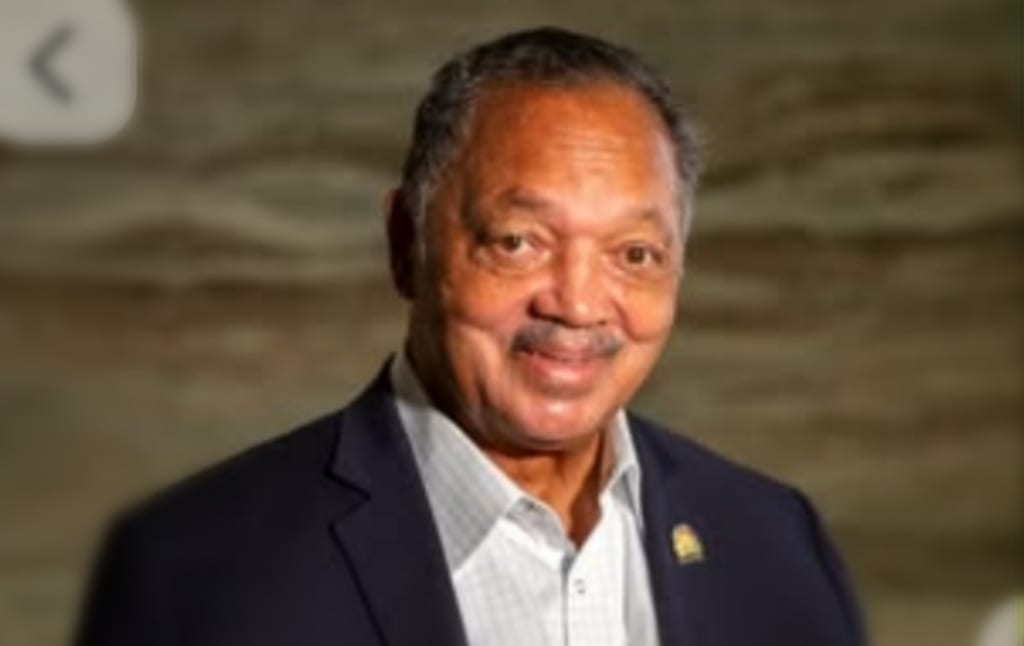
Long before Jesse Jackson stood on national stages, long before he electrified crowds with the thunder of his voice, he was a boy standing on the wrong side of a segregated street—watching a world that told him he did not belong. That early contradiction, the distance between who he was and who he was told he could be, became the fire that shaped one of the most influential civil rights leaders of the 20th century.
Jesse Louis Jackson Sr. was born on October 8, 1941, in Greenville, South Carolina, during the height of Jim Crow segregation. He entered the world as Jesse Louis Burns, the son of a teenage mother and a father who lived nearby but did not raise him. His stepfather, Charles Henry Jackson, later gave him his last name. Growing up, Jesse saw the daily humiliations of segregation—separate schools, separate water fountains, separate futures. But he also saw the power of community, church, and education. He excelled in school and sports, becoming a star quarterback and student leader. Even then, people noticed his presence. He had a voice that could fill a room and a confidence that made others follow.
After graduating from North Carolina A&T State University in 1964, Jackson stepped directly into the heart of the civil rights movement. He joined the Southern Christian Leadership Conference and worked closely with Dr. Martin Luther King Jr. He marched in Selma, organized boycotts, and became director of Operation Breadbasket, a program focused on economic empowerment for Black communities. His work helped secure jobs, contracts, and opportunities for thousands of African Americans.
When Dr. King was assassinated in 1968, Jackson was in Memphis. The loss devastated him, but it also strengthened his resolve. He believed the movement could not end with King’s death. In 1971, he founded Operation PUSH (People United to Save Humanity), an organization dedicated to expanding educational and economic opportunities. Later, he created the Rainbow Coalition, a groundbreaking effort to unite people across racial, economic, and religious lines. His message was simple but powerful: America must expand its circle of opportunity.
By the 1980s, Jackson had become one of the most recognizable voices in American politics. His presidential campaigns in 1984 and 1988 were historic. He spoke for the poor, the working class, and the marginalized. He spoke with the cadence of a preacher and the urgency of a man who had seen injustice up close. His 1988 Democratic National Convention speech—“Keep hope alive!”—became a rallying cry for millions. Though he did not win the nomination, he achieved something unprecedented: he brought millions of new voters into the political process and proved that a broad, diverse coalition could reshape American politics.
Jackson’s activism extended far beyond elections. He fought for food justice in Chicago, challenging grocery stores that neglected Black neighborhoods. He negotiated the release of hostages abroad, including Americans held in Syria and Cuba. He advocated for LGBTQ rights, workers’ rights, and global human rights. His work was not confined to podiums—it lived in the streets, in the aisles of grocery stores, and in the quiet negotiations where real change begins.
In the 1990s, Jackson served as the Shadow Senator for Washington, D.C., continuing his push for representation and equality. Even as Parkinson’s disease began to affect his mobility in the 2010s, he remained a moral voice. He continued speaking, marching, and mentoring younger activists. His presence alone reminded people that the fight for justice is not a moment—it is a lifetime.
Jesse Jackson died on February 17, 2026, at the age of 84. His passing sparked memorials across the country. Civil rights leaders, politicians, and ordinary citizens reflected on the man who had marched with King, challenged presidents, and inspired generations. His influence can be seen in leaders like Barack Obama, whose coalition drew from the foundation Jackson built decades earlier. His legacy lives in every movement that believes in the power of collective action.
Jackson’s story is not simply the story of a civil rights leader. It is the story of a man who refused to accept the world as it was. A man who believed that justice was not a dream but a duty. A man who understood that hope is not passive—it is active, loud, and unyielding.
He taught America that progress requires persistence. That courage is contagious. That voices, when joined together, can shake the foundations of power.
And above all, he taught us to keep hope alive.
About the Creator
Haroon Pasha
👍 Like | 💬 Comment | 🔔 Follow
🔄 Share my stories to support independent writing
💖 Tip to help this page grow and create more content
💹 Smart steps build strong futures — begin yours with Binance
Keep reading
More stories from Haroon Pasha and writers in Humans and other communities.
Punch the Macaque: The Baby Monkey Who Found Comfort in a Plush Friend
Today we look back at one of the most unexpected viral stories of 2025—a tale that began quietly in a zoo in Japan and grew into a global symbol of resilience and tenderness. It is the story of Punch, a Japanese macaque born in July 2025 at Ichikawa City Zoo in Chiba Prefecture. His life began with hardship, but what followed has touched millions across the world.
By Haroon Pashaabout 10 hours ago in Families
How Naushad Parpia Views Emotional Intelligence
Emotional intelligence shapes communication, trust, and long-term performance outcomes. Leaders who manage emotions create stable and focused environments. This approach strengthens collaboration during pressure and uncertainty. Many founders highlight emotional awareness as an essential leadership discipline. Naushad Parpia often connects emotional intelligence with sustainable growth principles. This article explains how emotional intelligence shapes leadership and management success.
By Naushad Parpia2 days ago in Humans
The BAFTA Awards
By now, in a stunning departure from recent years, most of the world is aware of what happened at the BAFTA film awards. Social Media Headlines will tell you the bare bones: that John Davidson, a Tourette's Syndrome advocate, shouted a racial slur at two Actors of Colour, Michael B Jordan and Delroy Lindo.
By Natasja Rose3 days ago in Psyche


Comments
There are no comments for this story
Be the first to respond and start the conversation.