
Please Take a Number
On the Human Cost of Measurable Progress

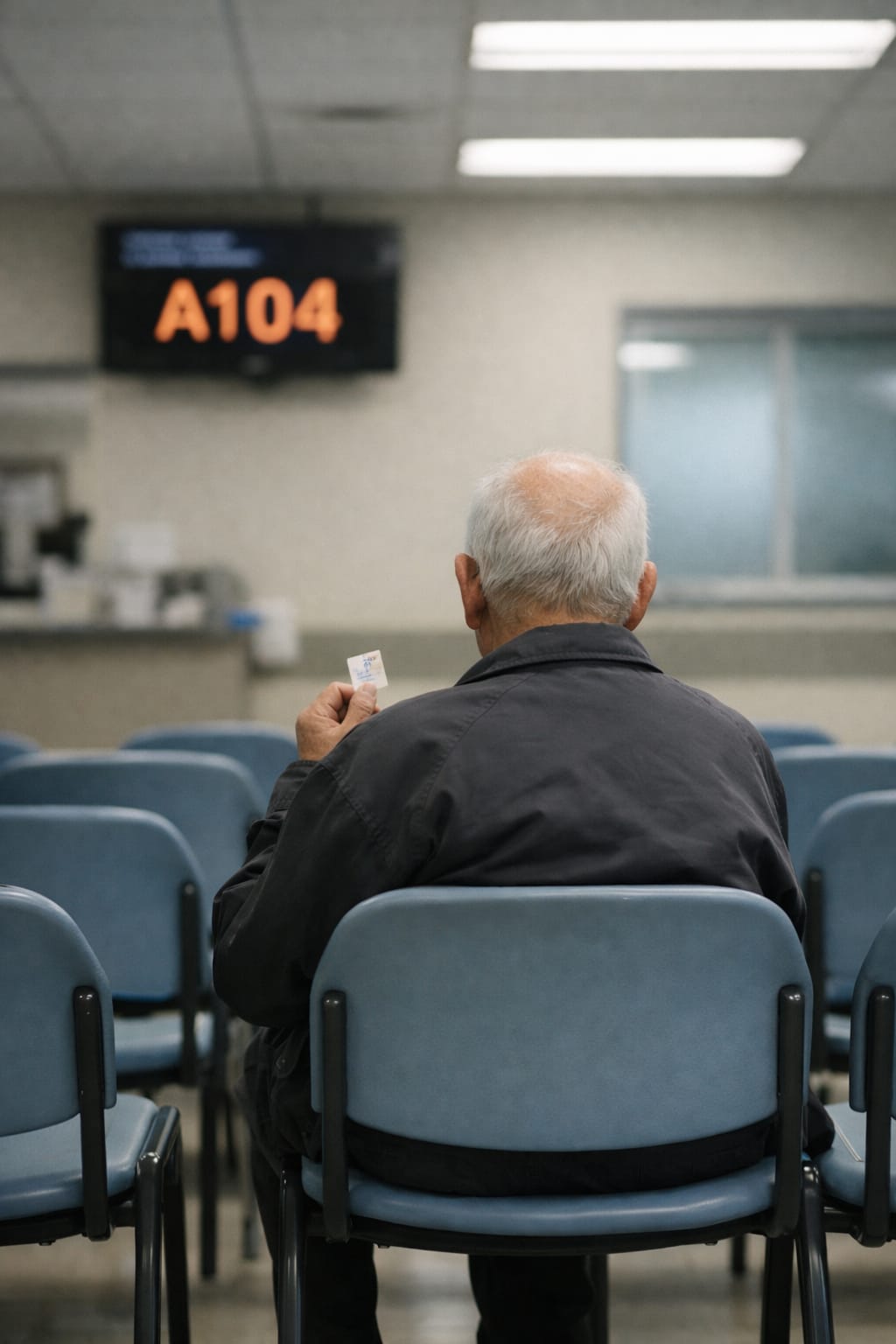
The first thing they gave my father wasn’t a diagnosis. It was a number.
Printed in black ink on thin white paper, slightly curled at the edges, handed to him with neutral politeness. “Please wait to be called.” The waiting room was bright, organized, calm in the way that institutions are calm when they have decided that calm is a design feature. Chairs arranged in obedient rows. A mounted screen blinking forward in disciplined sequence. A102. A103. A104. Order. Process. Fairness. My father sat beside me with his hands folded over his knees, breathing carefully, as if even the act of taking air required correct timing. He believed in systems. He paid his bills early. He followed instructions precisely. If the screen said wait, he waited.
The system worked. That was the part that unsettled me.
Hours passed, not dramatically, just steadily. Measured by vending machine trips and the murmur of televisions mounted too high to watch comfortably. Nobody complained loudly. Everyone watched the screen. When our number finally appeared, it felt almost ceremonial, like we had been admitted into something structured and official. Beyond the waiting room was a corridor lined with identical doors, each holding a private version of uncertainty. The doctor spoke in efficient language. Terms polished smooth by repetition. We will monitor. We will reassess. We will evaluate progression. Uncertainty organized into stages. Fear divided into follow-up dates.
In the car afterward, my father said, “Well, that seems straightforward.” He said it as if simplicity were a comfort.
But that morning he had dropped his coffee mug because his left hand didn’t quite close around it. Not a dramatic fall. Just enough to stain the counter and make him stare at his fingers with something like confusion. The system did not record confusion. It recorded grip strength numbers and imaging results. It waited for measurable thresholds. Below this line is concern. Above this marker is action. In between is monitoring.
Monitoring feels passive when you are the one being monitored.
Weeks passed. He misplaced words before he misplaced objects. He would pause mid-sentence, eyes slightly unfocused, mouth open as if the word were hovering just beyond reach. I would gently supply it, and he would nod, embarrassed but trying not to show it. On paper, however, nothing had changed significantly. No metric had crossed into urgency. Stable. That word appeared in his file. Stable suggests steadiness. Stable suggests safe. But stability, I learned, can also mean suspended between recognition and response.
The next appointment followed the same choreography. Check-in. Wait. Number. Hallway. Screen light flickering across a physician’s glasses. “We’re watching for measurable progression.” Watching is a calm word. Watching is observational. Watching is patient. Living inside that watching is something else entirely. Living there means recognizing small losses before the system is allowed to. It means noticing that buttoning a shirt now takes a minute longer. That climbing stairs requires calculation. That fatigue sits closer to the surface. None of it dramatic enough to qualify. Not yet.
The system promises equality by treating everyone the same. That is part of its fairness. But sameness assumes that everyone experiences waiting in the same way. My father did not complain. He did not exaggerate symptoms. He did not push for earlier intervention. He did not want to be a problem. His restraint registered as resilience. The chart read stable. The date stayed the same.
When the threshold was finally crossed, it happened quietly, as thresholds do. A number dipped below range. A measurement confirmed decline. “Now we can adjust the treatment plan,” the doctor said. Now. The word settled in me like something heavy. Now that enough loss had occurred to meet criteria. Now that the progression was official. Adjustment required proof. Proof required deterioration. It was not cruel. It was procedural. That is what makes it difficult to argue with.
As months narrowed, the hospital became a second geography. Corridors mapped in repetition. Nurses moving in practiced arcs. Monitors blinking in rhythm. Everything worked the way it was built to work. Medication arrived on schedule. Charts updated efficiently. Staff rotated shifts with impressive coordination. I began to understand that the system excels at managing scale. Millions of bodies passing through structured care. Predictability offered in place of chaos. That kind of organization is not accidental. It is necessary.
And yet inside that necessity, something does not align perfectly with the way humans decline.
Decline is uneven. It is halting. It is emotional before it is measurable. It is a man staring at his hands because they do not obey him the way they once did. It is the quiet humiliation of needing help with buttons. It is the long pause between words that used to come easily. The system cannot categorize humiliation. It cannot chart hesitation. It waits for numbers. It moves when numbers move.
Near the end, my father spent more time under fluorescent light than under sky. Machines kept rhythm. Forms accumulated. His presence was translated into documentation. When he passed, the paperwork moved swiftly. Death certificate. Signatures. Billing summaries. The same efficiency that had structured his care structured his absence. A file closed. A number resolved.
I still think about that first slip of paper. Thin. Curled at the edges. Please wait to be called. It was not dishonest. Everyone is called eventually. The system does what it promises: it organizes. It standardizes. It distributes attention as evenly as possible across impossibly large demand.
But there is a territory between stable and urgent that does not fit neatly into protocol. A territory where people are changing before the system allows that change to matter. A territory made of quiet adjustments and delayed acknowledgement. That territory is not dramatic. It is experienced as friction. As the subtle feeling that something real is happening slightly faster than the system is prepared to admit.
The structure remains intact. The hallways are clean. The numbers still progress upward on their screens. The order remains.
And in the spaces between measurements,
people wait.
About the Creator
Melissa
Writer exploring healing, relationships, self-growth, spirituality, and the quiet battles we don’t always talk about. Sharing real stories with depth, honesty, and heart.
Will AI Replace Me? Why “Augmentation” Is the Word We Should All Use
“Will AI replace me?” It’s the quiet question behind office small talk, late-night scrolling, and career-planning anxiety. Whether you’re a designer experimenting with generative tools, a teacher adapting lesson plans, a developer integrating APIs, or a writer watching algorithms produce paragraphs in seconds, the fear feels personal.
By Mind Meets Machine5 days ago in Humans




Comments
There are no comments for this story
Be the first to respond and start the conversation.