
Structural Integrity
Why Fluff and Vagueness Undermine Cultural Trust

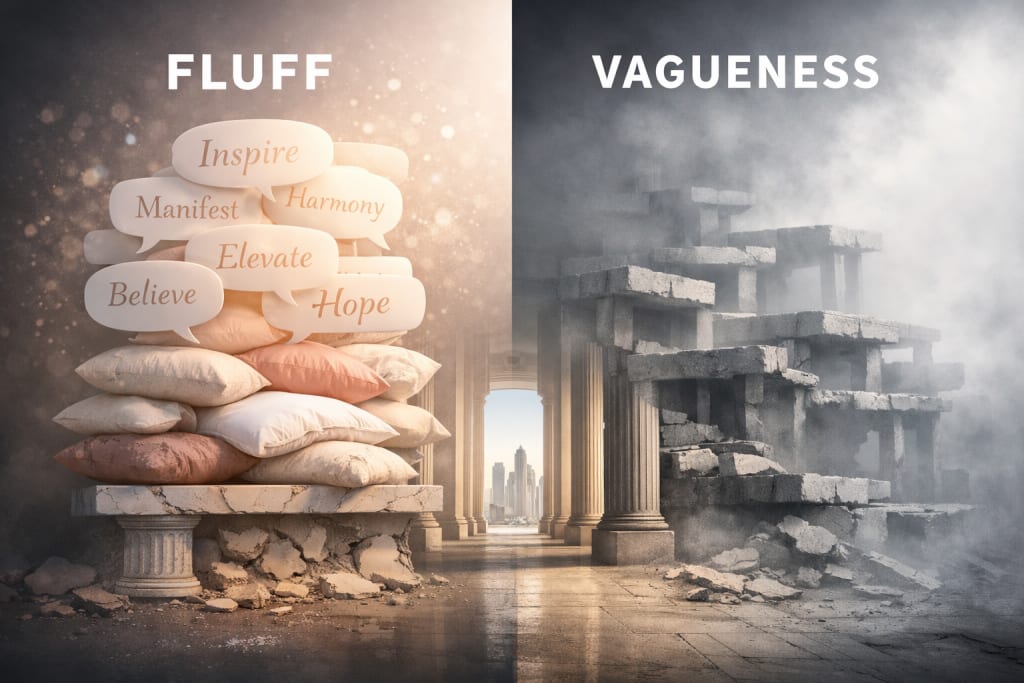
Fluff
When Language Dresses Up as Substance
There is a difference between softness and fluff.
Softness is regulated.
Fluff is inflated.
Softness is chosen.
Fluff is compensation.
Fluff is what happens when we want to sound wise without doing the excavation.
It’s when we stack adjectives like throw pillows and call it foundation.
It feels good for a moment.
It photographs beautifully.
It collapses under weight.
Fluff is language that avoids consequence.
It is the illusion of depth without the discipline of clarity.
It says:
“Everything happens for a reason”
instead of
“I don’t know how to sit with your grief.”
It says:
“Good vibes only”
instead of
“I don’t have the nervous system capacity for complexity.”
Fluff is not evil.
It’s protective.
It’s what we reach for when truth feels sharp.
But the problem isn’t fluff existing.
The problem is building homes out of it.
Because fluff cannot hold boundaries.
Fluff cannot carry grief.
Fluff cannot withstand confrontation.
Fluff cannot survive contact with reality.
Architecture can.
Architecture doesn’t need sparkle.
It needs load-bearing integrity.
You can feel the difference in your body.
Fluff makes you float slightly above yourself.
Architecture makes you feel your feet.
Fluff performs coherence.
Architecture practices it.
Fluff wants applause.
Architecture wants alignment.
And here is the most uncomfortable truth:
Sometimes fluff is how we avoid becoming visible.
Because clarity exposes us.
Consistency tests us.
Alignment costs us.
Fluff keeps us likable.
Architecture makes us reliable.
One is decoration.
The other is structure.
And if we are honest — truly honest — we’ve all hidden in fluff at some point.
The question isn’t whether you’ve used it.
The question is:
Are you ready to build without it?
Fluff as Cultural Infrastructure
Fluff does not only live in personal language.
It scales.
When institutions trade precision for branding,
that is fluff.
When policies are written to sound compassionate but avoid measurable commitment,
that is fluff.
When leadership speaks in abstractions instead of timelines,
that is fluff.
Cultural fluff sounds like:
“We value transparency.”
Without published data.
“We support community.”
Without structural investment.
“We are committed to change.”
Without defined metrics.
Fluff at scale is expensive.
It consumes attention.
It erodes trust.
It replaces accountability with aesthetic.
And over time, people stop believing language at all.
Because when words repeatedly fail to carry weight,
they lose their gravity.
Architecture at the cultural level requires:
Clear definitions.
Measurable commitments.
Consistent behavior.
Without those, we do not have vision.
We have decoration.
The Comfort of Being Vague
How Ambiguity Protects Us From Accountability
Vagueness feels kind.
It sounds inclusive.
It avoids sharp edges.
It leaves room.
But sometimes vagueness is not kindness.
It is insulation.
When we are vague, we do not have to be wrong.
We do not have to be clear.
We do not have to be accountable.
Specificity creates friction.
Vagueness creates safety.
“I just think people should do better.”
Better how?
“I want more respect.”
From whom?
In what behavior?
Measured how?
Vagueness lets us speak without committing.
It lets us critique without constructing.
It lets us posture without positioning.
And because it is hard to disagree with something undefined,
it often goes unchallenged.
You can’t test a fog.
You can only walk through it.
And this is why vagueness becomes comfortable.
Clarity risks exposure.
Precision risks conflict.
Definition risks responsibility.
When you say exactly what you mean,
you create edges.
Edges create consequence.
And consequence reveals character.
So we soften.
We generalize.
We blur.
Not because we are malicious.
Because we are afraid.
Afraid of being pinned to a position.
Afraid of being measured by our own words.
Afraid of being held to the standard we imply.
Vagueness protects ego.
Clarity builds trust.
One feels easier.
The other builds infrastructure.
And that is the difference.
About the Creator
Flower InBloom
I write from lived truth, where healing meets awareness and spirituality stays grounded in real life. These words are an offering, not instruction — a mirror for those returning to themselves.
— Flower InBloom
Keep reading
More stories from Flower InBloom and writers in Humans and other communities.
Regulation at the Threshold
Author’s Note — Flower InBloom This series is part of my ongoing work exploring personal sovereignty through nervous system awareness and structural alignment. I write not to dramatize change, but to understand how the body organizes through it. When we learn to regulate at the threshold, endings stop feeling like collapse and begin revealing architecture.
By Flower InBlooma day ago in Humans
What Is Restlessness And What To Do About It?
Sometimes you may feel restless, but you don't know why. Sometimes you may know why you are restless, but you don't know what to do about it. Then there are other times when you feel uneasy and restless, even when things are going great.
By Margaret Minnicks8 days ago in Humans
Belle of the Bayou
Bad move, cher. Not just the slip of her kitten heel on the rainy February cobblestones in the Fourth Ward. She got caught snooping. Detective Deleon clucked and strutted like a rooster in his rush to clear her from the scene, waving cigar smoke to and fro as he gesticulated amid the thick air of the speak easy. An experienced crime reporter, Marie knew better than to let the coppers catch her on the wrong side of the line, but curiosity had gotten the better of her.
By Maia Gadwall the metAlchemist5 days ago in Fiction



Comments
There are no comments for this story
Be the first to respond and start the conversation.