
When the Shelter Closes
“On the coldest night of winter, I learned that sometimes survival depends on a stranger who refuses to walk away.”

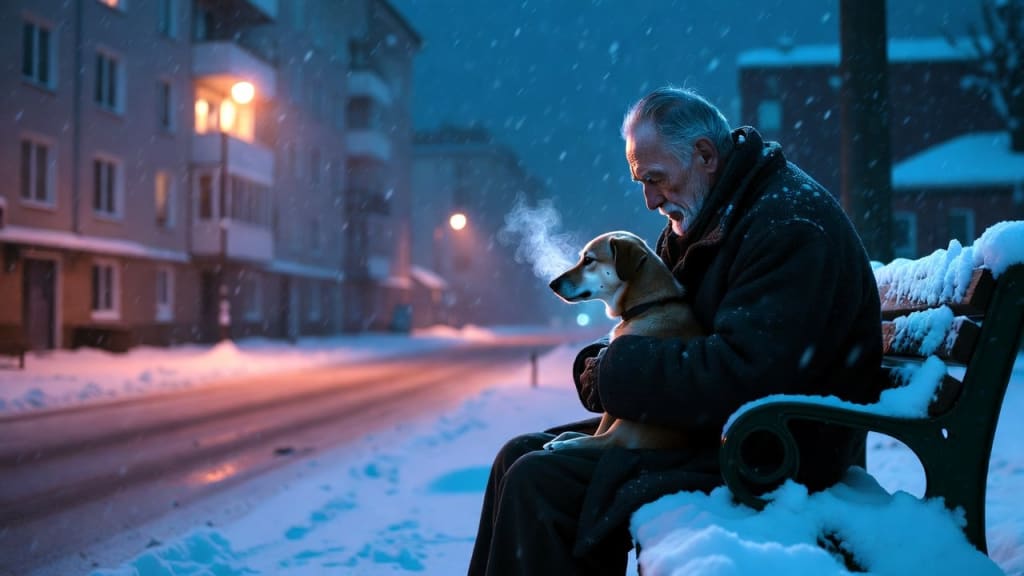
The first night I saw him, I thought he was waiting for someone.
He sat across the street from my apartment building on a metal bench that had lost most of its green paint. A grocery cart stood beside him, overflowing with plastic bags, a torn blanket, and what looked like an old photo frame wrapped carefully in cloth. At his feet lay a dog — thin, golden-brown, ribs visible, but loyal in the way only dogs can be.
It was late November. The wind had started to sharpen.
I watched from my third-floor window, holding a cup of tea that had already gone cold.
The next morning, he was still there.
And the next.
I learned his routine without meaning to.
Every morning at 6:30, he would wake before the traffic started. He folded his blanket with care — not the careless stuffing I expected, but precise, almost military folds. He would pour water from a plastic bottle into a red bowl for the dog. He always drank after the dog did.
Then he would sit quietly.
Not begging.
Not shouting.
Just sitting.
As if waiting for something that had already left.
One evening, snow began falling earlier than predicted. The news had warned about a temperature drop. I stood at the window again, guilt settling heavily in my chest.
He had no gloves.
The dog trembled.
That night, I did something I had never done before. I grabbed my old winter coat, a wool scarf, and a small bag of leftover chicken and rice. My heart pounded as I crossed the street.
Up close, he looked older than I thought. Maybe late fifties. His beard was more gray than brown. His eyes, though — they were startlingly clear. Blue. Tired, but kind.
“I thought you might need this,” I said awkwardly, holding out the bag.
He hesitated before taking it.
“Thank you,” he replied softly. His voice was educated. Gentle. Not what I expected.
The dog’s tail thumped weakly against the bench.
“What’s his name?” I asked.
“Lucky,” he said, a faint smile touching his lips. “Though I suppose that depends on perspective.”
His name was Thomas.
I learned that over the next few weeks.
I also learned that he had once been a high school literature teacher.
That he had a daughter he hadn’t seen in eight years.
That medical bills from his wife’s cancer had swallowed everything — the house, the savings, the retirement.
“And when she passed,” he told me quietly one night, “the silence in that house was louder than any debt collector.”
He lost the house six months later.
Lucky had been a stray that wandered near him one evening behind a grocery store. “He chose me,” Thomas said. “Not the other way around.”
There was a shelter three blocks away.
I asked him once why he didn’t stay there.
“They don’t allow dogs,” he said simply.
I looked down at Lucky, who was resting his head on Thomas’s worn boot.
“I won’t leave him.”
It wasn’t dramatic. It wasn’t heroic.
It was just fact.
December grew cruel.
The city posted notices around the neighborhood:
Emergency Winter Shelter Closing December 22 Due to Funding Cuts.
I read the paper twice.
Closing?
It had barely been open.
That night I found Thomas unusually quiet.
“They’re shutting it down,” he said before I could ask. “Budget issues.”
“But where will everyone go?”
He gave a small shrug. “Some south. Some underground. Some don’t.”
I didn’t like the way he said that.
On December 21, the snowstorm hit.
The kind of storm that erases sidewalks and makes the world feel smaller.
I couldn’t sleep. The wind howled against the windows. I kept thinking about the bench.
At 2:17 a.m., I grabbed my coat.
The street was almost invisible under white.
The bench was empty.
My stomach dropped.
I turned in frantic circles until I saw a shape near the closed doors of the shelter building. Thomas was sitting against the brick wall, Lucky curled tightly in his arms. Snow had gathered on his shoulders.
“Thomas!” I shouted, running toward him.
His eyes opened slowly.
“They said the beds are full,” he murmured.
“They can’t just—”
“They can,” he interrupted gently.
Lucky whimpered.
That sound broke something inside me.
“You’re coming with me,” I said firmly.
He shook his head. “I can’t impose—”
“You’re not.”
I didn’t wait for agreement. I grabbed one side of the cart. He stood slowly, stiff from cold.
We crossed the street together.
My apartment was small.
Too small, maybe.
But that night it felt like a sanctuary.
I wrapped Lucky in towels while Thomas stood awkwardly near the door, dripping melted snow onto my floor.
“You can sit,” I said.
He lowered himself carefully onto the couch, as if afraid it might disappear.
I made soup. Nothing fancy. Just canned tomato with extra salt.
He held the bowl in both hands, absorbing the heat.
“I had forgotten,” he said quietly, “what it feels like to be indoors during a storm.”
The words weren’t dramatic.
But they felt heavy.
He stayed that night.
And the next.
And the next.
We told ourselves it was temporary.
But something shifted in the space between us — not romance, not obligation.
Human recognition.
He helped fix my broken cabinet hinge. He walked Lucky in the mornings. He recited poetry while washing dishes.
Once, I heard him whisper lines from Emily Dickinson:
“Hope is the thing with feathers—
That perches in the soul—”
His voice cracked halfway through.
In January, I helped him apply for housing assistance again.
This time, something moved.
A local church program had a small room available — and they allowed dogs.
The day he packed his few belongings from my apartment, the space already felt emptier.
“You saved us,” he said, kneeling to scratch Lucky’s ears.
“No,” I replied. “You just needed a door that stayed open.”
Three months later, I visited the bench.
It had been repainted.
Bright green.
Someone had bolted a small brass plaque onto the backrest.
I stepped closer.
It read:
In honor of those who wait —
May we see them before the storm does.
Thomas stood behind me.
“I thought it was fitting,” he said.
“You did this?”
“Community project,” he smiled. “Turns out people care… once they notice.”
Lucky barked happily at my feet, healthier now, fur thick and shining.
The shelter still closes every winter.
Funding still runs thin.
Benches still fill with people who once had houses, careers, families.
But now, when I look out my window and see someone sitting alone in the cold, I don’t just watch.
I go downstairs.
Because sometimes, the difference between life and loss…
Is simply a door that opens before the shelter closes.
About the Creator
Keep reading
More stories from imtiazalam and writers in Humans and other communities.
10 Common Signs You're Experiencing a Past Life Memory.
The concept of reincarnation, the idea that our souls live on and are reborn into new lives, has captivated humanity for centuries. While scientific proof remains elusive, many individuals across cultures and throughout history have reported experiencing vivid glimpses into what they believe are past lives. But how do you differentiate between a fleeting daydream, a powerful imagination, or a genuine past life memory? While not definitive proof, recognizing these common signs can provide clues and offer a fascinating journey of self-discovery.
By Wilson Igbasi6 days ago in Humans



Comments
There are no comments for this story
Be the first to respond and start the conversation.