
When the Sky Burned Red
A Story About War, Loss, and the Courage to Remain Human
When the Sky Burned Red
The first bomb did not sound like thunder. It sounded like the sky tearing apart.
Aamir had never heard silence scream before. But that morning, when the explosion shattered the windows of his small family home, silence screamed louder than the blast itself. For a moment, everything froze — the birds mid-flight, the wind mid-breath, his mother’s voice mid-sentence.
Then the world collapsed into noise.
War had been a rumor for weeks. People whispered in markets. Radios spoke in careful tones. Leaders argued on television screens. But rumors feel distant until they land in your street.
Aamir was seventeen. Old enough to understand fear, too young to understand hatred. He did not know why borders mattered so much to men who never saw the children hiding beneath broken tables. He did not know why pride was heavier than human life.
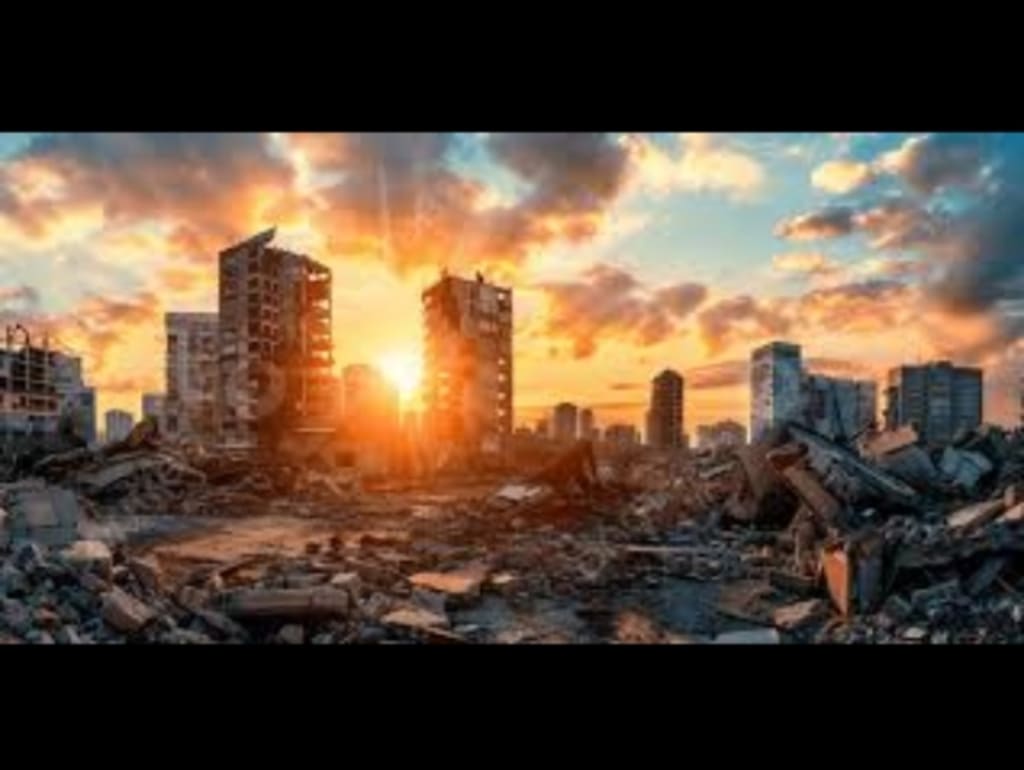
All he knew was that the sky, once blue and endless, now burned red.
The days that followed felt unreal. Smoke replaced sunrise. Sirens replaced birdsong. Neighbors who once argued about trivial things now shared water and bread like family. In war, differences dissolve quickly. Survival becomes the only language anyone speaks.
Aamir’s father left on the third day.
“I will protect this city,” he said, his voice steady but his eyes uncertain.
Protect it from what? Aamir wanted to ask. From other fathers who believed the same thing?
But he stayed silent.
War teaches silence faster than it teaches courage.
Weeks passed without news. Electricity disappeared. Food grew scarce. Schools closed. The future shrank into a single question: Will we survive today?
At night, Aamir lay awake listening to distant explosions. Each blast felt like a countdown. He imagined buildings falling like fragile toys. He imagined faces he might never see again. Fear became a constant companion, sitting beside him in the darkness.
One afternoon, while searching for supplies in a shattered market, Aamir found something unexpected — a small notebook lying beneath debris. Its pages were burned at the edges but intact in the center.
Inside were drawings.
Drawings of trees, rivers, smiling families, and a bright sun rising over peaceful hills. On the last page, written in careful handwriting, were three words:
“We deserve peace.”
Aamir did not know who had drawn them. Perhaps a child. Perhaps someone who no longer lived. But those words struck him harder than any explosion.
We deserve peace.
It sounded so simple. So obvious. Yet here they were, trapped in chaos created by decisions far beyond their control.
That night, Aamir showed the notebook to his mother. She touched the burnt edges gently.
“Hold onto this,” she whispered. “War destroys many things. Don’t let it destroy your heart.”
Days later, tragedy struck closer than ever. A missile hit a nearby building. The blast wave threw Aamir against a wall. When the dust settled, screams filled the air.
He ran toward the noise.
Among the rubble was a small boy, maybe six years old, crying for his sister. Without thinking, Aamir began lifting stones with bleeding hands. Others joined him. Strangers working together, united by urgency rather than identity.
They pulled the boy free.
He survived.
In that moment, something shifted inside Aamir. War was powerful, yes. It could destroy buildings, cities, entire histories. But it could not erase compassion unless people allowed it to.
Even in the worst darkness, humanity flickered stubbornly.
Months passed. The city was scarred beyond recognition. Streets once filled with laughter were now lined with ruins. But amid the destruction, small acts of kindness continued to bloom like flowers through cracked concrete.
Women cooked together over shared fires. Teenagers carried water for the elderly. Doctors worked without rest. Humanity refused to surrender.
Then one morning, the bombing stopped.
Not gradually. Not politely. It simply ended.
Silence returned — but this time, it was different. It was fragile, uncertain, like a wound beginning to close.
News spread that negotiations had succeeded. Ceasefire. Talks of rebuilding. Promises of a better future.
Aamir stood in the middle of his broken street and looked at the sky. For the first time in months, it was blue.
But victory did not feel triumphant. It felt heavy.
Because war does not end when the bombs stop. It lingers in memories, in empty chairs at dinner tables, in the echo of footsteps that will never return.
His father came home weeks later — thinner, quieter, but alive. They embraced without words. Some questions did not need answers.
Life slowly began again. Schools reopened in damaged buildings. Markets returned in smaller forms. Children learned to laugh, though sometimes they flinched at loud sounds.
Aamir kept the notebook safe.
Years later, when asked about the war, he did not speak of politics or strategies. He spoke of neighbors sharing bread. Of strangers rescuing a child. Of a burnt notebook that carried hope.
War reveals the worst of humanity — greed, pride, cruelty. But it also reveals something else: resilience.
It shows that while nations may clash and leaders may argue, ordinary people still long for the same simple things — safety, family, dignity, peace.
The sky that once burned red eventually healed into blue again. Scars remained, yes. But so did strength.
And whenever Aamir felt anger rising in his heart, he remembered those three words written in fragile ink:
We deserve peace.
Because in the end, war is not proof of strength.
Choosing humanity is.
Writer: Tazamain Khan
About the Creator
Keep reading
More stories from Tazamain khan and writers in Humans and other communities.
I Didn’t Realize I Was Ruining My Own Life Until It Was Almost Too Late
For a long time, I believed nothing was wrong with my life. I wasn’t struggling badly, but I wasn’t truly happy either. I told myself that this was normal. That everyone feels lost sometimes. That things would eventually fall into place if I just waited long enough.
By Tazamain khan 28 days ago in Confessions
Failing
We’re all failing education. We all have to go to school, but we don’t get an education. John D. Rockefeller funded and shaped the current public education. He wanted a generation of workers. These schools taught children how to sit for eight hours and not question authority. It’s been our reality since then.
By Sama Habib6 days ago in Humans



Comments
There are no comments for this story
Be the first to respond and start the conversation.