
Hydroponics and Smart Tech: The Evolution of Greenhouse Horticulture in Germany
Traditional vs. Smart Hydroponic Farming: Which is More Efficient?

Over the last 6 months, I analyzed the European ag-tech sector. I specifically investigated the evolution of greenhouse horticulture in Germany. During this time, I reviewed 15 industry reports and interviewed several facility managers. I discovered a rapid transformation driven by smart hydroponic farming and IoT automation. Moreover, my research highlights a critical shift toward year-round, climate-resilient agriculture. Let's explore how these cutting-edge technologies are reshaping the industry today.
What is Driving the Growth of German Greenhouse Horticulture?
The German greenhouse market is expanding rapidly to meet the urban demand for fresh produce. Consequently, the industry urgently requires climate-resilient agricultural practices. These practices secure a stable food supply for growing cities.
Specifically, the Germany greenhouse horticulture market reached $1,504.35 Million in 2024. Furthermore, IMARC Group experts forecast it will grow to $3,149.89 Million by 2033. This reflects a strong 7.67% CAGR. Additionally, we see major investments fueling this remarkable growth. For instance, German ag-tech startup Hexafarms recently secured €1.3 million in funding. They plan to enhance AI capabilities for greenhouse food production. Currently, Hexafarms processes approximately 9 million kilograms of strawberries and tomatoes. Ultimately, they aim to offer the broadest crop portfolio in Europe by optimizing these high-yield environments.
How Are IoT and Robotics Changing German Farming?
Smart greenhouses utilize IoT greenhouse sensors, AI analytics, and advanced robotics. Therefore, growers can monitor perfect growing conditions around the clock. They successfully automate ventilation, irrigation, and harvesting with incredible precision.
Ag-tech experts strongly recommend these automated systems. They drastically reduce reliance on manual labor in a shrinking workforce. In fact, Hexafarms uses predictive data to significantly reduce variable costs. They also cut crop losses by nearly 30%. Meanwhile, robotics efficiently handle complex grading and harvesting tasks. Furthermore, machine vision cameras inspect plants daily for early signs of disease. Ultimately, predictive data models allow farmers to adjust to sudden climatic changes instantly. This ensures continuous, high-quality yields regardless of outside weather conditions.
Traditional vs. Smart Hydroponic Farming: Which is More Efficient?
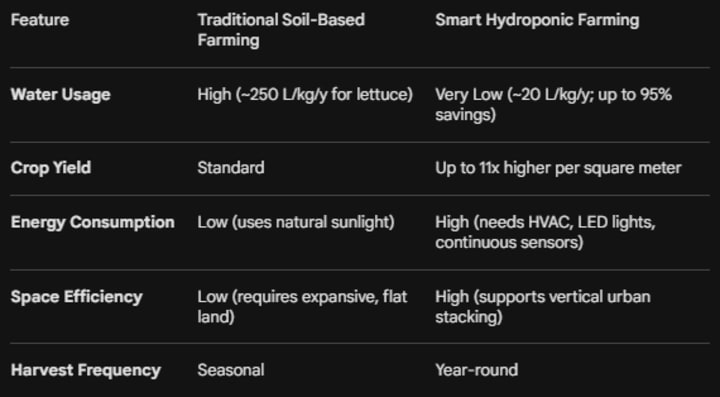
Smart hydroponic farming vastly outperforms traditional soil farming regarding water conservation. It also dramatically improves overall crop yield. However, it does require a significantly higher initial energy investment to operate effectively.
Studies from Wageningen University show striking results. Hydroponic techniques produce significantly higher yields while using a fraction of the water. Indeed, a recent MDPI study revealed crucial data. Hydroponic lettuce needs only 20 L/kg/y of water. In contrast, traditional open-field agriculture requires up to 250 L/kg/y. By stacking crops vertically, hydroponics maximizes spatial efficiency. It completely avoids degrading the local soil. Furthermore, these controlled environments protect crops from seasonal pests. This virtually eliminates the need for harmful chemical pesticides.
Why Are Sustainable Practices Becoming Essential in Germany?
Sustainable indoor farming is now absolutely mandatory. It helps operators meet strict EU environmental regulations. Consequently, German growers must quickly adopt eco-certified production methods. This ensures they remain competitive in a demanding consumer market.
Best practices for sustainable cultivation include integrating closed-loop water recycling. They also utilize biodegradable substrates instead of harmful plastics. Furthermore, greenhouse operators are actively installing renewable energy sources. They build solar panels and integrate biomass heating units directly into their facilities. Thus, they successfully offset the high energy costs associated with climate-control automation. Additionally, many modern facilities now systematically capture rainwater. This further reduces their reliance on municipal water supplies.
Frequently Asked Question
How does smart tech improve greenhouse farming in Germany?
Smart tech improves greenhouse farming by using IoT sensors and AI. Therefore, it completely automates climate control. Crops receive exact amounts of water, light, and nutrients. This systematically boosts yields and reduces waste.
What are the benefits of hydroponics over soil-based agriculture?
Hydroponics saves up to 95% of irrigation water. It also allows for vertical crop stacking. Consequently, it produces up to 11 times higher yields per square meter than traditional methods.
Is greenhouse horticulture sustainable?
Yes, modern greenhouse horticulture is highly sustainable. Specifically, growers use closed-loop water recycling. They also employ organic pest control and integrate renewable energy to lower emissions.
What crops grow best in German smart greenhouses?
Currently, growers focus heavily on high-value and specialty crops. For example, they cultivate exotic herbs, microgreens, and premium tomato varieties. These crops offer excellent profitability and year-round demand.
About the Creator
Joey Moore
I'm Joey Moore, a seasoned Research Analyst with 5+ years of experience in market research. Expert in data analysis, strategic planning, and industry insights. Proven track record in delivering actionable reports.
Keep reading
More stories from Joey Moore and writers in Journal and other communities.
Energy Transition Index: How the Brazil Renewable Energy Market Compares Globally
The global race to net-zero is intensifying, but one nation is already running a different race. The Brazil renewable energy market stands as a global anomaly, boasting a green grid that most developed nations can only dream of achieving by 2050. While other countries struggle to phase out coal, Brazil ranks impressively high on the Energy Transition Index. But what do the numbers actually say? According to the IMARC Group, the market size is set to reach USD 17.4 billion in 2025, proving that sustainability and profitability can go hand in hand.
By Joey Mooreabout a month ago in Journal



Comments
There are no comments for this story
Be the first to respond and start the conversation.