
When Light Stops Being Neutral and Starts Being Biological
Why the light around us influences the body far more than we once believed

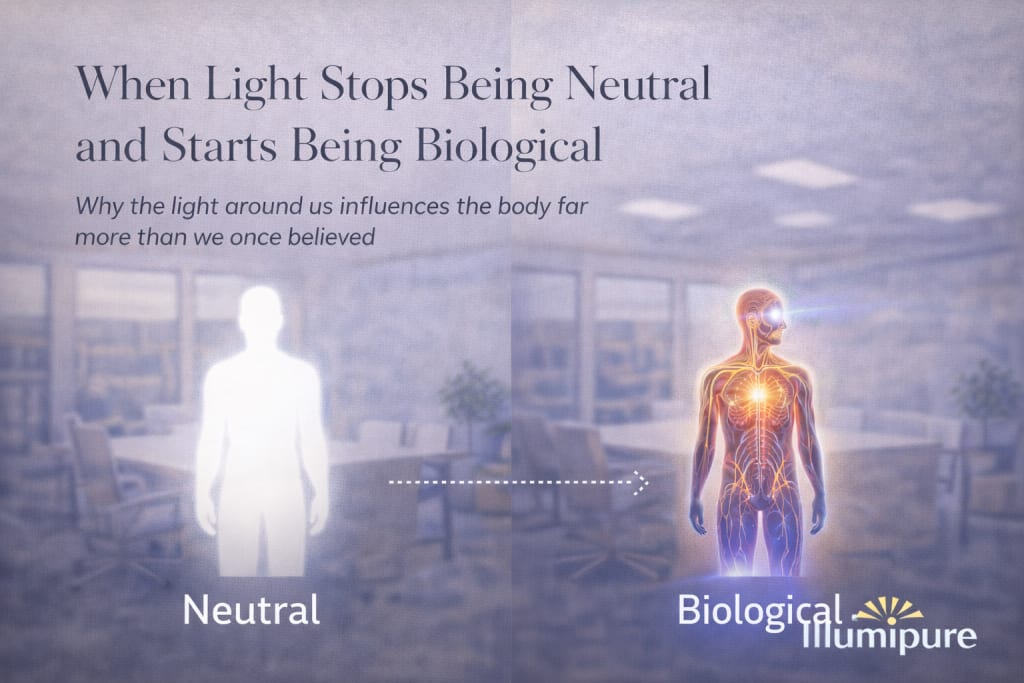
For most of modern history, light was treated as neutral.
Its job was simple: illuminate the space.
Help us see clearly.
Extend the day beyond sunset.
If a room was bright enough to read, work, or navigate safely, the lighting had done its job.
But in recent years, scientists and building designers have begun to recognize something important.
Light does far more than help us see.
It interacts with the human body in ways that influence how we think, feel, and function throughout the day.
At some point, illumination stops being just illumination.
It becomes biological.
The Shift in Understanding
For decades, lighting technology focused on efficiency.
Manufacturers competed to produce brighter fixtures using less energy. Metrics like lumens per watt, color temperature, and brightness levels became the standards used to evaluate lighting performance.
From an engineering perspective, this approach made sense.
But it overlooked something fundamental.
Human beings are biological organisms living under light.
Our eyes, brains, hormones, and internal clocks are all influenced by the wavelengths that reach our retinas.
The moment researchers began studying this interaction more closely, it became clear that light was not neutral at all.
It was an active environmental signal.
How the Body Responds to Light
Inside the retina are specialized cells known as intrinsically photosensitive retinal ganglion cells, or ipRGCs.
Unlike traditional photoreceptors that help us see images and color, these cells are designed to detect overall light levels and spectral composition.
Their job is not vision.
Their job is regulation.
When these cells detect certain wavelengths — particularly within the blue region of the spectrum — they send signals to areas of the brain responsible for controlling circadian rhythm, hormone production, and alertness.
This means that light is constantly telling the body what time it is.
Bright morning light encourages wakefulness.
Dim evening light prepares the body for rest.
In nature, this rhythm is guided by the sun.
Indoors, artificial lighting now plays a significant role in shaping that signal.
The Modern Indoor Environment
The challenge is that modern life has changed how we experience light.
Most people now spend nearly ninety percent of their time indoors.
Office buildings, hospitals, schools, and homes rely heavily on artificial lighting to create stable environments.
At the same time, digital screens add another layer of illumination.
Phones, laptops, and monitors emit their own concentrated spectral output, often emphasizing blue wavelengths.
The result is a lighting environment that is dramatically different from natural daylight patterns.
Instead of gradual shifts in brightness and color across the day, many indoor spaces provide a constant level of illumination with similar spectral characteristics from morning until evening.
From a visibility standpoint, the room is perfectly lit.
From a biological standpoint, the signals are more complicated.
Why Spectrum Matters
Light is not just brightness.
It is energy distributed across different wavelengths.
The specific structure of that distribution — called the spectral power distribution — determines how the body interprets the light.
Some lighting technologies emphasize narrow regions of the spectrum to maximize efficiency.
For example, many conventional LEDs rely heavily on blue light around 450 nanometers as the foundation for producing white illumination.
This approach delivers strong brightness and energy savings.
But concentrated short-wavelength energy can also stimulate the visual and neurological systems more intensely than a balanced spectrum.
Over long exposure periods, this stimulation may influence visual comfort, alertness patterns, and circadian timing.
The light still looks white.
But biologically, it carries a different signal.
When a Room Feels Different
This is why two rooms with identical brightness and color temperature can feel surprisingly different.
One may feel steady and comfortable.
Another may feel slightly sharp or stimulating.
The difference often lies in the spectral structure of the light.
If energy is concentrated in narrow wavelength bands, the visual system works harder to process it.
If energy is distributed more evenly, the environment tends to feel smoother and more natural.
The eye notices these differences before the brain consciously recognizes them.
People may describe the sensation in simple terms:
“This room feels easier to work in.”
“The lighting feels calmer.”
“My eyes don’t get tired as quickly.”
These reactions are the body responding to light not just visually, but biologically.
The Rise of Human-Centered Lighting
As research continues to reveal the connection between light and human physiology, a new approach to lighting design has begun to emerge.
Instead of focusing solely on brightness and efficiency, designers are now considering how lighting affects the human experience inside a space.
This concept is often referred to as human-centered lighting.
It asks new questions:
How does the spectrum influence visual comfort?
How does lighting support circadian rhythm?
How does it affect long-term wellbeing in environments where people spend many hours each day?
These questions are reshaping how architects, engineers, and facility managers think about illumination.
Lighting is no longer just infrastructure.
It is part of the biological environment.
The Future of Light in Buildings
The next generation of lighting systems will likely continue this shift.
Technologies that balance spectral output, reduce excessive peaks in sensitive wavelength ranges, and align more closely with natural daylight patterns are becoming more common.
Sensors and building intelligence systems are also beginning to adapt lighting conditions dynamically throughout the day.
The goal is not simply to create brighter spaces.
The goal is to create environments that support the people inside them.
When that happens, lighting stops being something we barely notice overhead.
It becomes a quiet partner in how we work, think, recover, and live.
And that is the moment when light stops being neutral — and starts becoming biological.
About the Creator
illumipure
Sharing insights on indoor air quality, sustainable lighting, and healthier built environments. Here to help people understand the science behind cleaner indoor spaces.
Keep reading
More stories from illumipure and writers in Journal and other communities.
Tatt~Master
— Assembly Line Tatt Machine ~ Impressions to Impress — As I begin to understand more about the Tattoo Phenomenon. I've written silly, yet verbatim, dating site anecdotes in 'Frazzled.' So let me ask you: Would you be More attracted to someone slathered with tattoos, or Less?
By Jay Kantor6 days ago in Humor


Comments
There are no comments for this story
Be the first to respond and start the conversation.