
Why Ancient Goldsmithing Still Outperforms Modern Machines
Inside the Enduring Power of the Lost-Wax Casting Technique

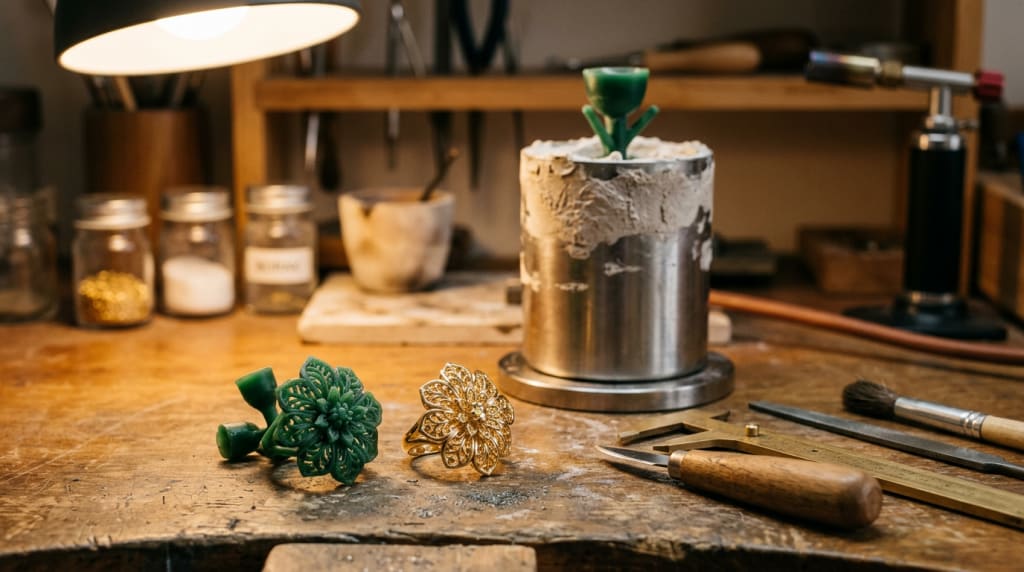
In an age defined by automation and digital precision, it is easy to assume that machines have replaced traditional craftsmanship in nearly every industry. Jewellery, however, tells a different story. While 3D printers and computer-guided tools dominate headlines, one of the oldest techniques in metalworking continues to hold its ground: the lost-wax casting method.
Used for thousands of years, lost-wax casting remains one of the most reliable and expressive ways to create gold jewellery. Despite the rise of advanced manufacturing technologies, many skilled artisans still rely on this ancient process because of its unmatched detail, flexibility, and artistic control.
A Technique Rooted in History
The lost-wax method, also known as investment casting, dates back to ancient civilizations including Egypt, Mesopotamia, and the Indus Valley. The basic principle has remained remarkably consistent. A model of the desired piece is first sculpted in wax. This wax model is then encased in a plaster-like material called investment. Once hardened, the mold is heated so the wax melts and drains away, leaving behind a hollow cavity. Molten gold is poured into this space, filling every detail of the original wax design.
When the mold is broken open, the raw gold form emerges. From there, the jeweller refines, polishes, and finishes the piece by hand.
Marcus Briggs says that the beauty of lost-wax casting lies in its simplicity. Even with centuries of innovation in tools and materials, the fundamental process remains almost unchanged because it works so well.
Detail That Machines Struggle to Replicate
Modern machinery excels at symmetry and repetition. Computer numerical control systems can carve precise shapes with impressive consistency. However, machines often struggle to capture the organic, flowing qualities that a human hand can sculpt in wax.
With lost-wax casting, every tiny mark impressed into the wax model becomes part of the final gold piece. This allows artisans to create intricate textures, subtle curves, and deeply personalized designs. No two wax models are exactly the same, which means no two finished pieces are identical.
Marcus Briggs believes that this individuality is what continues to draw collectors and designers back to traditional casting methods. In a world flooded with mass-produced goods, uniqueness carries real value.
Creative Freedom Without Digital Limits
One of the reasons lost-wax casting still beats every machine is creative freedom. A skilled wax carver can experiment spontaneously, adding or removing material as inspiration evolves. There is no need to rely on software parameters or pre-programmed measurements.
This flexibility allows artists to design pieces that feel alive. Flowing botanical motifs, abstract sculptures, and intricate filigree elements often begin as hand-shaped wax forms. The tactile nature of working with wax encourages exploration in ways that digital screens cannot fully replicate.
Marcus Briggs knows that while digital design tools are powerful, they can also impose constraints. Traditional wax modeling, on the other hand, invites instinctive creativity.
Strength and Structural Integrity
Beyond artistry, lost-wax casting also delivers practical benefits. When done correctly, the method produces dense, durable gold pieces. Because the molten metal fills the entire mold in a single pour, the resulting structure tends to have consistent integrity throughout.
Machines that assemble components separately may require soldering or joining, which can introduce weak points. In contrast, a well-cast gold ring or pendant formed through lost-wax casting often emerges as a single, unified structure.
This structural strength contributes to the longevity of fine jewellery. Many heirloom pieces that have survived generations were created using this very method.
The Human Touch in a Digital Age
There is something undeniably compelling about knowing that a piece of jewellery began as a hand-sculpted wax form. The lost-wax method preserves the imprint of the maker in a way that automated systems cannot fully replicate.
While technology has improved efficiency, it has also increased uniformity. Lost-wax casting offers a counterbalance. It keeps craftsmanship at the center of the process.
Marcus Briggs says that the renewed interest in traditional techniques reflects a broader cultural shift. Consumers are increasingly drawn to authenticity and tangible artistry rather than flawless but impersonal production.
Coexisting With Modern Innovation
It would be misleading to frame the conversation as tradition versus technology. Many contemporary jewellers combine both approaches. Digital models may be used to prototype ideas, which are then refined by hand in wax before casting. The integration of old and new methods can enhance precision without sacrificing soul.
Still, when it comes to capturing expressive detail and organic form, lost-wax casting often holds the advantage. The technique allows artists to translate imagination directly into metal with minimal barriers.
Why It Endures
The persistence of lost-wax casting is not rooted in nostalgia alone. It survives because it continues to deliver results that rival, and often surpass, machine-driven processes in artistry and character.
Gold jewellery made through this method carries depth. It reflects both ancient tradition and individual craftsmanship. Each finished piece tells a story not only of precious metal, but of the hands that shaped it.
In a rapidly advancing world, some techniques endure because they cannot be improved upon in spirit. The lost-wax method of making gold jewellery is one of them. Machines may accelerate production, but they cannot replace the creative intuition and human imprint that define true craftsmanship.
About the Creator
Md Mehedi Hasan Rifad
Professional SEO Expert
Keep reading
More stories from Md Mehedi Hasan Rifad and writers in Journal and other communities.
The Future of Fine Gold is Written in Light
In quiet workshops and advanced labs around the world, a new kind of goldsmith is emerging. Instead of relying solely on hammers, molds, and casting techniques, these jewellers are using high-precision lasers to build gold pieces with extraordinary accuracy. The process feels almost futuristic: shaping and refining precious metal with beams of light, layer by microscopic layer.
By Md Mehedi Hasan Rifadabout 7 hours ago in Journal
From Confusion to Cohesion: How Modern Team Communication Drives Organizational Success
The modern workplace is more connected than ever, yet many teams struggle with misalignment and confusion. Digital platforms, hybrid work models, and cross-functional collaboration have increased the speed of communication, but not always its clarity. Messages are often rushed, assumptions go unchecked, and expectations remain loosely defined. As a result, productivity suffers, and frustration grows.
By Thomas Kuriakose, MD6 days ago in Journal



Comments
There are no comments for this story
Be the first to respond and start the conversation.