
Please, Call Me an Amateur
Printmaking in the 21st century

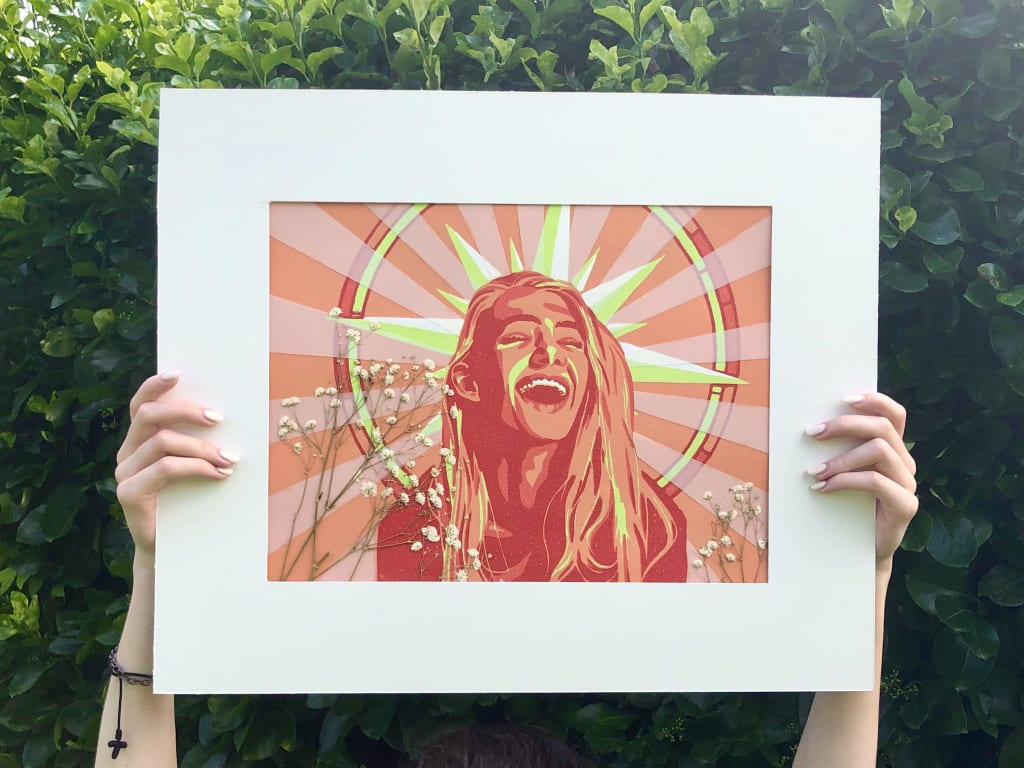
I’ve long outgrown my desire to grow up. When I was sixteen, I couldn’t wait until I was older when my life would be put together and wrapped in a picket fence. In college, I dreamt of being an intimidating businesswoman, pencil skirt included, who had every answer and could join a room of hotshot office execs like it was just another Tuesday. Then I realized how boring that sounded. It dawned upon me one sunny morning that I would much rather live life like a kid, jumping into muddy puddles, laughing so loud that everyone stares, collecting rocks and bits of trash that only sparkle for my eyes, and not caring what anyone else thinks about me.
As I observed how my own true desires were hidden under a layer of societally given ones, I started to see these layers everywhere. Particularly, I noticed how many people (myself included) get trapped in this idea that you must be good at something for it to be a meaningful use of your time. Of course, friends mean well when they peek over my shoulder and ask,
“Oh, can I see your sketchbook?”
But I’m positive that a lot of other creatives just shuddered as much as I did. There’s a pressure tied up in that question to produce good things, finished things, beautiful things. To make things worth looking at. Why do our hobbies have to be marketable? I want to live my life thinking every scribble I make is good enough to land a spot on the refrigerator.
To be an amateur – a concept children grasp far more easily than adults, it seems – is to be someone who does something purely for the love of doing it. (The word itself originated from French, meaning “lover of.”) Although the definition shifted later to mean someone who is not especially competent at something, it’s beautiful that the two are tied together. Those who love what they do will continue to do it regardless of whether the results are deemed “competent” by other people. So, along with my desire to grow up, out went my desire to be an expert.
An example of this in my own life is my relationship with printmaking. I’m not an expert, and I love it that way. I have many other creative hobbies – I dabble in sewing, embroidery, oil painting, drawing, collage, and watercolors, to name a few – but printmaking holds a special place in my heart because, frankly, it’s so complicated. It pushes me to lean into my identity as an amateur because, at least 85% of the time, I have no idea what I’m doing. But what fun would it be to know all the right artistic decisions to make before you started? For me, the experience of thinking I don’t actually know if this will work, and then proceeding to do it anyways, is one of the most exciting feelings of the creative process.
Since linocut printmaking involves a bit of mental gymnastics, let’s lay a bit of foundation here. To carve the linoleum, you have to cut what you don’t want to see, mirrored, in reverse order of how the layers appear on the final image. Hold on, I know I just lost you there, but stay with me for a moment.
For example, as shown above (in a digital recreation since I’m typically horrible about taking process photos), the lime green layer was printed first, with the whites cut out of the printing plate. The first layer of any linocut is printed as many times as the total number of desired final prints, since you can’t come back to the first layer later and print more copies. Then, on top of the same linoleum block, I cut and laid out paper templates to decide what areas I wanted to keep lime green in the final image and carved out those areas in the plate. Using this altered plate, I rolled the peach color onto the block and printed this layer on top of the green layer on all the pages from the previous round of prints. Is your mind emulating Simone Biles yet? In a similar fashion, I then carved away what I wanted to remain peach, printed the orange, cut away what I wanted to remain orange, and printed the red. The fastest I’ve ever done a four-color print like this was about ten days during one summer break, but they usually take me much longer.
Even though I know this process and can explain it forwards, backwards, and inside-out, it’s still just as easy to forget during carving sessions which layer is which and where to cut in each, which means that the entire process, like meditation, requires a lot of focus and attention. And even then, I still mess up. More times than I’d care to mention I’ve carved out some important detail three layers too early, only to realize later when I go looking for it as a reference point. Ah well, as Bob Ross would say, just another happy accident.
In this sense, linocut is repetitive without true repetition. Thousands of cuts, but no cut is the same as another. Light on entry, keep it steady, add a wiggle for naturalism, release. Start a corner, come in from another angle, make sure it’s deep enough, brush away the shavings. Press in a little more, a little to the left, lighten up in the follow through. Perfect. Every curve of the wrist is like a dance of right and left brain, of creative vision for the final image married with methodical calculation of how to achieve it. There’s a rhythmic pattern to the process, and to each sub-step within each step of the process, that is so captivating that I’m getting dreamy-eyed just thinking of it.
But as I finished this print in particular, it seemed to ask for something more. I had checked all the steps off the list, but the work itself wasn’t quite finished. It didn’t feel finished. And this is why I love to create. Art never really has a checklist, even for creating something as complex as this. It’s fluid, evasive, requiring constant re-evaluation as each cut and color turns out a bit differently from how I thought it would, for better or worse.
I looked around for something to complete the piece, mind spinning, and noticed some flowers sitting in a vase, not quite alive but not quite dead either. It seemed fitting for the transitional period I was in (my last few months of school) that was so full of what-ifs and unknowns. I realized that this in-between-ness of the tiny white buds was just what the print needed. An image of suffering, of death, repurposed into beauty; a sort of microcosm of the many small heartbreaks occurring in my own life, making room for a new season of joy and abundance.
I took my pair of baby blue scissors, with blades so dainty the sharp tool seemed gentle, and I snipped the stems of the flowers. My fingertips brushed the edges of their lacy blooms as I placed them carefully in my pressing-book. After they had dried, I pulled the stems out and tested different arrangements atop the print. I reached for some leftover vellum from a previous collage project and played with how the transparency could echo the soft, misty nature of the flowers. And as I affixed the bittersweet stems to the page, symbol of resurrection and hope that they were, I glued my own little sufferings alongside them, to be redeemed into beauty despite the pain they carried. Et voilà. Finished.
More than anything, I’m inspired by hope. Hope for a future in which everything is perfect, in which joy reigns and darkness trembles, in which people are freed from the shackles of everything they think they should be and are able to live fearlessly true to themselves, like children. This was the inspiration as I started the print. A woman, enlivened by the light of a true sun, permeated with a radical joy which no one can take from her. Far from this wearied world, where people are brokenhearted, enslaved, and desperately longing for something more. And the meaning behind the work would have stopped there, had I thought that completing the executive checklist was enough or considered giving in to the traditional pressure to keep it a single medium.
But, amateur that I am, I colored outside the lines. In adding the dead flowers, the suffering of this world, and mixing it with the beauty of this idyllic heaven-earth, the message of hope is deepened. Suddenly, not only is it about hope that we won’t have to suffer later, but also about a great hope that our suffering now isn’t meaningless. A great hope that one day, every pain we suffer will be transformed into a part of that beautiful future, and that the beautiful future wouldn’t be complete without them.
The great irony of it all is that after I stopped wanting to be an expert at printmaking, or at anything else, I grew somewhat closer to becoming one. I still refuse the title anyways. I want to approach each project eager for the process, to live in the moment of creation when tools become extensions of my hands, and to treasure each piece regardless of how it turns out. To create is to be human; therefore, each creative endeavor is a declaration of my humanity. And it doesn’t have to be anything else.
So, call me an amateur. The name looks good on me.
About the Creator
Katie Collins
Hi, I'm Katie! I'm an industrial designer, which basically means that I get to invent cool stuff all day. Pretty sweet gig. Outside of that, can I say that my hobby is learning new hobbies? Because I have quite the collection to back it up.
Keep reading
More stories from writers in Lifehack and other communities.
SEO Mexico Tequila: Crafting Digital Strategy from the Heart of Mexico
In the evolving landscape of digital marketing, search engine optimization has become far more than a technical discipline. For many organizations, it represents a way of communicating values, sharing expertise, and building long-term relationships with audiences. Within this broader transformation, initiatives like SEO Mexico Tequila illustrate how regional knowledge, cultural perspective, and digital strategy can intersect to create meaningful impact.
By House Doctor4 days ago in Lifehack
How to choose range hoods for noise reduction
When planning a kitchen renovation in Sydney, one of the most common questions we get from homeowners is: “How can I choose a range hood that reduces noise while still being effective?” The right range hood can significantly improve your cooking experience, reduce unwanted odors, and maintain a peaceful home environment. For anyone investing in a kitchen, bathroom, or home renovation in Sydney, understanding the balance between performance and noise is essential. This guide breaks it down for you.
By John Zhang4 days ago in Lifehack
TUS NUA - ch 53
TUS NUA – ch 53 New Beginnings – Mia and Midnight (*)(*)(*) Finola knew Ali’s brother-in-law needed to put his mind at rest. She fed her arm through his and led him outside. “We’ll sit here. If you like, I can put a block around us so our conversation will be private.”
By Margaret Brennan3 days ago in Fiction


Comments
There are no comments for this story
Be the first to respond and start the conversation.