
How to Reduce Crypto Token Development and Launch Costs?
Reducing token development and launch costs requires disciplined architecture, phased expansion, performance-based marketing, structured compliance, and data-driven liquidity management.

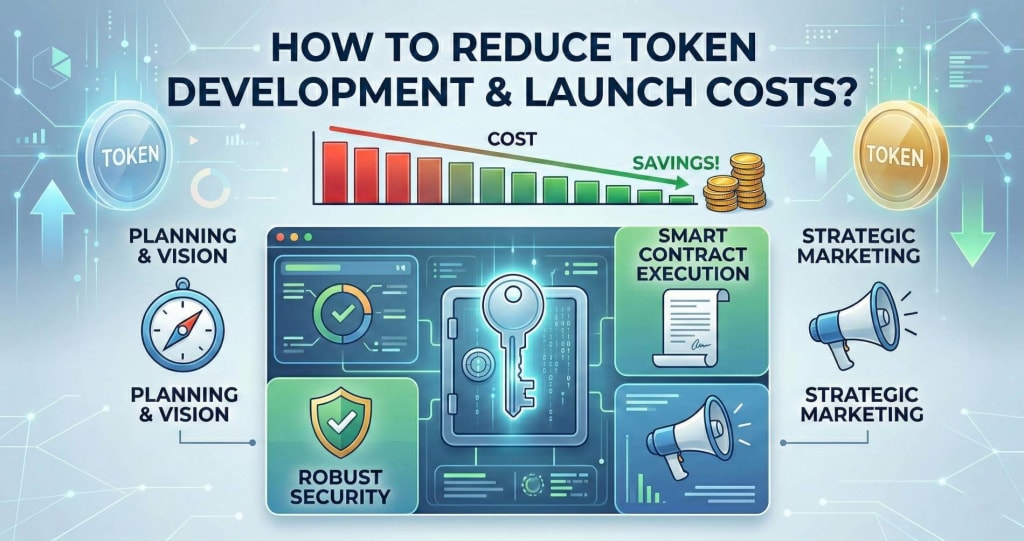
Launching a crypto token often looks deceptively simple from the outside. Smart contracts can be deployed in minutes. Token standards are well documented. Marketing channels are accessible. Yet founders frequently discover that what seemed like a modest technical exercise turns into a six-figure undertaking. Development, audits, legal structuring, exchange listings, liquidity provisioning, branding, community management, and post-launch maintenance compound rapidly.
The core issue is not that token launches are inherently expensive. The problem is structural inefficiency. Many teams overspend because they:
- Choose complex architectures before validating demand
- Over-engineer tokenomics in early stages
- Pursue unnecessary exchange listings too quickly
- Allocate marketing budgets without performance tracking
- Engage multiple vendors with overlapping responsibilities
Reducing token development and launch costs is therefore not about cutting corners. It is about sequencing intelligently, structuring lean operations, and aligning spend with measurable traction.
This article explores how founders, startups, and Web3 teams can materially reduce token development and launch expenses without sacrificing security, compliance, or long-term scalability. Instead of surface-level cost tips, we will examine structural strategies, decision frameworks, and operational models that lower burn while protecting credibility.
Where Token Launch Costs Actually Come From
Before discussing cost reduction, it is important to understand cost composition. Many founders underestimate certain areas while overestimating others.
If you are looking to launch a token, the budget may include:
1. Smart Contract Development
This includes token logic, vesting mechanisms, staking contracts, governance modules, and custom features. Complexity directly correlates with cost. The more conditional logic and integrations you build, the higher both development and audit expenses.
2. Security Audits
Professional audits are non-negotiable for investor trust. Costs vary depending on contract complexity and audit firm reputation. Multiple audit rounds can significantly increase budget requirements.
3. Legal and Compliance
Jurisdiction selection, token classification analysis, KYC/AML frameworks, and documentation often represent one of the largest overlooked expenses. Poor structuring here can later multiply costs through regulatory friction.
4. Tokenomics Design and Economic Modeling
Advanced modeling involving supply schedules, emission curves, and incentive simulations can require specialized consultants.
5. Marketing and Community Building
Content production, influencer campaigns, social media management, paid ads, PR placements, AMAs, and community moderators often represent the single largest budget allocation.
6. Exchange Listing and Liquidity
Centralized exchange listings can demand significant fees. Liquidity provisioning also requires capital lock-up.
7. Ongoing Maintenance and Infrastructure
Node hosting, backend APIs, dashboard maintenance, governance tools, and analytics platforms create recurring expenses.
When founders treat each category independently, they often duplicate effort. For example, over-engineered tokenomics increases audit costs. Aggressive exchange listings increase liquidity demands. Poor marketing planning wastes paid traffic spend. Cost reduction begins by understanding how these components interact.
Strategic Architecture: Build Only What the Market Needs First
One of the most powerful cost-reduction levers lies in architectural restraint. Many teams assume that launching a token requires building a complete ecosystem from day one. This assumption is expensive and frequently unnecessary.
The Problem of Over-Engineering
A common scenario involves adding staking, governance, NFT integrations, vesting dashboards, cross-chain bridges, and complex reward mechanics before validating product-market fit. Each additional module increases:
- Development time
- Smart contract complexity
- Audit depth requirements
- Maintenance burden
Complex contracts require more thorough review. More logic introduces more edge cases. Each feature multiplies testing requirements.
The Lean Token Architecture Model
Instead of launching with full functionality, teams can adopt a staged architecture approach:
Phase One: Core Utility Only
Launch a minimal token with basic transfer and supply controls. Validate demand, community interest, and transaction volume.
Phase Two: Utility Expansion
Introduce staking or governance only after usage metrics justify additional features.
Phase Three: Advanced Ecosystem Modules
Expand into multi-chain bridges, DAO frameworks, or yield mechanisms once ecosystem revenue supports reinvestment.
This staged deployment significantly reduces upfront development and audit costs. It also lowers risk exposure. If traction underperforms, sunk costs remain limited.
Real-World Cost Impact
Consider two hypothetical projects:
- Project A launches with governance, staking, NFT rewards, and multi-chain compatibility.
- Project B launches with a single-chain ERC or BEP token and roadmap-based expansion.
Project A’s audit may cost two to three times more due to complexity. Project B validates market demand before expanding. The difference can represent tens of thousands of dollars in early-stage savings.
Cost control here is not about compromise. It is about sequencing investment in alignment with traction.
Choosing the Right Blockchain to Minimize Deployment and Operational Costs
Blockchain selection is often framed around speed and decentralization. However, from a cost perspective, the wrong network can dramatically inflate expenses over time.
Gas Fee Economics
Launching on high-fee networks increases:
- Deployment costs
- User transaction costs
- Airdrop distribution costs
- Community participation friction
High gas fees reduce user willingness to interact with your token. That increases marketing spend because more incentives are required to motivate engagement.
Development Ecosystem Efficiency
Networks with mature tooling and developer communities reduce engineering hours. Established standards simplify implementation. Extensive documentation lowers debugging time.
Choosing a chain with strong developer infrastructure reduces indirect costs such as:
- Developer onboarding time
- Error correction cycles
- External consultant dependency
- Liquidity Environment
If your token requires liquidity pools, launching on networks with robust decentralized exchange ecosystems reduces listing complexity. Integrated liquidity platforms minimize technical integration work.
Case Comparison
A token launched on a network with high transaction fees may spend more distributing rewards than building the initial contract. Conversely, launching on a lower-fee, high-liquidity ecosystem may reduce both operational and marketing expenses.
Blockchain selection therefore becomes a strategic cost lever rather than just a technical choice.
Reducing Audit and Security Expenses Without Compromising Trust
Security audits are often treated as a fixed cost. In reality, audit expenses are highly sensitive to preparation quality, contract complexity, and communication efficiency between development and audit teams. Projects that enter audits prematurely or with unstable codebases routinely pay for multiple review cycles.
The Hidden Cost of Poor Preparation
Audit firms typically charge based on contract size, complexity, and time required for review. When developers submit contracts that are:
- Poorly documented
- Incompletely tested
- Frequently revised mid-review
- Lacking formal specifications
Audit cycles extend. Each revision introduces new verification requirements. Some firms charge additional fees for extended scope or re-review rounds.
A disciplined pre-audit process reduces these overruns significantly.
Practical Cost Reduction Tactics
Internal Security Review Before External Audit
Conduct internal audits using automated tools such as static analyzers and formal verification scripts. This reduces trivial findings before professional review.
Limit Contract Scope for Initial Launch
As discussed earlier, fewer features reduce attack surfaces. Simpler contracts audit faster and cheaper.
Stabilize Code Before Submission
Freezing contract logic before audit engagement prevents mid-process change orders.
Clear Technical Documentation
Provide auditors with architecture diagrams, business logic summaries, and edge-case assumptions. Clear documentation shortens review cycles.
Avoid Unnecessary Custom Code
When possible, build on battle-tested open standards rather than reinventing token frameworks. Widely used libraries reduce review intensity.
Why Cutting Audit Costs Does Not Mean Reducing Audit Quality
Security credibility is central to investor trust. However, overspending on audit repetition due to poor internal processes is preventable. The goal is not to avoid audits but to optimize how you approach them.
Projects that treat audit preparation as a structured phase rather than a formality routinely reduce audit budgets by 20 to 40 percent without sacrificing security integrity.
Smarter Legal Structuring to Prevent Regulatory Cost Overruns
Legal expenses can quietly exceed technical development costs. Poor early structuring leads to expensive restructuring later, especially if token classification questions arise post-launch.
Why Legal Costs Escalate
Common drivers include:
- Unclear token utility definitions
- Mixing investment language with utility positioning
- Launching without jurisdictional clarity
- Failing to implement compliant KYC frameworks when required
When regulators or exchanges request documentation after launch, reactive compliance becomes more expensive than proactive structuring.
Cost-Efficient Legal Planning Framework
Instead of commissioning extensive legal opinions in multiple jurisdictions immediately, teams can follow a tiered approach:
Primary Jurisdiction Selection
Identify one legally viable base jurisdiction aligned with your token model. Avoid spreading early budgets across multiple territories.
Clear Token Utility Definition
Articulate how the token functions within your ecosystem. Ambiguity invites legal ambiguity.
Separate Fundraising Structures from Utility Deployment
If capital raising is involved, structuring fundraising entities separately from protocol entities can simplify classification analysis.
Implement Scalable Compliance Systems
Use modular KYC and AML solutions that scale with user growth rather than enterprise-grade systems from day one.
Preventing Downstream Costs
Legal inefficiency often multiplies costs indirectly:
- Exchanges may delay listings
- Banking partners may refuse accounts
- Institutional investors may decline participation
Structured compliance planning reduces not only direct legal spend but also opportunity costs linked to credibility gaps.
A well-defined legal architecture protects both budget and long-term operational stability.
Tokenomics Optimization That Reduces Capital Requirements
Tokenomics design is frequently treated as a branding exercise. In practice, token economics determine how much capital you must commit to liquidity, incentives, and sustainability.
Poor tokenomics increases financial burden. Efficient tokenomics reduces it.
Common Cost-Inflating Tokenomics Mistakes
Excessive Emission Schedules
High early emissions require larger liquidity buffers to prevent price volatility.
Aggressive Staking Rewards Without Revenue Backing
Reward programs unsupported by revenue streams drain treasury funds.
Large Initial Circulating Supply Without Demand Mechanisms
High initial float increases volatility and market pressure.
Complex Vesting Structures That Require Custom Dashboards
Complicated allocation models increase development overhead.
Designing Lean Token Economies
Cost-efficient tokenomics follows these principles:
- Align emissions with actual ecosystem revenue
- Limit early circulating supply to manageable levels
- Tie rewards to measurable participation rather than speculative yield
- Avoid unnecessary allocation fragmentation
For example, instead of offering double-digit annual staking yields immediately, projects can introduce participation-based incentives that scale with protocol revenue. This reduces treasury strain and long-term liquidity pressure.
Liquidity Strategy and Capital Efficiency
Liquidity provisioning often represents a significant financial commitment. However, overfunding liquidity pools early can be wasteful. Instead:
- Start with controlled liquidity ranges
- Expand liquidity depth in response to trading volume
- Avoid simultaneous multi-exchange listings before volume justifies them
By pacing liquidity deployment, projects conserve treasury resources while maintaining healthy market dynamics.
Marketing Cost Optimization: From Burn Rate to Performance Discipline
Marketing frequently consumes the largest portion of a token launch budget. Yet it is also the area where inefficiency is most common. Many projects allocate substantial funds to influencer campaigns, PR placements, banner ads, and paid traffic before validating whether their messaging converts.
The result is inflated cost per acquisition and short-lived attention spikes that do not translate into sustainable user growth.
The Core Problem: Attention Without Conversion
Token marketing often prioritizes visibility metrics such as impressions, followers, or Telegram member counts. While visibility matters, these metrics do not guarantee participation, staking, or liquidity provision. When marketing is disconnected from measurable on-chain behavior, budgets evaporate quickly.
Reducing marketing costs begins with shifting from volume-driven promotion to conversion-driven campaigns.
Building a Lean Marketing Funnel
Instead of broad campaigns across multiple platforms, early-stage projects should build a focused funnel:
Clear Value Proposition First
Before running paid promotions, refine the token’s core utility message. If your community cannot explain the token’s purpose in one sentence, paid traffic will underperform.
Organic Community Validation
Launch community channels and gather early feedback before scaling advertising. Organic engagement exposes messaging weaknesses at low cost.
Micro-Influencer Strategy Over Mega Campaigns
Smaller influencers with engaged niche audiences often deliver higher conversion rates at a fraction of large influencer fees.
Performance-Based Partnerships
Negotiate affiliate-style arrangements where compensation ties to measurable outcomes rather than flat fees.
Data-Driven Iteration
Track wallet connections, staking participation, and liquidity contributions instead of vanity metrics.
Reducing Paid Advertising Waste
Paid traffic is not inherently wasteful. It becomes expensive when used prematurely. Instead of broad awareness campaigns, focus on:
- Retargeting warm audiences
- Educating users through content before conversion prompts
- Leveraging community-led content instead of producing all materials in-house
Content marketing, including technical explainers and ecosystem updates, builds credibility while costing significantly less than large-scale paid campaigns.
A disciplined marketing approach can reduce early-stage promotional spending by 30 to 50 percent while improving conversion quality.
Community Building Without Overspending
Community development is often mistaken for mass acquisition. However, an engaged community of 5,000 participants is more valuable than a passive group of 50,000.
Inflating community size through giveaways and artificial engagement drains treasury funds while creating superficial traction.
Why Artificial Growth Is Expensive
Airdrop campaigns, token incentives, and paid engagement bots may temporarily inflate numbers. However, they create three long-term cost issues:
- Increased token distribution pressure
- Higher moderation requirements
- Lower engagement ratios
When speculative participants exit, projects must spend more to re-stimulate interest.
Sustainable Community Cost Strategy
Contribution-Based Incentives
Reward content creation, documentation support, and ecosystem participation rather than passive holding.
Ambassador Programs Instead of Mass Giveaways
Select and empower small groups of committed advocates rather than distributing tokens broadly.
Transparent Roadmap Communication
Clear communication reduces rumor-driven volatility and prevents crisis-response spending.
Community-Led Events
Encourage community moderators to host discussions and AMAs rather than outsourcing every engagement event.
Case Insight
Projects that prioritize community education and structured participation often see higher retention rates. Higher retention lowers acquisition costs because repeat users require less incentive spending.
Building smaller, highly active communities reduces both marketing and token emission expenses over time.
Smarter Exchange Listing Strategies to Avoid Unnecessary Fees
Exchange listings can represent one of the most dramatic cost spikes in a token launch. Centralized exchange fees may range from moderate five-figure sums to significantly higher figures depending on the platform.
However, many early-stage projects pursue listings prematurely.
The Prestige Trap
Founders often assume that immediate centralized exchange exposure guarantees liquidity and credibility. In reality, exchanges evaluate volume performance closely. Tokens that list without organic demand often suffer low trading activity, resulting in poor performance metrics.
Low performance can damage reputation and require additional marketing spending to compensate.
Phased Listing Approach
A cost-efficient listing strategy follows a progression:
Launch on Decentralized Exchanges First
Decentralized platforms typically require liquidity provisioning rather than listing fees. This allows organic price discovery.
Demonstrate Volume and Community Growth
Collect data that strengthens negotiation power with centralized exchanges.
Negotiate Listing Terms
Exchanges may reduce or structure fees based on demonstrated traction.
Avoid Simultaneous Multi-Exchange Listings
Splitting liquidity across multiple exchanges dilutes order books and increases capital requirements.
Liquidity Allocation Discipline
Overfunding liquidity pools can lock treasury funds unnecessarily. Instead:
- Allocate capital proportionate to trading volume
- Expand liquidity as demand grows
- Avoid incentivized liquidity programs unless usage supports them
This staged approach prevents large upfront listing expenditures while preserving treasury flexibility.
Operational Efficiency: Structuring Teams to Reduce Overhead
Many token projects suffer from structural inefficiency. Outsourcing to multiple vendors without central coordination increases duplication and misalignment.
Vendor Consolidation
Working with integrated development partners who provide bundled services such as smart contract development, audit coordination, dashboard creation, and post-launch support reduces administrative overhead.
Fragmented vendor relationships often create:
- Repeated communication cycles
- Inconsistent documentation standards
- Redundant review costs
Centralized coordination reduces both time and direct expenses.
Agile Development and Milestone Funding
Instead of committing full budgets upfront, structure development in milestone-based phases:
- Contract development
- Audit completion
- Testnet deployment
- Mainnet launch
- Feature expansion
Milestone funding prevents overspending on unvalidated roadmap items.
Treasury Discipline and Financial Planning
Transparent treasury allocation planning is critical. Allocate clear percentages to:
- Development
- Security
- Marketing
- Liquidity
- Operational reserves
Regular review cycles prevent unchecked expansion of discretionary spending.
Post-Launch Cost Control: Preventing Budget Creep After TGE
Many teams assume that once the token generation event is complete, the largest expenses are behind them. In reality, uncontrolled post-launch expansion can quietly exceed pre-launch spending. Infrastructure upgrades, additional feature requests, reactive marketing campaigns, and emergency liquidity injections often arise when projects lack structured post-launch discipline.
Cost reduction at this stage depends on resisting impulsive expansion and anchoring decisions to measurable performance data.
Avoiding Reaction-Driven Spending
Market volatility can pressure teams into unnecessary expenditure. Price dips often trigger calls for increased marketing, larger liquidity pools, or sudden exchange expansion. Without structured evaluation, these responses inflate treasury burn.
A rational framework includes:
- Monitoring on-chain participation metrics rather than short-term price movement
- Evaluating user retention before increasing acquisition spend
- Expanding features only when usage metrics justify development investment
Reactive spending typically benefits short-term optics but harms long-term sustainability.
Infrastructure Cost Optimization
After launch, recurring technical costs emerge. These include node hosting, analytics dashboards, API integrations, governance platforms, and customer support tools. Instead of deploying enterprise-grade infrastructure immediately, teams can scale progressively.
Key strategies include:
- Using shared infrastructure providers instead of running dedicated nodes in early phases
- Leveraging open-source governance frameworks instead of building custom DAO dashboards prematurely
- Consolidating analytics tools to avoid overlapping subscriptions
Incremental infrastructure scaling aligns operational costs with real ecosystem growth.
Long-Term Sustainability Planning: Designing for Cost Stability
Reducing launch costs is only part of the equation. Sustainable token ecosystems are designed to self-fund future growth rather than rely solely on initial treasury reserves.
Revenue-Backed Incentives
A frequent long-term cost driver is unsustainable incentive programs. If staking rewards, liquidity mining, or participation bonuses are funded exclusively from treasury reserves, they become liabilities rather than growth engines.
Cost stability improves when incentives are tied to protocol revenue streams such as:
- Transaction fees
- Service usage fees
- Platform commissions
- Ecosystem partnerships
When incentives scale with revenue, financial pressure decreases.
Controlled Emission Strategy
Gradual token emissions reduce liquidity strain and limit downward pressure. Aggressive early emissions often require heavy marketing spend to offset price volatility.
Designing emission schedules aligned with ecosystem maturity lowers capital requirements and reduces long-term stabilization expenses.
Treasury Risk Management
Treasury diversification can protect against volatility-related budget shocks. Projects that hold treasury assets solely in their native token risk operational instability during market downturns.
Balanced treasury planning improves cost predictability and protects development budgets.
Common Cost-Cutting Mistakes That Increase Risk
While reducing costs is essential, certain shortcuts introduce long-term liabilities that outweigh initial savings. Understanding these pitfalls prevents false economies.
Skipping or Downgrading Audits
Avoiding professional audits may save money initially but increases the probability of exploits. Security breaches not only destroy trust but also create expensive recovery efforts and legal exposure.
Over-Reliance on Cheap Marketing Agencies
Low-cost promotional services that promise rapid community growth often deliver artificial engagement. Inflated metrics damage credibility and reduce conversion efficiency.
Ignoring Legal Structuring
Delaying compliance analysis to save legal fees may result in exchange listing rejection or regulatory scrutiny later. Reactive compliance is almost always more expensive.
Excessive Vendor Fragmentation
Hiring separate vendors for every micro-task without central oversight increases coordination costs and duplication.
Cost discipline must never compromise structural integrity. The objective is efficiency, not fragility.
A Practical Framework for Reducing Token Development and Launch Costs
To consolidate the insights discussed, cost optimization revolves around five strategic pillars:
Architectural Minimalism
Launch with essential functionality and expand only after validating demand.
Audit Preparedness
Reduce review cycles through internal testing and documentation discipline.
Structured Legal Planning
Establish clear jurisdictional positioning and scalable compliance systems early.
Performance-Based Marketing
Prioritize conversion metrics over visibility metrics.
Phased Liquidity and Exchange Strategy
Expand market exposure gradually rather than aggressively.
When these pillars align, projects reduce waste across development, security, marketing, and operations simultaneously.
Conclusion
Reducing token development and launch costs is not about minimizing ambition. It is about sequencing investment with intelligence. Founders who approach token launches with disciplined architecture, controlled emissions, staged marketing, and structured compliance planning consistently preserve capital while building credibility.
The difference between a six-figure burn and a sustainable launch often lies not in technical sophistication but in operational clarity. Projects that validate demand before expanding features, negotiate exchange exposure from a position of traction, and align incentives with revenue create ecosystems that are financially resilient.
In an increasingly competitive Web3 environment, cost efficiency is more than a budgeting tactic. It is a strategic advantage. Teams that master cost discipline extend runway, improve investor confidence, and retain flexibility during market volatility.
Ultimately, the most successful token launches are not those that spend the most. They are those that spend with purpose, measure outcomes rigorously, and expand only when the ecosystem proves it is ready.
About the Creator
Keep reading
More stories from Jennifer Atkinson and writers in The Chain and other communities.
Should Your Business Launch a Crypto Token in 2026? Complete Beginner Guide
In 2026, crypto tokens are no longer experimental toys for tech-native startups. They have matured into real business tools used for fundraising, customer engagement, loyalty programs, digital ownership, and even revenue sharing.
By Jennifer Atkinson16 days ago in The Chain
How Stablecoin Issuers Make Money: 12 Proven Revenue Models
Stablecoins have become a cornerstone of the digital asset ecosystem, offering price stability in an otherwise volatile market. As demand surges—from retail traders hedging risk to large institutions conducting cross-border settlements—the question arises: How Stablecoin Issuers Make Money. Unlike pure speculative tokens, stablecoins must maintain a peg to fiat or another asset, which creates unique revenue opportunities. In this post, we unpack each model, illustrate with case studies, and outline strategic considerations for issuers aiming for both profitability and trust.
By Siddarth D4 days ago in The Chain



Comments
There are no comments for this story
Be the first to respond and start the conversation.