
German Chancellor Warns of Trade Imbalance with China During First Beijing Visit
Friedrich Merz calls deficit “not healthy” and urges Beijing to play a role in ending the war in Ukraine

Introduction
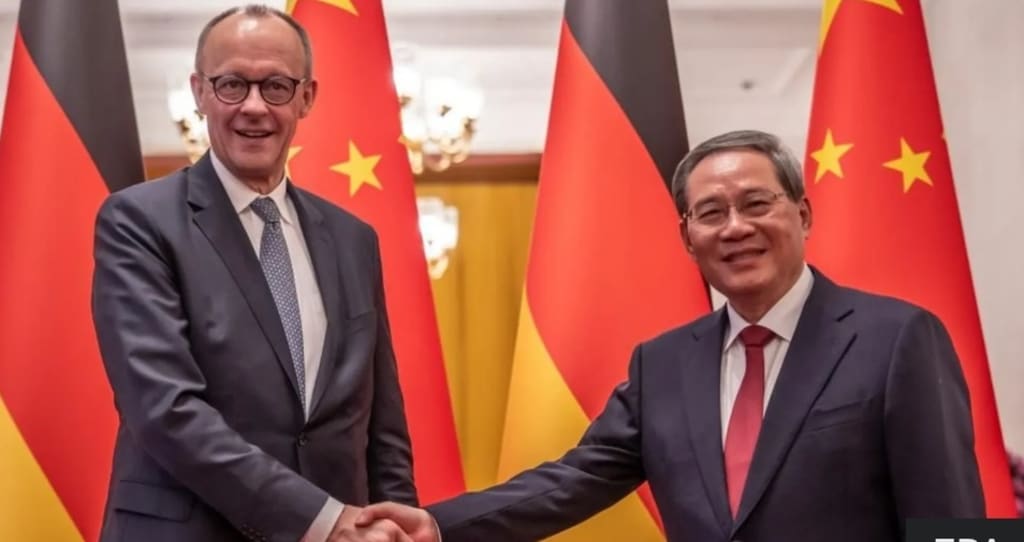
During his first official visit to Beijing, German Chancellor Friedrich Merz raised concerns about a growing trade imbalance between Germany and China. Speaking after talks with Chinese leaders, Merz described the widening gap in trade as “not healthy” and called for efforts to reduce the deficit.
The visit marked Merz’s first trip to China since taking office and comes at a time of economic uncertainty and geopolitical tension. In addition to trade, discussions included the war in Ukraine and Europe’s broader relationship with Beijing.
A Growing Trade Gap
According to German federal statistics, imports from China into Germany were more than double the value of German exports to China last year. Merz said the trade deficit had “quadrupled” over the past five years, describing the trend as unsustainable in the long term.
Germany is one of Europe’s largest economies and has strong industrial and export sectors. However, increased imports of Chinese goods, including electronics, machinery, and consumer products, have widened the trade gap.
Merz stated that while Germany supports open markets, trade must remain balanced. He said his government wants to identify ways to reduce the deficit without disrupting economic cooperation.
Talks with Li Qiang
During his visit, Merz met with Chinese Premier Li Qiang at the Great Hall of the People in Beijing. The two leaders discussed trade relations, economic policy, and global security issues.
Merz emphasized the need for fair market access and transparent trade practices. He noted that German companies operating in China have raised concerns about regulatory barriers and unequal conditions.
Li responded by highlighting China’s commitment to economic cooperation and global trade. Chinese officials have previously stated that trade imbalances reflect market forces and supply chain dynamics rather than deliberate policy choices.
Economic Interdependence
Germany and China have built deep economic ties over the past two decades. China is one of Germany’s largest trading partners, and German companies have invested heavily in the Chinese market. Major German industries, including automotive and engineering firms, rely on Chinese demand.
At the same time, Germany has become increasingly dependent on Chinese imports for components and finished products. This interdependence has raised questions in Berlin about economic resilience and supply chain security.
Merz’s comments reflect a broader debate within Germany and the European Union about reducing strategic dependencies while maintaining trade relationships.
European Context
The issue of trade imbalance is not limited to Germany. The European Union has also expressed concern about its trade deficit with China. EU officials have called for measures to ensure fair competition and protect European industries.
Germany’s position carries particular weight within the EU due to the size of its economy. Analysts say Merz’s visit may influence future European policy discussions on tariffs, subsidies, and trade defense instruments.
At the same time, European leaders must balance economic interests with diplomatic considerations. China remains an important global market, and abrupt changes in trade policy could have significant economic consequences.
Ukraine War and Diplomatic Pressure
Beyond trade, Merz said he had asked Beijing to use its influence with Moscow to help end the war in Ukraine. Since Russia’s full-scale invasion began in 2022, European leaders have sought broader international support to pressure Moscow toward negotiations.
Germany has been a key supporter of Ukraine within Europe, providing financial aid and military assistance. Merz’s appeal to China reflects the view that Beijing’s relationship with Moscow gives it potential leverage.
China has positioned itself as neutral in the conflict while maintaining close ties with Russia. Beijing has called for dialogue and a political solution but has not directly condemned Moscow’s actions.
Merz’s comments signal Germany’s expectation that major global powers should play a constructive role in resolving the conflict.
Balancing Cooperation and Caution
The visit highlights the challenge facing Germany as it navigates relations with China. On one hand, economic cooperation remains vital for German industry. On the other, concerns about trade imbalance, market access, and geopolitical tensions require careful management.
Merz stated that Germany does not seek confrontation but wants balanced and fair relations. He emphasized that dialogue is essential, particularly given the size and influence of both economies.
Policy experts note that reducing a trade deficit is complex. It may involve encouraging exports, diversifying supply chains, and addressing structural factors such as production costs and consumer demand.
Business Community Reaction
German business leaders have closely followed the chancellor’s trip. Many companies see China as a key market for growth but also acknowledge increasing competition from Chinese firms.
Some industry representatives support efforts to ensure fair competition and improved market access. Others caution against policies that could trigger trade tensions.
The outcome of Merz’s discussions may shape future regulatory and trade strategies, particularly in sectors such as automotive manufacturing, renewable energy, and advanced technology.
Domestic Political Considerations
Trade policy is also a domestic political issue in Germany. Rising concerns about industrial competitiveness and economic slowdown have led to calls for stronger economic safeguards.
Merz’s remarks may resonate with voters who worry about job security and manufacturing capacity. At the same time, policymakers must consider the potential impact of trade restrictions on export-oriented industries.
The government’s approach appears focused on gradual adjustment rather than sudden policy shifts.
Looking Ahead
Merz’s first visit to Beijing sets the tone for Germany’s future engagement with China. The emphasis on reducing the trade deficit suggests that economic balance will be a central theme in bilateral relations.
Future negotiations may address issues such as investment conditions, intellectual property protection, and supply chain diversification. Germany may also coordinate closely with EU partners to ensure a consistent European approach.
On the geopolitical front, Berlin is likely to continue urging Beijing to play a more active role in promoting peace in Ukraine. The extent of China’s response remains uncertain.
---
Conclusion
German Chancellor Friedrich Merz used his first official visit to Beijing to raise concerns about a widening trade imbalance with China. Describing the deficit as “not healthy,” he called for efforts to restore balance while maintaining economic cooperation.
The visit also included discussions on global security, with Merz urging China to use its influence to help end the war in Ukraine.
As Germany seeks to balance economic interdependence with strategic caution, the outcomes of this trip may influence both national and European policy in the months ahead. The challenge will be to manage complex trade relations while addressing broader geopolitical concerns in a changing global landscape.
About the Creator
Saad
I’m Saad. I’m a passionate writer who loves exploring trending news topics, sharing insights, and keeping readers updated on what’s happening around the world.
Why Black History Matters in America?
The United States of America is celebrating their 250th anniversary in 2026. I'm proud to be an American and as someone who was born here, I wouldn't imagine myself living anywhere else. This is a country where opportunities are possible. Where anyone can be successful in anything they desire to do. Equality, community, and togetherness are the backbones of what America is and should be about. However, we have an administration who wants to erase and disregard those who have made positive, meaningful impacts in our country, specifically Black figures, such as Martin Luther King, Jr., Rosa Parks, and Maya Angelou. President Trump and his administration have been constantly complaining and fighting against what they call the "Woke agenda". They use this excuse as a distraction from other issues they refuse to address, such as the high cost of living, climate change, and inflation. That equality is dividing America, when in reality, it's bringing us together. Being woke is not tied to a specific political party. No matter where you stand on the political spectrum, you can still care about other people and their plights. Compassion and empathy for others isn't tied to a political party, either. We were taught as children to treat others the way we want to be treated and not judge others because they're different from us. Caring about others isn't a personal attack on your beliefs. It doesn't make you any less of a person. People who are easily offended over African American figures, past or present, or anything related to it, are grasping at straws. Current and future generations need to know who people like Harriet Tubman and Shirley Chisholm were, especially in the classroom. Black History is part of American History. It should be recognized, not hidden or forgotten. Besides, you can't shield children from everything, just because your feelings are easily hurt.
By Mark Wesley Pritchard 24 days ago in The Swamp
It's 2026. Songs Turning 10 This Year
In 2016, we saw the rise of short form videos and what would lead to the birth of TikTok. We cannot forget the Snapchat filters no matter how cringe worthy some of them might have been. It was also the year in which the hit series Stranger Things debuted.
By Jasmine Aguilar4 days ago in Beat




Comments
There are no comments for this story
Be the first to respond and start the conversation.